
Brazil's Stranded Power Problem: How Grid Bottlenecks Are Turning Utilities Into Bitcoin Miners
A Renewable Giant With a Wiring Problem
Brazil's electricity matrix is the envy of most industrialized nations. With an installed capacity exceeding 200 GW, the country draws roughly 60% of its power from hydroelectric plants spread across the Amazon basin and its southern river systems, supplemented by rapidly expanding wind farms concentrated in the Northeastern states of Ceará, Rio Grande do Norte and Bahia, and an accelerating solar buildout. By the end of 2025, the National Electric Energy Agency — ANEEL — estimated that total installed renewable capacity had crossed 185 GW, a figure that positions Brazil among the top five clean energy producers globally.
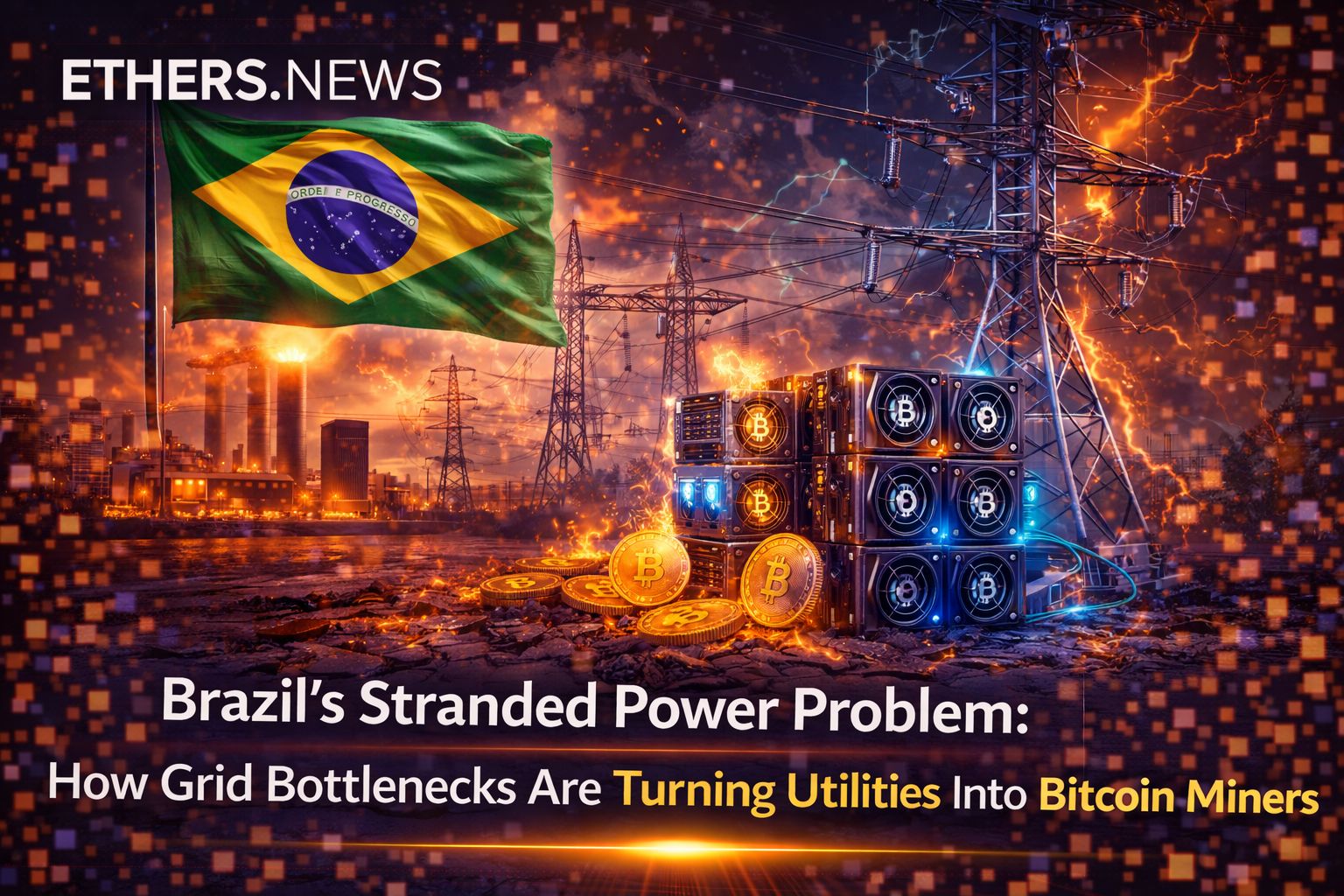
The problem is structural, and it sits not in generation but in transmission. Brazil's National Interconnected System (SIN) was designed for a different era of centralized, South-centric generation. As wind and solar capacity exploded in the Northeast, transmission lines did not follow at the same pace. Regulatory approval processes, environmental licensing, land rights disputes and sheer CAPEX requirements have slowed grid expansion to a crawl. ANEEL's own grid adequacy reports flag the Northeast-Southeast interconnection as critically constrained, with routine bottlenecks during peak wind generation hours — precisely the periods when the grid is simultaneously saturated with solar output and disconnected from the industrial demand centers of São Paulo and Rio de Janeiro.
Curtailment: The Silent Waste Bleeding Brazil's Energy Sector
When generation exceeds what the transmission network can absorb, grid operators have only one option: curtailment — forcing generators to physically switch off turbines and panels even while the wind blows and the sun shines. Curtailment losses in Brazil's Northeast have grown steadily alongside renewable capacity additions. Independent grid analyses estimate that the region wasted several hundred GWh annually in curtailed renewable energy during 2024 and 2025, with some peak-hour events seeing entire wind farms idled for hours at a time.
For developers and utilities that spent billions on wind and solar projects under long-term power purchase agreements (PPAs), curtailment is a direct revenue leak. Fixed costs — turbine maintenance, land lease, debt service — continue regardless of whether the plant is running. A curtailed MWh is, economically speaking, a sunk cost with zero return. Brazil's electricity tariff structure makes the problem even sharper: industrial users in demand centers pay among the highest tariffs in Latin America, averaging above BRL 700 per MWh including taxes and grid charges, while the stranded generators near the source receive near-zero marginal revenue during curtailment windows. EPEGOV
Enter Behind-the-Meter Bitcoin Mining
The concept of "behind-the-meter" Bitcoin mining is elegantly simple: instead of pushing surplus electricity through a congested transmission line, a generator installs mining hardware directly at the generation site and consumes the power on-site, producing Bitcoin as a by-product. The mined BTC is sold on global markets, effectively converting otherwise-worthless curtailed electricity into liquid digital assets that can be transferred instantly anywhere in the world — no wires required beyond the site perimeter.
The economics become compelling when power costs fall below roughly $0.03–$0.04 per kWh, a threshold regularly breached in Brazilian curtailment scenarios where the marginal cost of generation is effectively zero. A 1 MW mining facility running on near-free curtailed electricity can generate between $25,000 and $35,000 per month in Bitcoin revenue at mid-cycle prices — compared to exactly zero revenue from an idled turbine. Scaled to 10 MW or 50 MW — modest by the standards of Northeast wind parks — the economics become transformational for a plant's annual P&L.
"Every megawatt-hour we curtail is a megawatt-hour we cannot monetize. Behind-the-meter solutions — whether Bitcoin mining, green hydrogen or industrial electrolyzing — are the only tools available to generators right now while transmission infrastructure catches up. Mining is the fastest to deploy and the most liquid to exit."
— Energy trader operating in Brazil's Northeast renewable corridor, as cited in regional energy sector commentary
The "Interruptible Load" Advantage
One of the most strategically valuable characteristics of Bitcoin mining as a grid tool is its near-instant interruptibility. Unlike industrial manufacturing processes or data centers that require ramp-down procedures, mining rigs can be switched off within milliseconds via software commands — and switched back on just as quickly. This makes mining operations ideal as "flexible loads" or demand-response assets: when the grid needs power, the miners stop; when surplus accumulates, they restart automatically.
Brazilian grid operator ONS (Operador Nacional do Sistema Elétrico) has been developing demand-response frameworks as part of its grid modernization roadmap, and interruptible industrial loads have long been part of its toolkit during supply crunches. Bitcoin mining, if formally integrated into ONS dispatch protocols, could serve a dual function: absorbing surplus renewable generation during curtailment windows and releasing load during grid stress events. Texas's ERCOT grid has pioneered this model with remarkable success — large-scale miners like Riot Platforms and Argo Blockchain regularly earn substantial demand-response credits by curtailing on command during heat waves, effectively becoming grid-stabilizing assets rather than passive consumers.
Key Players Moving Into Brazil's Mining-Energy Nexus
Several operators are already positioning themselves at the intersection of Brazil's energy and mining sectors. Comerc Energia, one of Brazil's largest independent energy traders, has explored crypto mining as a load management strategy to optimize its renewable portfolio positions. In the post-privatization era, Eletrobras — the former state utility now operating as a listed company under pressure to optimize asset returns — has signaled openness to digital infrastructure plays that monetize its vast generation base. Meanwhile, international mining infrastructure providers, including Bitmain-affiliated deployers and US-listed miners with emerging-market expansion mandates, have been conducting site assessments in the Northeast wind corridor and in Southern hydro regions where seasonal overflow creates natural curtailment windows.
On the startup side, Brazil-based mining operators have begun executing power purchase agreements directly with wind park operators, bypassing the national grid entirely and structuring arrangements where curtailment-hour power is supplied at near-zero tariff rates in exchange for guaranteed consumption that stabilizes the plant's operating metrics. Brazil's development bank BNDES has also been studying blockchain and digital infrastructure investment within its broader energy transition mandate, though no formal mining-focused programs have been announced as of early 2026.
Regulatory Landscape: ANEEL, Crypto Taxes and the Path to Legitimacy
Brazil's regulatory environment for crypto mining has matured significantly since 2023. Federal legislation passed in 2023 formalized Bitcoin and digital assets as financial instruments, bringing exchanges and major holders into a tax reporting framework administered by the Receita Federal (Brazil's IRS). Mining income is treated as taxable revenue, and corporate miners operating through Brazilian legal entities face standard corporate taxation — a clear, if not cheap, framework that provides legal certainty. ANEEL
On the energy regulation side, ANEEL's treatment of behind-the-meter consumption is governed by existing self-consumption rules designed primarily for renewable energy self-producers. Legal analysts in Brazil's energy bar have argued that behind-the-meter mining at generation sites falls within existing self-consumption frameworks, meaning no special licensing is required beyond standard mining business registration. That regulatory clarity — combined with Brazil's transparent electricity auction system, robust PPA market and established grid operator in ONS — gives Brazil a structural advantage over many emerging-market mining destinations where legal frameworks remain grey or actively hostile.
Risks: BTC Price Dependence, Political Headwinds and Grid Stability
The model is not without risks. The most obvious is Bitcoin price dependence: the economics that make curtailed-power mining compelling at $65,000–$87,000 BTC can invert rapidly if prices fall toward $40,000 or below, particularly if on-site infrastructure costs were financed during higher-price expectations. Generators that built mining facilities as a primary revenue diversification tool — rather than a supplemental hedge — could find themselves with stranded mining assets on top of stranded generation assets if the next crypto winter arrives before transmission infrastructure catches up. CCAF
Political risk is also real. Brazil's current federal administration has a complicated relationship with privatization and with activities perceived as financializing the country's natural resources. A shift in energy policy that prioritized subsidized tariffs for industrial consumers over grid-efficiency optimization could reduce the commercial viability of curtailment-monetization models. Additionally, if large-scale Bitcoin mining begins to visibly compete for grid capacity or drive up local electricity demand, residential and political backlash — as seen in regions of the US and Central Asia — could prompt regulatory intervention.
Global Playbook: What Brazil Can Learn From Texas, Iceland and Paraguay
Brazil is not reinventing the wheel. The "stranded energy to Bitcoin" playbook has been executed at scale in several jurisdictions, each with instructive lessons. Texas's ERCOT grid has successfully integrated Bitcoin miners as flexible demand-response loads, with ONS equivalents dispatching curtailment in real time. Iceland leverages geothermal surplus for clean mining at ultra-low tariffs. Paraguay — Brazil's smaller neighbor — has been supplying cheap Itaipu hydroelectric power to Argentine and Brazilian miners for years, effectively exporting energy through the Bitcoin network rather than transmission lines.
The common thread across all three is regulatory clarity combined with surplus-energy economics. Brazil has both: a clear if evolving legal framework, and a structural surplus problem that will not be solved by transmission alone for at least a decade. The question is not whether Bitcoin mining will become a meaningful part of Brazil's energy mix — it is whether utilities will lead the integration or cede that opportunity to foreign miners who are already quietly signing PPAs in the Northeast.
Bottom Line
Brazil's grid bottleneck is not a temporary inconvenience — it is a structural feature of an energy system where renewable capacity has dramatically outpaced transmission infrastructure, ANEEL's own reports confirm chronic Northeast congestion, and curtailment losses run into hundreds of GWh annually. Behind-the-meter Bitcoin mining offers generators the fastest, most liquid mechanism available to monetize stranded power, with interruptible-load characteristics that could simultaneously benefit ONS grid stability. Key players from Comerc and Eletrobras to international miners are already circling the opportunity, and Brazil's post-2023 crypto regulatory framework provides the legal clarity needed to execute at scale.
Brazil's story is one of the most compelling macro intersections in crypto right now, and it is almost entirely absent from mainstream financial coverage. The country has a genuine, grid-scale problem — wasted clean energy — and Bitcoin mining is one of the few technologies that can deploy fast enough, flex fast enough and exit fast enough to fit the operational reality of a curtailment window. Critics will argue, correctly, that this ties clean energy to a volatile asset's price cycle. But the alternative — curtailed wind turbines generating zero revenue while São Paulo pays premium tariffs — is not a sustainable policy position either. The smarter framing is to treat mining as a transitional monetization bridge: valuable precisely because it works today, while transmission catches up over the next decade. Brazil's utilities would be wise to own that bridge themselves rather than lease it to foreign capital.
About the Author
Ethers News
Ether News Team - Highly dedicated to provide up to date crypto related news and upcoming events.
-At Ethers.News, we are committed to delivering accurate, transparent, and well-researched information related to cryptocurrency, blockchain, and digital assets. Our content is created for educational and informational purposes only and should not be considered financial, investment, or legal advice. We encourage readers to conduct their own research and consult with qualified professionals before making any financial decisions. Market conditions can change rapidly, and past performance does not guarantee future results. Our goal is to promote informed decision-making through responsible journalism.