
Featured Articles
Latest Articles
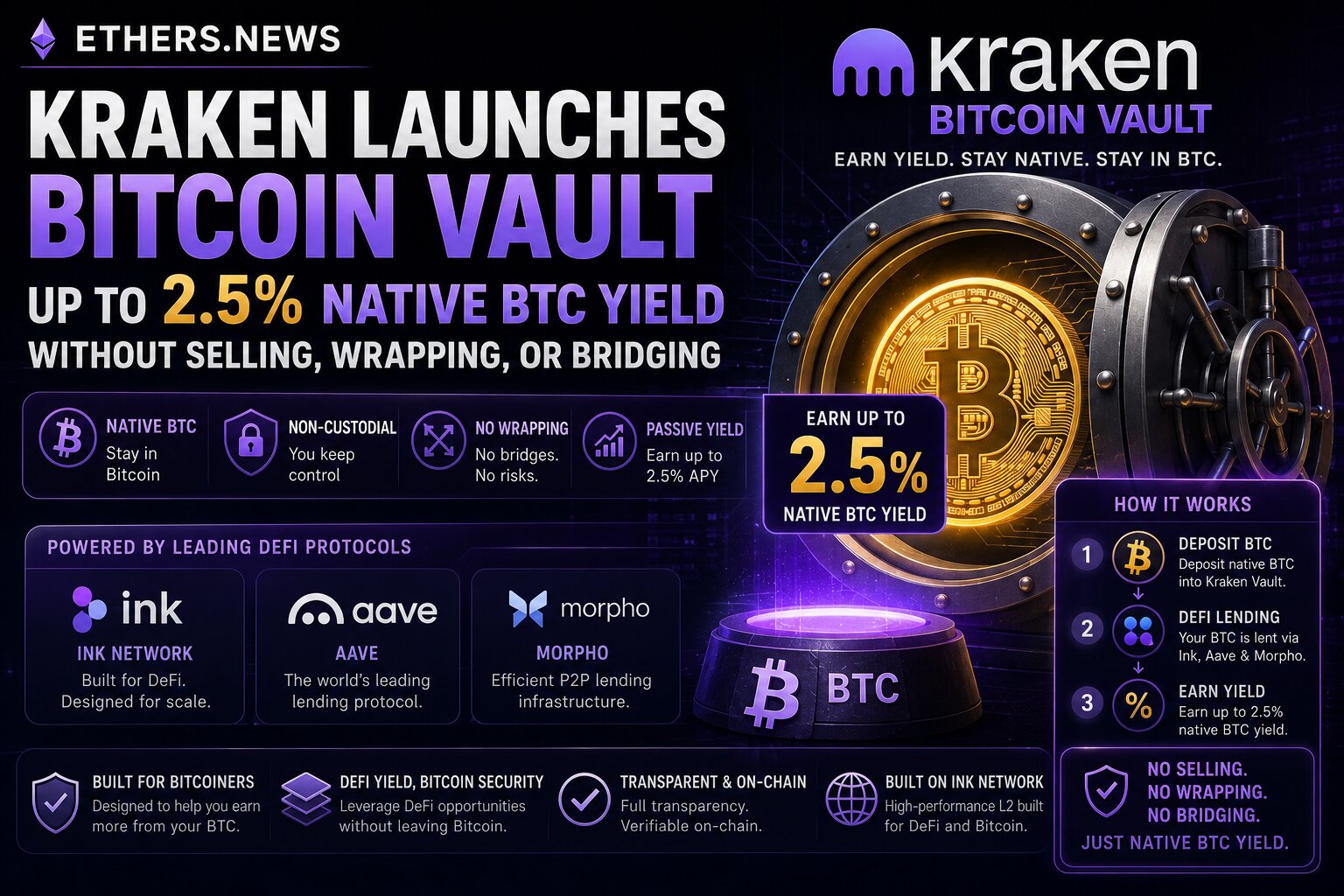
Kraken Launches Bitcoin Vault: Up to 2.5% Native BTC Yield Without Selling, Wrapping, or Bridging — DeFi Lending via Ink Network, Aave, and Morpho
Kraken launched Bitcoin Vault — up to 2.5% APY in native BTC rewards without selling, bridging, or wrapping. Mechanism: BTC → kBTC on Ink network → non-custodial embedded wallet (Veda/Sentora) → collateral in DeFi lending (Aave, Morpho, Tydro) → stablecoins borrowed → yield strategies → rewards to kBTC → auto-compound. 5-day withdrawals. 25% performance fee. No deposit/gas fees. Available US (excluding NY/ME), EEA, Canada. Not UK/UAE/Australia. USDC Vaults precedent: $180M+, 38K users. First major exchange native BTC yield via DeFi without selling holdings.
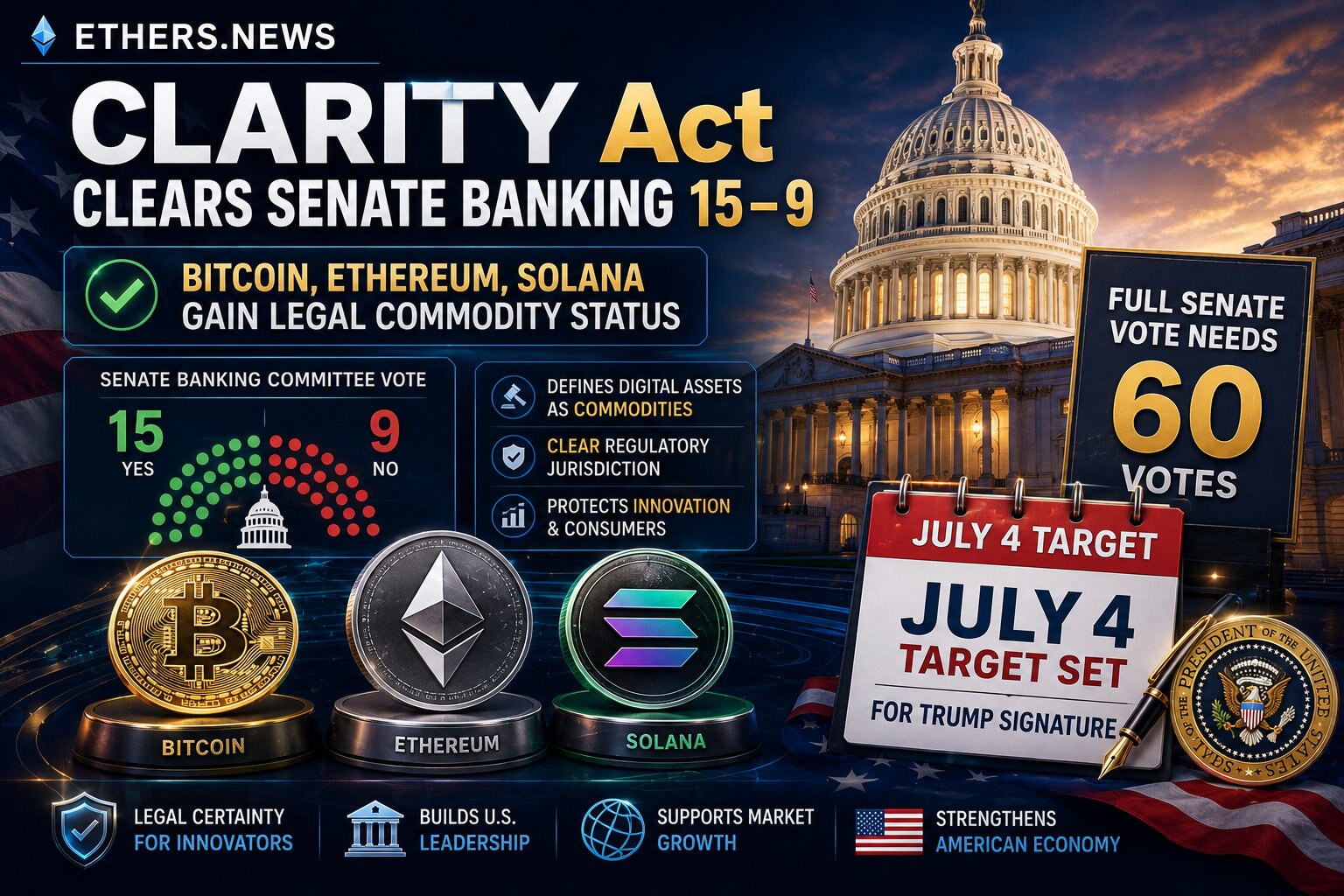
CLARITY Act Clears Senate Banking 15–9: Bitcoin, Ethereum, Solana Gain Legal Commodity Status — Full Senate Vote Needs 60, July 4 Target Set for Trump Signature
CLARITY Act Senate Banking Committee 15-9 vote May 14 2026, Bitcoin Ethereum Solana XRP permanent commodity status CFTC federal law, Ruben Gallego Angela Alsobrooks Democrat crossover CLARITY Act vote, Section 404 passive stablecoin yield ban exchanges intermediaries, CLARITY Act 60 vote Senate floor threshold July 4 Trump signature, Senate Agriculture Committee CLARITY Act merge January 2026 version, Coinbase 9 percent Strategy 8 percent Robinhood Galaxy Digital rally, CLARITY Act DeFi developer protections non-custodial protocols, GENIUS Act stablecoin issuer yield ban intermediary extension loophole, CLARITY Act House reconciliation 2025 version midterm election deadline
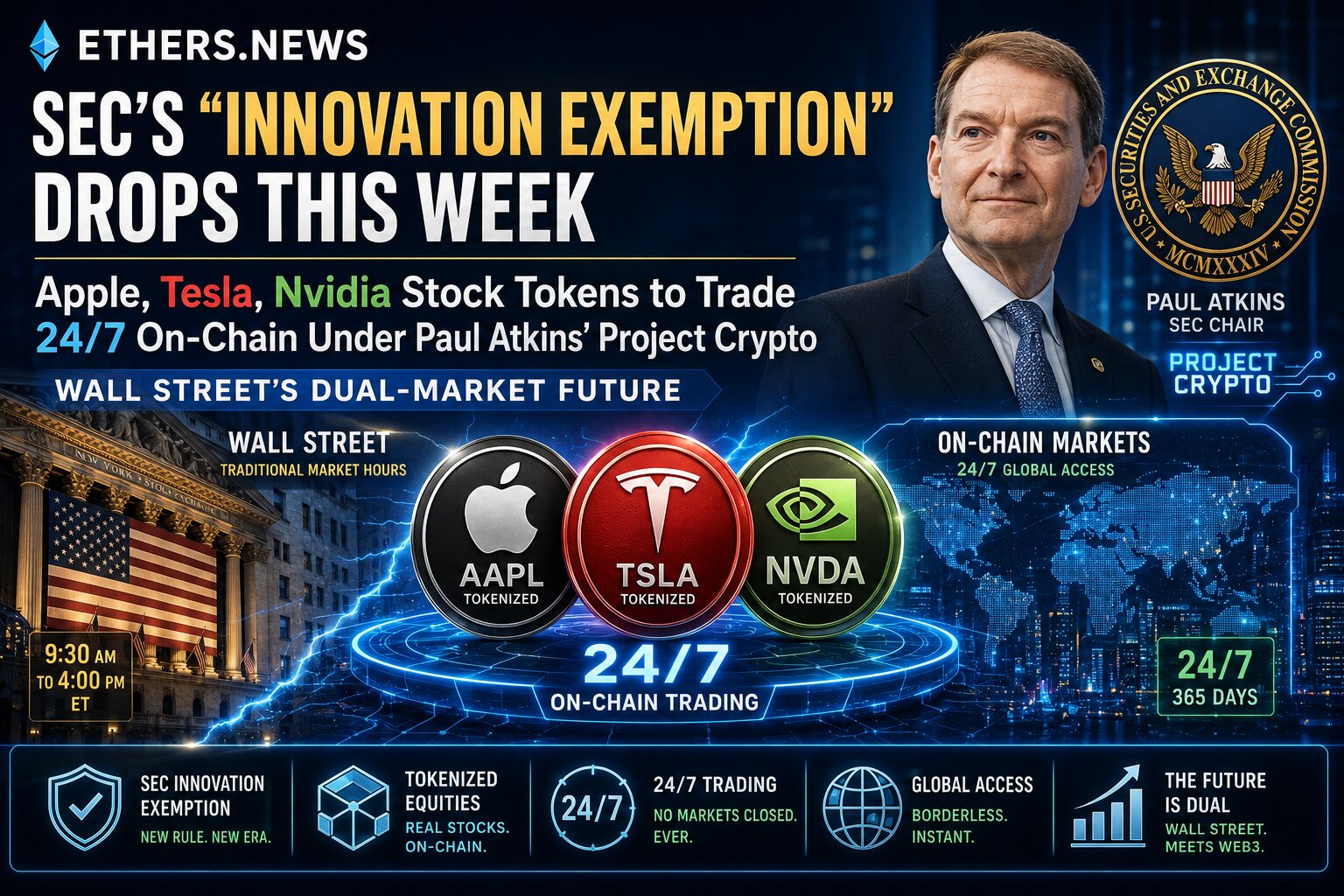
SEC's "Innovation Exemption" Drops This Week: Apple, Tesla, Nvidia Stock Tokens to Trade 24/7 On-Chain Under Paul Atkins' Project Crypto — Wall Street's Dual-Market Future
Week of May 18–21, 2026: SEC expected to announce 'Innovation Exemption' for tokenized stocks — Apple, Tesla, Nvidia to trade 24/7 on-chain with fractional ownership. Bloomberg broke May 18. Forbes: 'Two Stock Markets For The Same Company.' Third-party tokenization without issuer consent. No voting rights, no direct dividends. Two pathways: (1) DTCC pilot July 2026 with 50+ firms (BlackRock, JPMorgan, Goldman), October full launch; (2) crypto-native platforms under lighter rules. Market: $1.4B tokenized securities, up 30%. Atkins detailed July 31, 2025 (America First); March 17, 2026 (DC Blockchain Summit). Wall Street opposed December 2, 2025. Target: mega-cap US equities first. 12–36 month sandbox.

Iran Unveils "Hormuz Safe" — A Ministry of Economy-Backed, Bitcoin-Settled Maritime Insurance Platform for the Strait of Hormuz That Claims $10 Billion in Revenue, Establishes the Persian Gulf Strait Authority, and Directly Challenges the Dollar-Denominated Global Shipping Insurance Order
On May 16, 2026, Iran's Ministry of Economy unveiled 'Hormuz Safe,' a Bitcoin-settled maritime insurance platform for vessels transiting the Strait of Hormuz. First reported by Fars News Agency, confirmed by Bloomberg and Yahoo Finance. Coverage: vessel inspection, detention, confiscation. War-damage excluded. $10B+ annual revenue projected. Coverage activates on blockchain confirmation. Bitcoin formally a shipping payment option since April 2026 (Hamid Hosseini, FT). On May 18, Iran's SNSC established the Persian Gulf Strait Authority (PGSA) to govern the strait. The Hormuz handles 20% of global oil. US and China oppose transit toll. No shipping firm has confirmed acceptance.
March 27, 2026: The SEC's Most Historic ETF Day — Final Rulings on 91 Applications Across 24 Tokens Green-Light XRP, Solana, Litecoin, Dogecoin, and 20 More Assets as America's Regulated Investment Infrastructure Opens to the Full Breadth of the Crypto Asset Class
On March 27, 2026, the SEC issued final rulings on 91 crypto ETF applications spanning 24 tokens — XRP, SOL, LTC, DOGE, ADA, AVAX, DOT, HBAR, LINK, SHIB and more. Bloomberg Intelligence compiled the full list. Products already trading — BlackRock ETHB, VanEck VSOL, REX-Osprey DOJE — had remaining legal overhang cleared. Franklin Templeton XRPZ: 0.19% expense ratio waived through May 2026. Solana and XRP ETFs had reached market by November 2025 after SEC's September 2025 generic listing standards cut approvals from 240 to 75 days. Seven spot XRP ETFs: $1.44B inflows. Institutional XRP projection post-approval: $8B. Bitcoin ETFs $22B net inflows 2025; Ether ETFs $10B. WisdomTree withdrew XRP application January 6, 2026. March 27 Federal Register 2026-05943 published formal rulemaking.
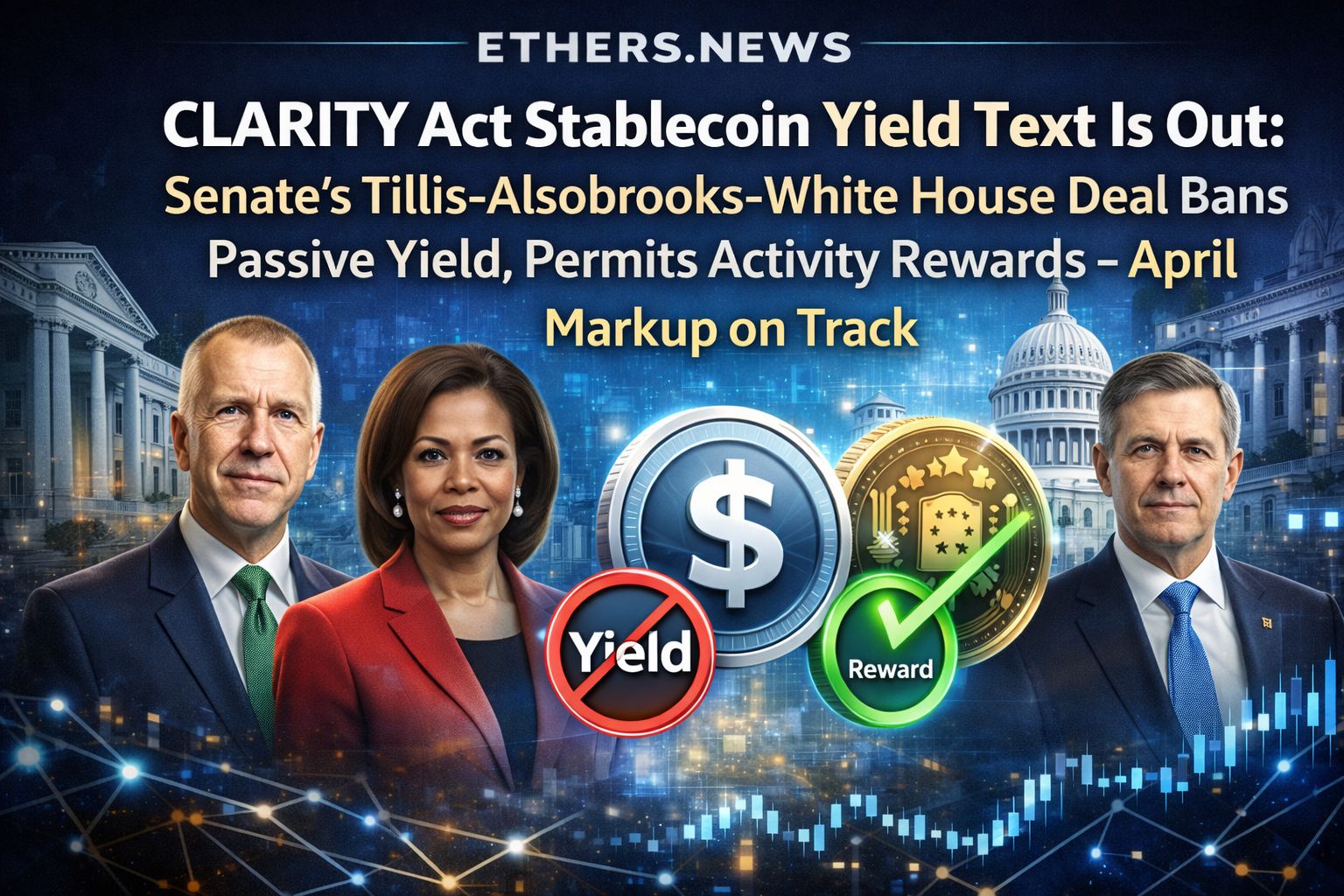
Senate's Stablecoin Yield Deal Is Sealed: The CLARITY Act's Tillis-Alsobrooks-White House Compromise Bans Passive Yield, Permits Activity Rewards, and Sets a Late April Markup — The Most Consequential Regulatory Line in US Crypto Finance Since the GENIUS Act Is Now on Paper
On March 20, 2026, Senators Tillis and Alsobrooks, with White House adviser Patrick Witt, agreed in principle on stablecoin yield language for the CLARITY Act. Compromise text reviewed by crypto firms March 24, banks March 25. Section 404: passive yield on stablecoin balances prohibited; activity-based rewards permitted. CLARITY Act passed House 294–134 July 2025; cleared Senate Agriculture Committee January 2026. GENIUS Act (signed July 18, 2025) already bans issuer-level yield. Senate Banking markup targeted late April 2026. Senate floor deadline: May 2026. Missing May window risks legislative failure past 2026 midterms. Circle fell ~20% on yield restriction news. Coinbase stablecoin revenue: $364.1M Q4 2025. Coinbase has pushed back publicly.

Circle Expands Beyond USDC With the Launch of cirBTC — A 1:1 Bitcoin-Backed Token Built to Unlock $1.7 Trillion in Idle BTC for DeFi and Dethrone WBTC in the $14 Billion Wrapped Bitcoin Market
On April 2–3, 2026, Circle Internet Group (NYSE: CRCL) — issuer of USDC ($30B+ circulation) — announced cirBTC, a 1:1 BTC-backed wrapped Bitcoin token with real-time on-chain verifiable reserves. cirBTC launches first on Ethereum and Circle's Arc L1 blockchain. Full rollout Q2 2026 with Circle Mint integration, DeFi protocol connections by May. Expands to Solana post-launch. Targets $1.7 trillion in idle Bitcoin for DeFi lending, trading, and yield. Enters the $14B wrapped BTC market (208K BTC supply) against WBTC (BitGo) and cbBTC (Coinbase). Rachel Mayer, Circle VP: 'Bitcoin is sitting on the sidelines of DeFi — not because there is a lack of demand for yield or liquidity, but due to trust issues with the wrapper. cirBTC is Circle's solution: 1:1 backed, verifiable on-chain, and built on trusted infrastructure.'
Drift Protocol Suffers $285 Million Exploit on April 1 in the Largest DeFi Hack in Solana History — Amplify Vault's Recursive Leverage Flaw Drained in Under One Hour, TVL Drops 50%, and $42 Million in ETH Is Already on Ethereum as Solana's Leading Perpetuals DEX Faces an Existential Recovery Test
On April 1, 2026 at approximately 4:00 PM UTC, Drift Protocol — Solana's leading perpetuals DEX with $550M TVL — was exploited for $285 million in the largest DeFi hack in Solana history and the largest crypto theft of 2026. Lookonchain first flagged the attack (wallet HkGz4K). PeckShield confirmed $285M stolen. Arkham Intelligence confirmed $250M+ transferred. Root cause: Amplify vault recursive leverage logic flaw. Entire extraction completed in ~1 hour. TVL dropped 50% instantly. Attacker bridged funds to Ethereum, held 19,913 ETH (~$42M) by 17:45 UTC. 282 BTC also taken. Jupiter DEX aggregator used to swap. Funds routed through ChainFlip. Test transaction identified one week prior. Protocol lacked CertiK audit. DeFi Dev Corp. (Nasdaq: DFDV) and Forward Industries confirmed no exposure.
CoinShares PLC Begins Trading on Nasdaq Under CSHR — Europe's $6 Billion Pure-Play Crypto Asset Manager Completes Its $1.2 Billion SPAC Combination With Vine Hill Capital, Joins BlackRock, Fidelity, and Grayscale as a US Public Market Digital Asset Manager
On April 1, 2026, CoinShares PLC — Europe's largest digital asset manager with $6B+ AUM — began trading on Nasdaq under ticker CSHR, completing its $1.2 billion pre-money SPAC merger with Vine Hill Capital Investment Corp. Opening price: $8.72. Intraday range: $7.65–$10.43. Market cap: ~$322.67M. 22 million shares outstanding. The transaction received 81.32% shareholder approval. CoinShares delisted from Nasdaq Stockholm on March 31. The company ranks among the top global digital asset managers alongside BlackRock, Fidelity, and Grayscale. CoinShares holds 34% European digital asset management market share. US expansion plans include product development and acquisitions. Follows Circle, Gemini, Bullish, and BitGo going public in 2025–2026.

SWIFT Enters Construction Phase of Its Blockchain Shared Ledger With 40+ Global Banks — Real Tokenized Deposit Payments Across 200+ Countries Now Scheduled for 2026 as the World's Most Systemically Important Financial Network Makes Its Most Consequential Technology Bet
On March 29, 2026, SWIFT announced its blockchain-based shared ledger has completed its design phase and entered the construction phase of its first MVP iteration. MVP planned to go live with real-world transactions in 2026 across 200+ countries. 40+ financial institutions participated in the design — up from 30 at Sibos September 2025. Participating banks include JPMorgan, HSBC, Deutsche Bank, MUFG, NatWest, RBC, Standard Chartered, Wells Fargo, Westpac, Societe Generale-FORGE, and others. Ledger uses tokenized deposits for 24/7 cross-border payments, reuses existing compliance processes, supports multiple settlement methods. Chainlink provides blockchain interoperability with ISO 20022 standards. Advanced use cases: programmable corporate payments, FX PvP, securities cash movements. Compatible with CBDCs, stablecoins, Ripple, Stellar.
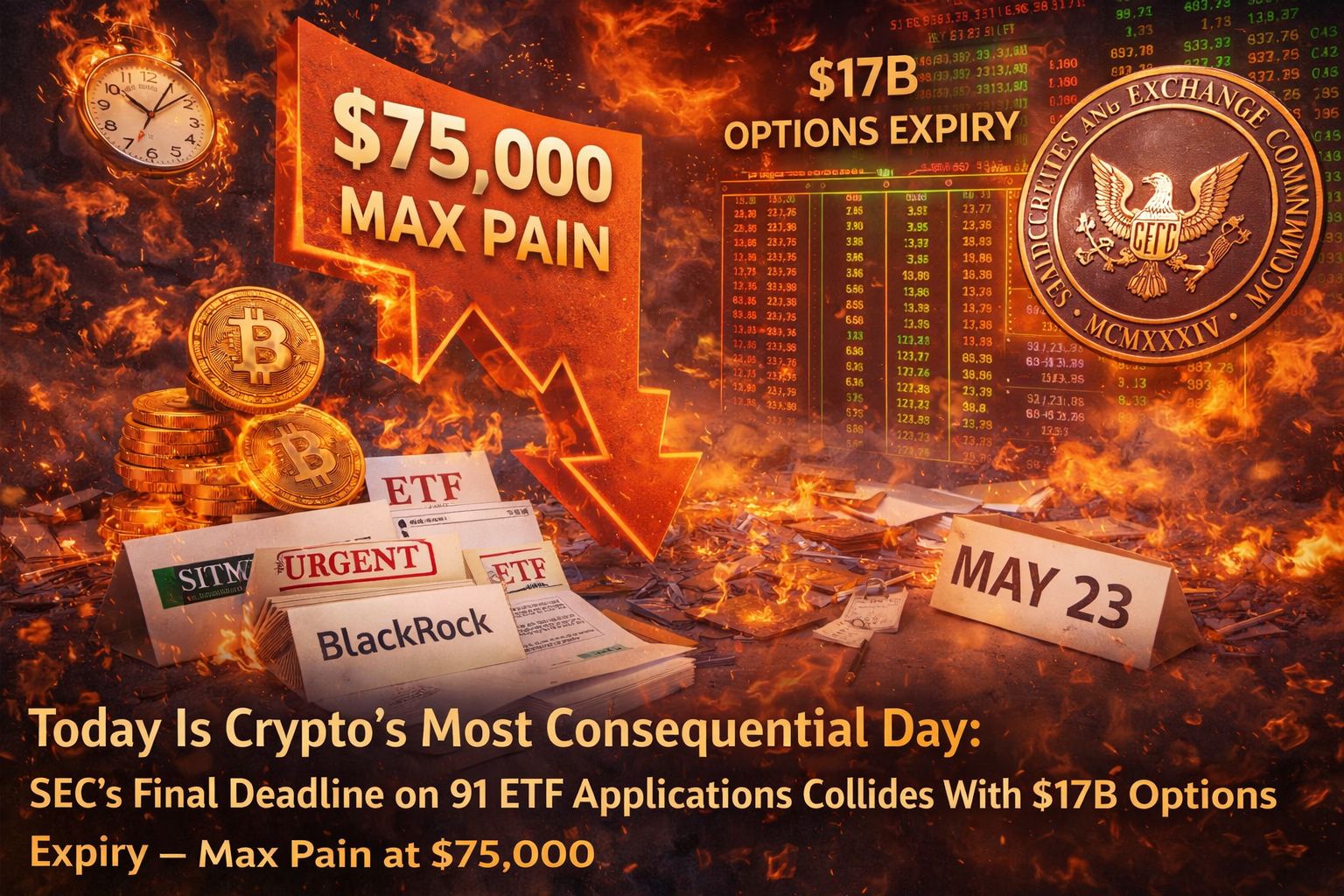
The Most Consequential Day in Crypto History Has Arrived: The SEC's Absolute Final Deadline on 91 Altcoin ETF Applications Collides With a $17 Billion Options Expiry on Deribit — XRP, Solana, Litecoin, and Dogecoin's Regulated US Future Gets Decided Today
The SEC faces its absolute final deadline today for rulings on 91 crypto ETF applications covering XRP, SOL, LTC, DOGE, ADA, and 19 other tokens from Grayscale, 21Shares, Bitwise, WisdomTree, and Canary Capital. Simultaneously, $17 billion in Bitcoin and Ethereum options expire on Deribit at 08:00 UTC — $14.16 billion in Bitcoin alone, representing ~40% of all Deribit open interest. Max pain: $75,000. Bitcoin is trading near $68,604. Put-call ratio: 0.84 — the highest since June 2021. Deribit CCO Jean-David Pequignot: max pain creates 'a gravitational pull.' DL News/ZeroStack CEO Daniel Reis-Faria: 'large enough to influence spot prices.' No single day in crypto history has seen these two catalysts collide.
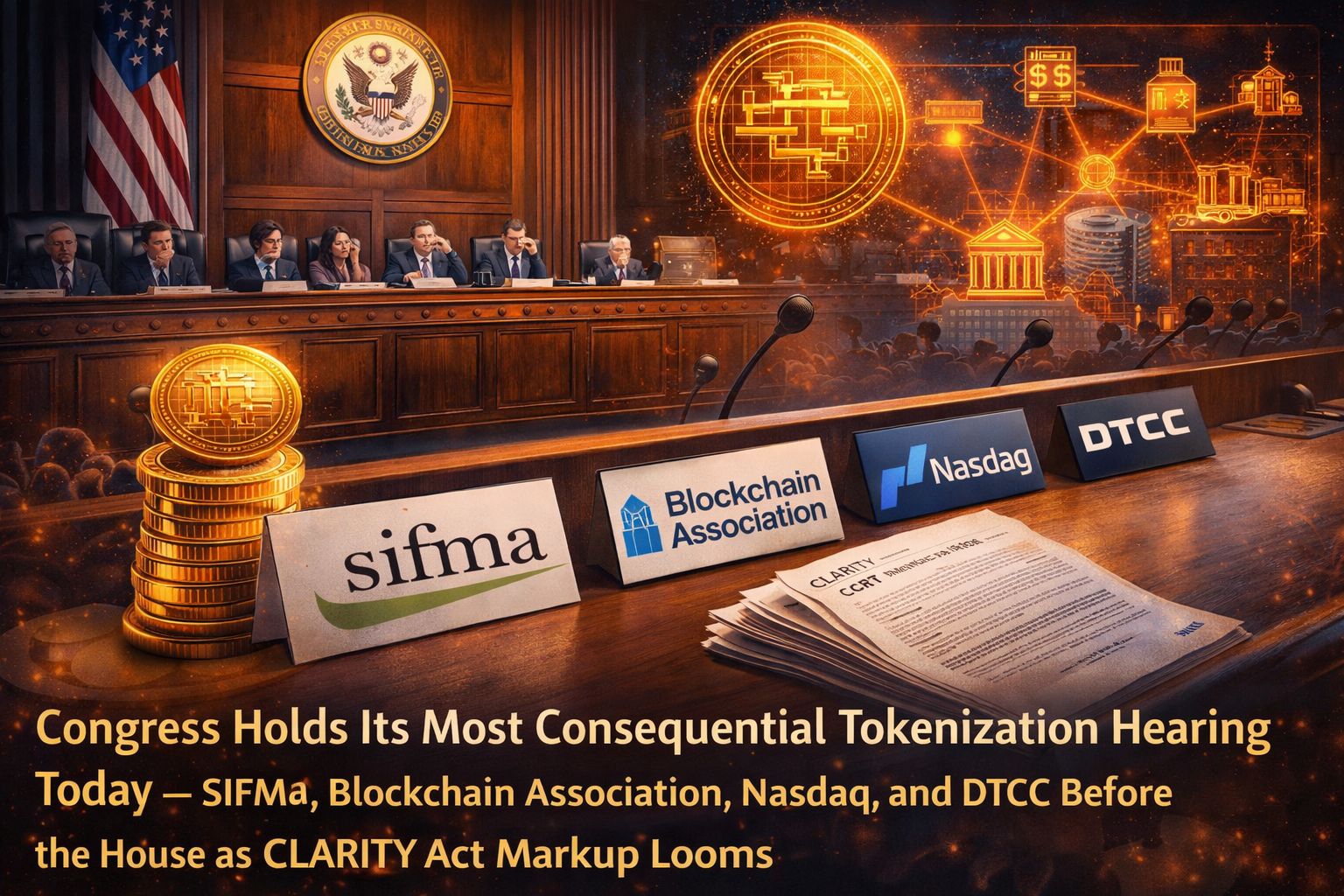
Congress Holds Its Most Consequential Capital Markets Hearing in a Generation: SIFMA, Blockchain Association, Nasdaq, and DTCC Testify on Tokenization Today as the CLARITY Act Markup Window Narrows and America's $16 Trillion Securities Infrastructure Faces Its Blockchain Reckoning
March 25, 2026: The United States House Financial Services Committee is convening its most consequential tokenization hearing in congressional history this morning — "Tokenization and the Future of Securities: Modernizing Our Capital Markets" — at 10:00 AM ET in Room 2128 of the Rayburn House Office Building. Witnesses testifying before the full committee include Kenneth Bentsen Jr., President and CEO of SIFMA, the Securities Industry and Financial Markets Association representing America's broker-dealers, investment banks, and asset managers; Summer Mersinger, CEO of the Blockchain Association, who has been central to both the CLARITY Act negotiations and the SEC-CFTC digital asset taxonomy process; and executives from Nasdaq and the DTCC. The Modernizing Markets Through Tokenization Act of 2026 has been formally noticed for the session. The hearing arrives four days after the SEC approved Nasdaq's proposal to allow tokenized securities to trade alongside traditional shares on the same order book, and fewer than four weeks before the Senate Banking Committee's expected April markup of the CLARITY Act — with Senator Bernie Moreno warning that failure to reach the Senate floor by May could freeze digital asset legislation for years.