
Nasdaq Goes On-Chain: Issuer-Led Equity Tokenization With DTCC Settlement and Kraken Gateway Launches H1 2027 — Wall Street's Most Consequential Market Infrastructure Overhaul in a Generation
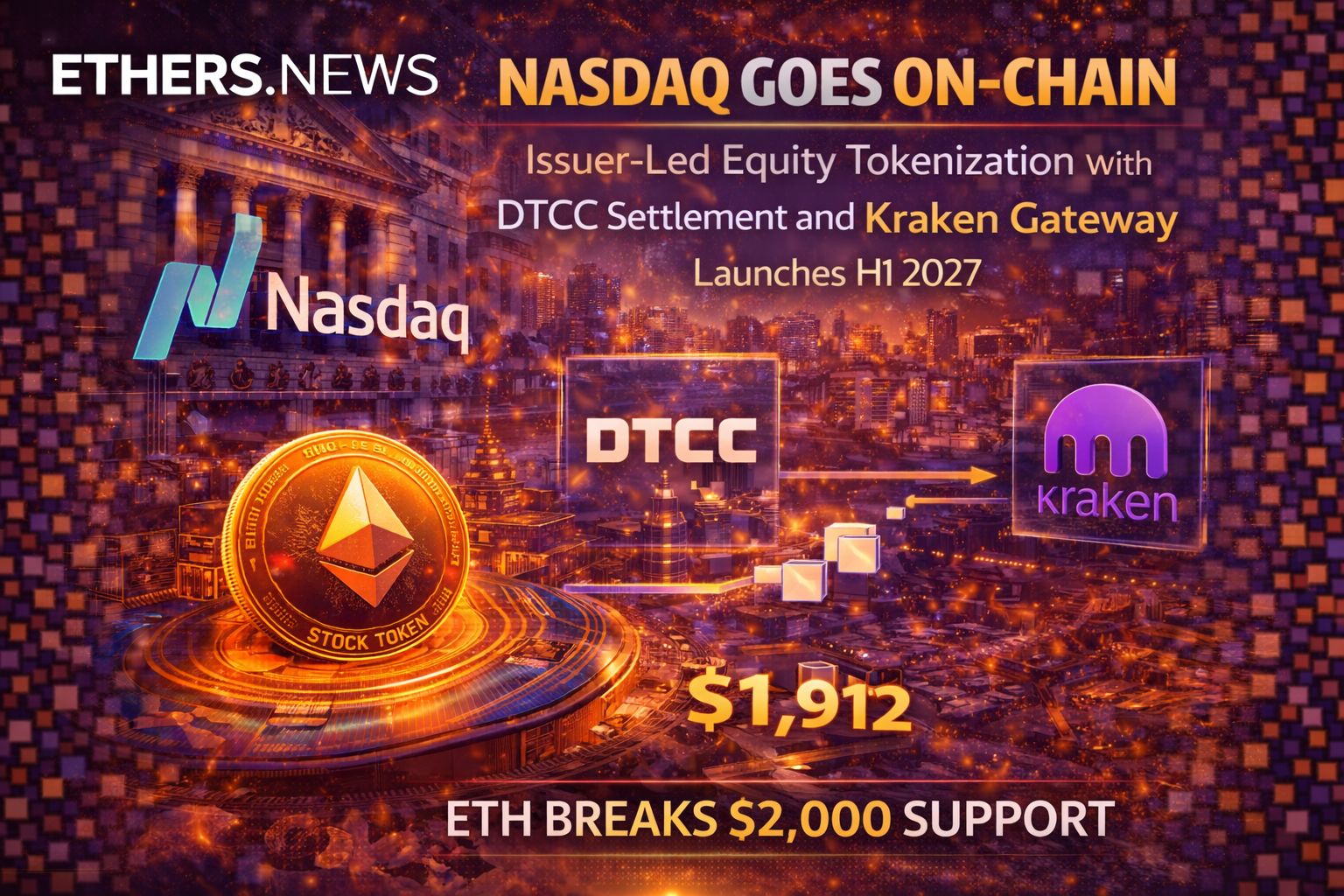
Every decade, one technological transition redraws the architecture of global capital markets. In the 1970s, it was the move from paper certificates to electronic book-entry records through the creation of the Depository Trust Company. In the 1990s, it was the conversion from floor-based open-outcry to electronic order matching. In the 2000s, it was decimalization and the rise of algorithmic trading on fragmented venues. On March 8, 2026, Nasdaq announced the transition that will define the 2020s: a fully issuer-led equity tokenization framework in which public companies opt in to having their shares represented as blockchain tokens, settled through the existing DTCC/DTC infrastructure in token form, and traded on Nasdaq's regulated markets with full legal equivalence to traditional shares. This is not a pilot. It is not a sandbox. It is not a research collaboration. It is a production-ready market infrastructure announcement with a live operational timeline — H1 2027 — backed by an SEC no-action letter granted to DTCC on December 11, 2025, a Federal Register rule filing published January 29, 2026, and a confirmed exchange-level partnership with Kraken for global investor access. Wall Street has not merely acknowledged that blockchain is coming to capital markets. It has set a date.
The March 8 Announcement: What Nasdaq Actually Said
Nasdaq's official investor relations press release, published on ir.nasdaq.com on March 8, 2026 and confirmed by StockTitan's Rhea-AI summary and Investing.com, describes the equity token design with specific technical and legal precision that distinguishes it from the aspirational blockchain announcements that have characterized the industry since 2017. The core framework involves public company issuers voluntarily opting in to Nasdaq's token program, receiving an issuer-controlled tokenization mechanism that preserves all existing governance rights, proxy voting entitlements, and corporate action eligibility in the token layer. Token transfers represent transfers of the underlying security, not derivatives or synthetic representations — the SEC's 2026 Staff Statement on Tokenized Securities explicitly classifies such tokenized equities identically to regular equity securities under federal law, which means the existing investor protection infrastructure — Regulation NMS, Securities Exchange Act Section 10(b), FINRA Rule 4370 — applies to tokenized share trading without modification. Blockchain records are integrated directly into the issuer's official share registry, meaning the on-chain record is not a secondary or shadow record but a legally authoritative component of the official ownership register. The Wall Street Journal confirmed on March 9 that Nasdaq's partnership with Kraken — operating through Kraken's parent entity Payward — establishes a global access gateway enabling international investors to access Nasdaq-listed tokenized equities through Kraken's platform infrastructure.
The Regulatory Foundation: SEC No-Action Letter to DTCC and the Federal Register Filing
The regulatory architecture supporting Nasdaq's March 8 announcement was built in two stages over the preceding four months. The foundational regulatory event was the SEC's December 11, 2025 no-action letter to the Depository Trust Company — DTC, the settlement arm of the DTCC — authorizing DTC to offer tokenization services on pre-approved blockchains. Bloomberg confirmed the no-action letter on December 11, 2025, describing it as a three-year authorization covering the custody and recognition of tokenized equities, bonds, and Treasuries as legitimate securities holdings within DTC's existing regulatory framework. Ledger Insights' December 11 technical analysis adds that Nasdaq's own no-action letter application — filed with the SEC in September 2025 — had specifically referenced DTC's planned tokenization service as the post-trade infrastructure layer that would support Nasdaq's tokenized equity trading, creating a regulatory dependency chain in which the DTC no-action letter was a prerequisite for the Nasdaq program's legal viability. The three-year no-action letter authorization provides sufficient runway for the H1 2027 operational launch and the initial phase of the program, with formal rulemaking expected to follow as the program scales.
The second regulatory stage was Nasdaq's formal rule filing, published in the Federal Register on January 29, 2026. The filing — classified under "Self-Regulatory Organizations; The Nasdaq Stock Market LLC" — specifically proposed that tokenized DTC-eligible securities would be permitted to trade on Nasdaq markets "in a transparent manner, without degrading the" existing market structure, quality, or investor protection framework. The Federal Register publication initiated the formal SEC comment and review period, during which market participants, trading firms, institutional investors, and public interest groups could submit comments on the rule change. The January 29 filing date is significant in context: it followed the December 11 DTC no-action letter by exactly 49 days, confirming that Nasdaq moved immediately to the rule-filing stage once the critical post-trade infrastructure authorization was secured from the SEC.
"US regulators gave the green light for a new service that will take a critical step toward moving some stocks, bonds and Treasuries onto blockchain technology. The Securities and Exchange Commission granted permission in the form of a no-action letter to the Depository Trust & Clearing Corp., or DTCC, allowing the firm to custody and recognize tokenized equities and other real-world assets on-chain. The move gives the DTCC the ability to offer tokenization services on pre-approved blockchains for three years."
— Bloomberg — reporting December 11, 2025, on the SEC's three-year no-action letter to DTCC authorizing tokenized stock custody services on pre-approved blockchains — the foundational regulatory event enabling Nasdaq's March 8, 2026 equity tokenization announcement
DTCC's Blockchain Infrastructure: Hyperledger Besu, ERC-3643, and the AppChain Architecture
The technical infrastructure underpinning Nasdaq's equity tokenization program is DTCC's permissioned distributed ledger — commonly referred to as DTCC's AppChain — which is built on Hyperledger Besu, an enterprise-grade Ethereum-compatible blockchain implementation maintained by the Linux Foundation's Hyperledger project. Hyperledger Besu provides an EVM-compatible execution environment with enterprise-grade privacy features, permissioned validator sets, and throughput characteristics calibrated for financial market infrastructure rather than public blockchain transaction volumes. The tokenized equity standard adopted for the Nasdaq program is ERC-3643 — also known as the T-REX standard — a permissioned token standard specifically designed for tokenized securities that embeds identity verification and compliance controls directly into the token contract, enabling automated KYC and AML compliance checks at the token transfer level. ERC-3643 was developed by Tokeny Solutions and has been endorsed by multiple European securities regulators as the appropriate technical standard for permissioned tokenized securities in regulated market contexts. The Wu Blockchain Substack analysis confirms that under Nasdaq's design, on-chain settlement occurs within DTCC's controlled consortium environment, with nodes operated by financial market infrastructure providers — meaning the tokenized equity system is not a public blockchain deployment but a permissioned enterprise DLT network operating alongside and integrated with DTCC's existing legacy infrastructure for safety and redundancy.
The Kraken Partnership: From Crypto Exchange to Global Equities Gateway
The most structurally disruptive element of Nasdaq's March 8 announcement — beyond the tokenization framework itself — is the confirmed partnership with Kraken, operating through its parent entity Payward, as Nasdaq's global investor access gateway for tokenized equities. The Wall Street Journal confirmed the Kraken-Nasdaq partnership on March 9, framing it as a "plan for 24/7 tokenized stock trading" that bridges Nasdaq's regulated market infrastructure with Kraken's global retail and institutional client base. The significance of this partnership is architectural: Kraken is not a traditional broker-dealer operating within the US-centric investor access framework. It is a globally regulated digital asset exchange serving retail and institutional clients in over 190 countries, with an existing compliance infrastructure spanning dozens of national regulatory regimes. By designating Kraken as its transformation gateway for tokenized equities, Nasdaq is explicitly building a product that extends legal-title equity ownership to global investors who currently have no efficient access to US-listed securities through traditional brokerage pathways. This is the 24/7 access, fractional ownership, and global reach proposition that blockchain advocates have been describing for years — now executing through a regulated exchange partnership rather than a DeFi protocol.
The $18.9 Trillion Market: Why the Tokenized Asset Race Is Already Underway
Nasdaq's March 8 announcement accelerates a tokenized asset market development race that is already in motion across the global financial industry. The current tokenized real-world asset market stands at approximately $28 billion, with approximately 60% of that value running on Ethereum per the LinkedIn analysis published at the time of Nasdaq's September 2025 filing. Ripple and Boston Consulting Group's joint forecast projects the tokenized asset market will reach $18.9 trillion by 2033 — an expansion of approximately 675 times the current market size over seven years. That forecast encompasses tokenized equities, government bonds, corporate bonds, real estate, commodities, and private credit — with tokenized equities representing the single largest potential category given the $100 trillion-plus market capitalisation of global publicly listed companies. Galaxy Digital became the first Nasdaq-listed firm to tokenize its own equity — executing the tokenization through Solana and Superstate — in the weeks preceding Nasdaq's September 2025 SEC filing, establishing the proof-of-concept that informed the broader issuer program architecture. The working group backing DTCC's AppChain development — confirmed to include Accenture, Consensys, Citi, Mastercard, Santander, and Visa — represents the institutional endorsement infrastructure that transforms a promising technical concept into a bankable market initiative.
Ethers News Summary and Editorial Perspective
Ethers News Summary: On March 8, 2026, Nasdaq officially announced its issuer-led equity token design on IRNasdaq— confirmed by StockTitan, the Wall Street Journal, and Genfinity. The framework allows public company issuers to voluntarily tokenize their shares with full legal equivalence to traditional equity under the SEC's 2026 Staff Statement on Tokenized Securities. DTCC/DTC settlement in token form. Blockchain records integrated into official share registries. Programmable proxy voting, automated corporate actions, and direct shareholder communication. Regulatory foundation: SEC three-year no-action letter to DTC confirmed by Bloomberg on December 11, 2025; Federal Register rule filing published January 29, 2026. Technical infrastructure: DTCC AppChain on Hyperledger Besu with ERC-3643 permissioned token standard. Kraken (Payward) confirmed as global equities transformation gateway partner per Wall Street Journal, March 9. Operational timeline: H1 2027. Nasdaq's September 2025 SEC filing referenced DTC tokenization services as the post-trade dependency. DTC anticipated production-ready service H2 2026 per dtcc, supporting H1 2027 live trading. Tokenized asset market: $28B today, 60% on Ethereum. Ripple + BCG forecast: $18.9T by 2033. Galaxy Digital first Nasdaq-listed issuer to tokenize equity via Solana + Superstate. AppChain working group: Accenture, Consensys, Citi, Mastercard, Santander, Visa. Sources: Nasdaq IR (March 8), Bloomberg (December 11, 2025), Wall Street Journal (March 9, 2026), Ledger Insights (December 11, 2025), DTCC, Federal Register (January 29, 2026), Genfinity (March 8), StockTitan (March 8), Wu Blockchain (January 19), Binance Square/LinkedIn (September 2025).
Ethers News Editorial Opinion: This is the announcement that every institutional blockchain advocate has been waiting for since the concept of tokenized equities was first proposed — and the details are better than most expected. The critical distinction that elevates Nasdaq's program above every prior tokenized equity initiative is the word "issuer-led." Every previous tokenized stock product — from Binance's now-defunct synthetic tokenized stocks to Robinhood's EU tokenized equities to DeFi protocols like Ondo's OUSG — involved a third party creating an exposure product that either referenced the underlying security synthetically or held shares in a custodial wrapper. None of them gave the issuer control, none of them produced on-chain records with legal equivalence to the official share register, and none of them carried the full suite of governance rights in the token layer. Nasdaq's framework does all three — and it does so through the DTC, which is the settlement counterparty for every US equity trade today. At Ethers News, the Kraken partnership is the detail the market has most underestimated. The moment Nasdaq-listed tokenized equities are accessible through Kraken's 190-country platform on a 24/7 basis, the distinction between "crypto exchange customer" and "equity market participant" collapses. That collapse is not a risk to the financial system — it is the financial system becoming more globally accessible, more continuously priced, and more programmable than it has ever been. H1 2027 cannot arrive fast enough.
Key Sources and References
Nasdaq Investor Relations — Official Press Release: Nasdaq to Launch Equity Token Design, March 8, 2026: ir.nasdaq.com — Primary source; issuer-centered design; full legal equivalence; H1 2027 operational timeline; SEC 2026 Staff Statement; DLT services confirmation

Bloomberg — SEC Gives DTCC OK to Tokenize Stocks in Move to Blockchain, December 11, 2025: bloomberg.com — Pull quote source; three-year no-action letter; equities, bonds, Treasuries authorized; DTCC on pre-approved blockchains

Wall Street Journal — Nasdaq Partners With Kraken in Plan for 24/7 Tokenized Stock Trading, March 9, 2026: wsj.com — Kraken (Payward) partnership confirmation; September 2025 approval request; 24/7 trading framing

Federal Register — Self-Regulatory Organizations; Nasdaq Stock Market LLC, January 29, 2026: federalregister.gov — Official rule filing; "tokenized DTC eligible securities to trade on its market in a transparent manner"; comment period opened

Ledger Insights — SEC Green Lights Stock Tokenization via DTCC Subsidiary, December 11, 2025: ledgerinsights.com — DTC Q3 2026 readiness (Nasdaq filing) vs H2 2026 broader DTC launch; Nasdaq-DTC regulatory dependency chain

DTCC.com — Tokenizing Real-World Assets / Paving the Way to Tokenized DTC-Custodied Assets, December 10–11, 2025: dtcc.com — Production-ready H2 2026 confirmation; no-action letter authorization scope; Frank La Salla CEO endorsement

Genfinity — NASDAQ Launches Issuer-Led Equity Tokenization With DTCC Settlement, March 8, 2026: genfinity.io — H1 2027 operational confirmation; four issuer feature categories; Kraken bridge; SEC 2026 Staff Statement; regulatory timeline table

Wu Blockchain Substack — Nasdaq and Tokenized Stocks: Is Blockchain Entering Wall Street?, January 19, 2026: wublock.substack.com — DTCC permissioned DLT consortium architecture; Hyperledger Besu; nodes operated by FMI providers; legacy system parallel operation

LinkedIn/David Gevorkian — Nasdaq Tokenization Filing Context, September 2025: linkedin.com — ERC-3643 standard; AppChain working group: Accenture, Consensys, Citi, Mastercard, Santander, Visa; $28B market 60% Ethereum; Ripple+BCG $18.9T 2033; Galaxy Digital first Nasdaq tokenizer via Solana+SuperstateAbout the Author
Ethers News
Ether News Team - Highly dedicated to provide up to date crypto related news and upcoming events.
-At Ethers.News, we are committed to delivering accurate, transparent, and well-researched information related to cryptocurrency, blockchain, and digital assets. Our content is created for educational and informational purposes only and should not be considered financial, investment, or legal advice. We encourage readers to conduct their own research and consult with qualified professionals before making any financial decisions. Market conditions can change rapidly, and past performance does not guarantee future results. Our goal is to promote informed decision-making through responsible journalism.