
Tag: crypto-regulations
Q2 2026 Crypto Regulatory Countdown: How Two Landmark U.S. Rulesets Could Reshape Global Markets
As Q2 2026 approaches, the crypto industry faces a pivotal regulatory moment. Two landmark U.S. rulesets — the GENIUS Act’s stablecoin framework and the CLARITY Act’s digital asset market-structure reforms — are moving from legislative text to practical enforcement, with implications that will reverberate across global markets and interact with Europe’s MiCA regime and new Basel banking standards.
Nasdaq Goes On-Chain: Issuer-Led Equity Tokenization With DTCC Settlement and Kraken Gateway Launches H1 2027 — Wall Street's Most Consequential Market Infrastructure Overhaul in a Generation
On March 8, 2026, Nasdaq officially announced its issuer-led equity token design — the most structurally significant move in US capital market infrastructure since the introduction of electronic trading. Tokenized equities will trade on Nasdaq markets, settle through DTCC/DTC in token form, carry full legal equivalence to traditional shares, and integrate blockchain records directly into official issuer share registries. The SEC granted DTCC a three-year no-action letter on December 11, 2025 — confirmed by Bloomberg — authorizing tokenized stock custody on pre-approved blockchains. Nasdaq's rule filing was published in the Federal Register on January 29, 2026. Kraken (Payward) is Nasdaq's global access gateway partner. The program goes operational in H1 2027. DTCC's permissioned DLT infrastructure uses Hyperledger Besu and the ERC-3643 standard. The global tokenized asset market stands at $28 billion today; Ripple and BCG forecast $18.9 trillion by 2033.
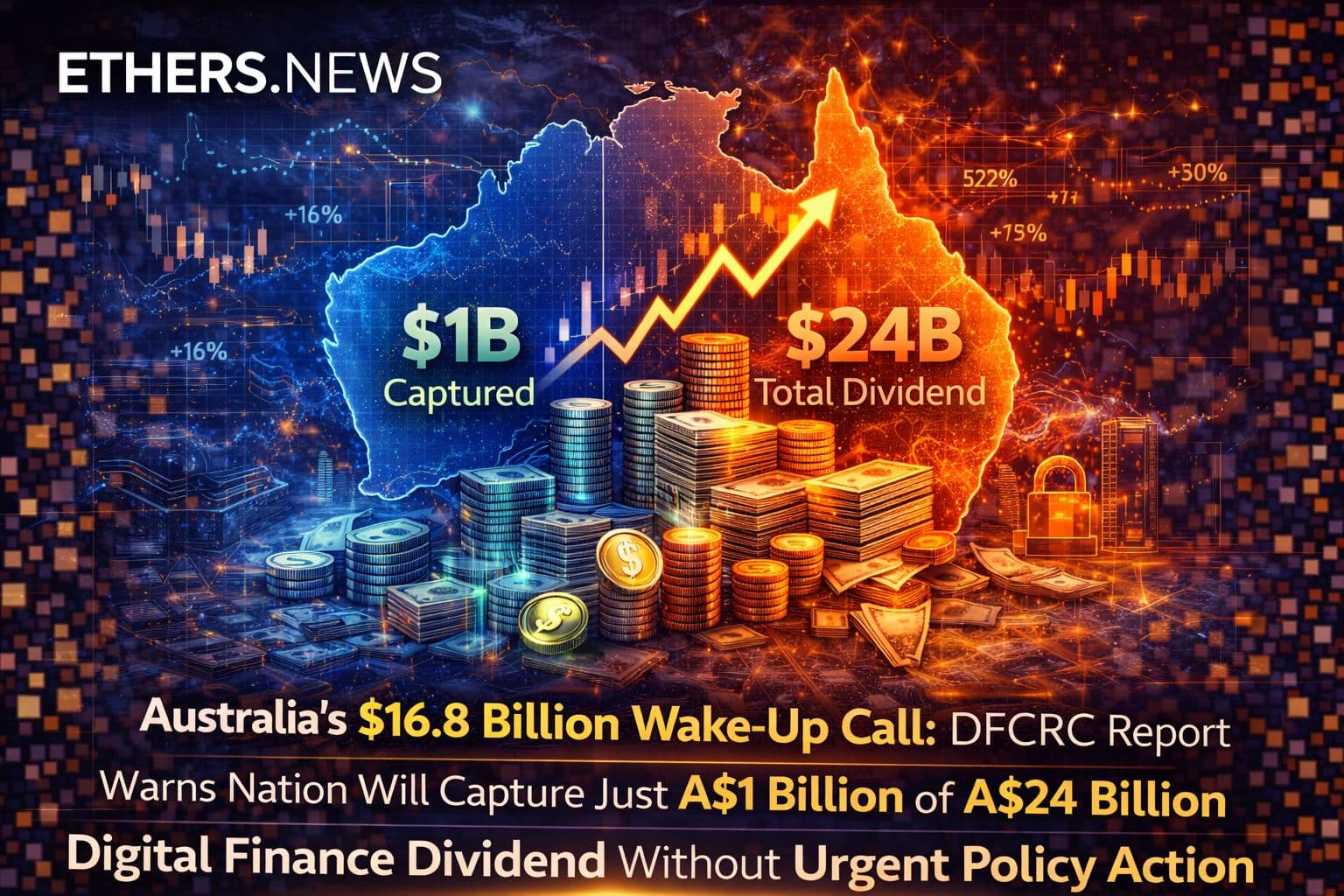
Australia's $16.8 Billion Wake-Up Call: DFCRC Report Warns Nation Will Capture Just A$1 Billion of A$24 Billion Digital Finance Dividend Without Urgent Policy Action
A landmark year-long study by the Digital Finance Cooperative Research Centre, launched March 2, 2026 with OKX financial backing, finds Australia could unlock A$24 billion — US$16.8 billion — in annual economic gains equivalent to 1% of GDP from digital finance innovation. Without targeted policy action, the country is on track to capture just A$1 billion annually by 2030 — missing 96% of the opportunity. Three structural reforms are identified as the critical path forward. The window, the report warns, is narrowing — and it is narrowing at exactly the moment that Australia's decade-long productivity crisis most urgently demands a structural solution.

UAE’s Hidden Bitcoin Reserve and Crypto Rulebook: The Macro Context Behind Abu Dhabi’s $1B ETF Bet
Abu Dhabi’s $1B BlackRock Bitcoin ETF position is only half the story: new Arkham Intelligence data shows UAE‑linked miners quietly holding 6,782 BTC worth about $453–454 million, with an estimated $344 million in unrealized profit, while the country’s regulators knit together one of the most comprehensive digital‑asset frameworks in the world. Taken together, the on‑chain reserve, ETF exposure and licensing sprint turn the Emirates into a front‑line macro signal for sovereign‑level conviction in Bitcoin and the broader crypto stack.

Inside the Leak: Axiom's $390M Platform Is Rocked by Allegations That a Senior Employee Used Internal Dashboards to Stalk Trader Wallets for Profit
ZachXBT's February 26, 2026 investigation has named Broox Bauer, a senior business development employee at Axiom Exchange — a Y Combinator-backed Solana trading platform with over $390 million in lifetime revenue — in an alleged year-long scheme to access private wallet data through internal dashboards, compile crypto influencer trading portfolios in shared spreadsheets, and trade ahead of high-profile positions dating back to early 2025. Axiom has confirmed that access to the relevant internal tools was abused, revoked the permissions involved, and stated it is conducting a full internal investigation. The U.S. Attorney's Office for the Southern District of New York may have jurisdiction given that Bauer is based in New York.
Grayscale's AAVE ETF Filing Ignites DeFi TVL Boom: Analyzing the $896M Catalyst for Explosive Growth
As DeFi TVL hits new highs with Aave leading at over $50B, the AAVE ETF emerges as a game-changer, bridging TradFi and decentralized lending for unprecedented growth. Grayscale's February 13, 2026, S-1 filing to convert its $858K Aave Trust into a spot ETF—holding AAVE tokens directly—has analysts projecting a potential 2–5x TVL boost for the DeFi lending leader, drawing parallels to BTC/ETH ETF inflows that added $57B to crypto markets. With Aave dominating 40% of DeFi lending at $15B+ TVL and $100M+ annualized revenue, ETF approval could flood the protocol with fresh liquidity, but governance centralization risks loom as institutions buy voting power.

Mortgage on the Blockchain: Better-com's Tokenized Home Loan Play Could Rewrite How America Borrows
Better.com is exploring whether home mortgages — America's largest and most illiquid asset class at over USD 13 trillion in outstanding balances — can be tokenized on-chain, opening them to DeFi liquidity pools, fractional institutional investment and automated smart contract servicing. If it works, the implications stretch far beyond one digital lender and into the structural foundations of how housing finance is originated, held, traded and settled globally.

X Trading & X Money Countdown: Elon Musk’s ‘Everything App’ Is About to Go Live
Years after Elon Musk promised to turn Twitter into an “everything app,” crypto and stock trading on X is finally moving from rumor to countdown: product lead Nikita Bier says Smart Cashtags with in‑feed trading will roll out “in a couple of weeks,” while X Money — the platform’s Visa‑backed wallet and payments rail — is shifting from internal to external beta with a limited public launch targeted within the next two months. For a platform boasting more than a billion users, that combination could turn timelines into trading terminals and make X one of the most powerful on‑ramps into Bitcoin, DOGE and other digital assets in 2026.

Congress Holds Its Most Consequential Capital Markets Hearing in a Generation: SIFMA, Blockchain Association, Nasdaq, and DTCC Testify on Tokenization Today as the CLARITY Act Markup Window Narrows and America's $16 Trillion Securities Infrastructure Faces Its Blockchain Reckoning
March 25, 2026: The United States House Financial Services Committee is convening its most consequential tokenization hearing in congressional history this morning — "Tokenization and the Future of Securities: Modernizing Our Capital Markets" — at 10:00 AM ET in Room 2128 of the Rayburn House Office Building. Witnesses testifying before the full committee include Kenneth Bentsen Jr., President and CEO of SIFMA, the Securities Industry and Financial Markets Association representing America's broker-dealers, investment banks, and asset managers; Summer Mersinger, CEO of the Blockchain Association, who has been central to both the CLARITY Act negotiations and the SEC-CFTC digital asset taxonomy process; and executives from Nasdaq and the DTCC. The Modernizing Markets Through Tokenization Act of 2026 has been formally noticed for the session. The hearing arrives four days after the SEC approved Nasdaq's proposal to allow tokenized securities to trade alongside traditional shares on the same order book, and fewer than four weeks before the Senate Banking Committee's expected April markup of the CLARITY Act — with Senator Bernie Moreno warning that failure to reach the Senate floor by May could freeze digital asset legislation for years.
The Rulebook Has Arrived: OCC Drops 376-Page GENIUS Act Stablecoin Framework — Bank-Grade Capital, Yield Prohibition and a $5M Floor That Will Reshape the $200B Stablecoin Industry
The OCC's 376-page proposed rule under the GENIUS Act — published February 25, 2026 as NR-OCC-2026-9 — is the first comprehensive federal stablecoin implementing regulation in US history. It requires 1:1 reserve backing, imposes a $5 million minimum capital floor for de novo issuers, mandates a formal bank-charter-style licensing application, and introduces a near-blanket yield prohibition backed by a rebuttable presumption that places Coinbase's USDC rewards program directly in the regulatory crosshairs. A 60-day public comment period runs until approximately May 1. This document will reshape the economics and competitive structure of the $200 billion stablecoin industry.

CFTC's March 23 Regulatory Revolution: The Joint SEC Interpretation Goes Live, Perpetual Futures Get Their First US Legal Home, and the Crypto Collateral Pilot Opens Bitcoin and ETH as Derivatives Margin — America's Most Complete Crypto Rulebook Becomes Enforceable
On March 23, 2026, the most comprehensive set of US crypto derivatives regulations in the asset class's seventeen-year history became simultaneously enforceable. The SEC-CFTC Joint Interpretation — published in the Federal Register as document 2026-05635 — established clear, binding jurisdictional rules for every crypto asset platform operating in the United States, determining which tokens are regulated by the SEC as securities and which are regulated by the CFTC as commodities. CFTC Chair Michael Selig confirmed at the Milken Institute's Future of Finance conference on March 3 that true crypto perpetual futures — not long-dated substitute contracts — are now permitted in the United States for the first time, reversing the de facto prohibition that had driven over $3 trillion in annual crypto perpetual futures volume to offshore exchanges in Asia, Europe, and the Bahamas. The CFTC crypto collateral pilot, authorised by Staff Letter 26-05 and detailed in FAQs issued March 20 by Greenberg Traurig's analysis, allows registered futures commission merchants to accept Bitcoin, Ethereum, and payment stablecoins as derivatives margin. The SEC-CFTC Memorandum of Understanding, signed March 11, commits both agencies to coordinated oversight, shared jurisdictional clarity, and streamlined compliance for dually regulated entities.
Arizona's Bitcoin Reserve Revolution: HB2749 Already Signed Law, SB1649 Seized-Asset Fund Clears Full Senate — America's Most Legally Advanced State Crypto Reserve Framework Is Live and Expanding
Arizona is executing the most comprehensive and legally advanced state-level Bitcoin reserve framework in the United States — operating across two parallel statutory tracks. HB2749, signed by Governor Katie Hobbs on May 7, 2025, created a Bitcoin and Digital Assets Reserve Fund from unclaimed and abandoned digital assets, making Arizona the second US state after New Hampshire to establish a state crypto reserve by signed law. SB1649 — introduced by Senator Mark Finchem on February 3, 2026 — creates a Digital Assets Strategic Reserve Fund from seized, confiscated, and voluntarily surrendered crypto, including Bitcoin, XRP, DigiByte, stablecoins, and NFTs. It cleared the Senate Finance Committee 4-2 on February 16, the Senate Rules Committee on February 23, and moved through the full Senate per the LegiScan March 9 roll call. Governor Hobbs has vetoed four prior crypto reserve bills but has not acted on SB1649. The eligible asset benchmark requires ≥1% of the digital gold standard, defined by Bitcoin's $100,000 market price milestone.
Cardano’s Fast‑Track to a Spot ADA ETF: SEC’s 75‑Day Shortcut Starts the Clock
On February 9, 2026, CME Group officially launched Cardano futures, quietly starting a six‑month regulatory clock that could enable the first US spot Cardano ETF as early as August 9, 2026 — a 75‑day faster path than Bitcoin had under the prior SEC framework. Under the SEC’s new “generic futures‑based” listing standards, if ADA futures remain listed and active on a CFTC‑regulated designated contract market for at least six months, a spot ADA ETF filing can follow on a 75‑day review track rather than the 240‑day maximum window that once defined the race to bring BTC and ETH to Wall Street.
Supreme Court’s Trump Tariff Ruling Sends Mixed Signals to the Crypto Market
The US Supreme Court’s 6–3 decision to invalidate President Donald Trump’s emergency global tariffs under the International Emergency Economic Powers Act (IEEPA) has scrapped one of his signature economic tools and opened the door to potential refunds on more than $100 billion in duties—just as the White House races to reinstall a 10–15% blanket tariff under a different statute. Traditional markets initially cheered the legal curb on tariff powers, while crypto, which sold off sharply on earlier tariff headlines in January, has so far taken the ruling and Trump’s rapid 15% counter‑move in stride, with Bitcoin holding near $68,000 and volatility far below the panic seen during previous trade shocks.

Kalshi Issues First-Ever Insider Trading Enforcement: MrBeast Editor Fined $20,000, CFTC Steps In
Kalshi's first-ever insider trading enforcement actions against a MrBeast editor and a political candidate mark a watershed moment for prediction market regulation under CFTC oversight.

Wall Street Declares War on the OCC: JPMorgan, Goldman Sachs and Citigroup Weigh Lawsuit as Crypto Firms Gain Federal Bank Charters — 11 Approvals in 83 Days
The Bank Policy Institute — representing 40 US mega-banks including JPMorgan Chase, Goldman Sachs, and Citigroup — is preparing to sue the Office of the Comptroller of the Currency over its decision to grant national trust bank charters to Ripple, Circle, BitGo, Fidelity Digital Assets, Paxos and six other crypto and fintech firms. Eleven companies received conditional approvals or filed applications in just 83 days. The legal challenge centres on OCC Interpretive Letter 1176. A new OCC rule effective April 1, 2026 is forcing BPI's hand on timing. On March 5, the American Bankers Association separately rejected the White House's CLARITY Act compromise. The biggest legal confrontation in the history of US crypto banking access is now formally in motion.
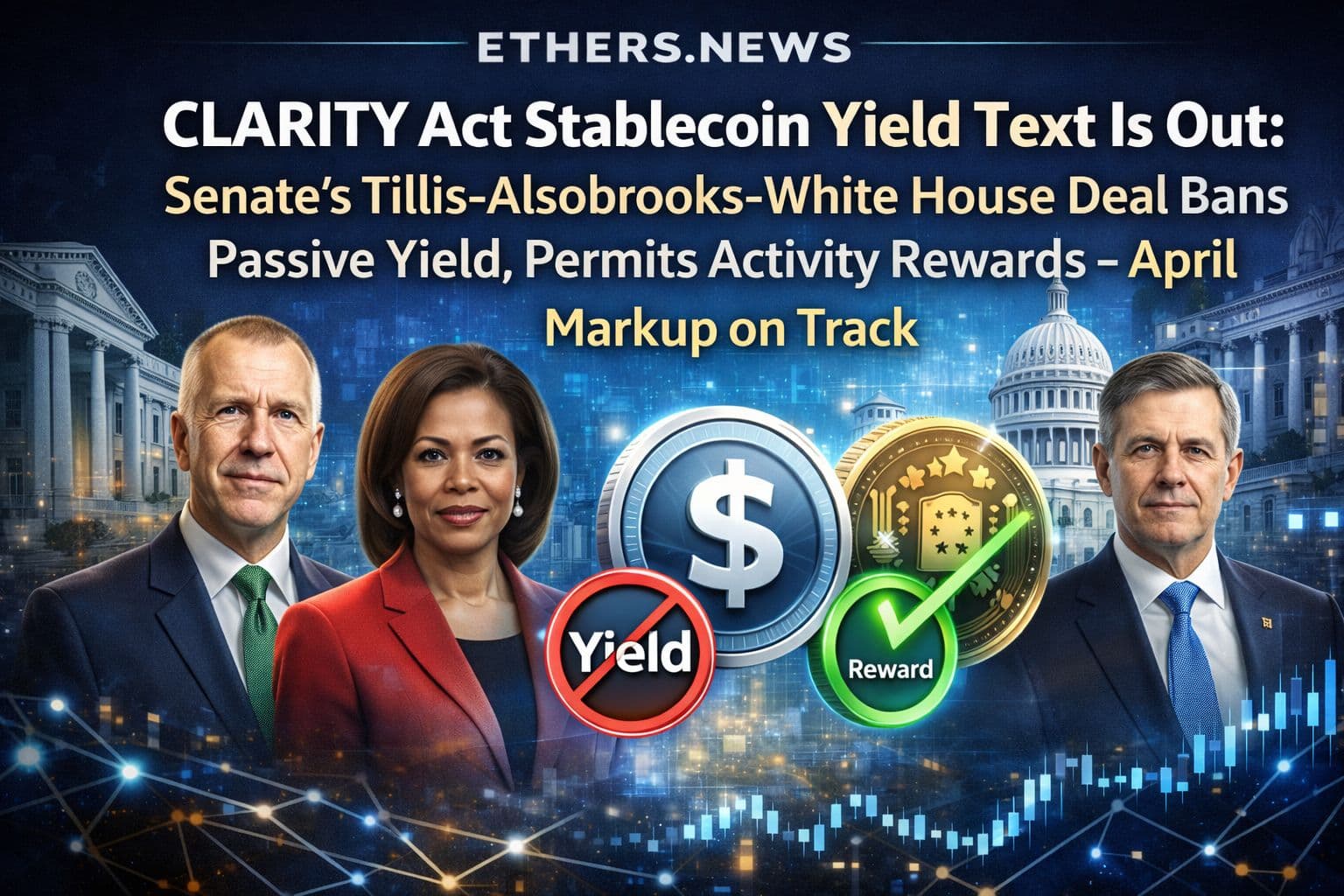
Senate's Stablecoin Yield Deal Is Sealed: The CLARITY Act's Tillis-Alsobrooks-White House Compromise Bans Passive Yield, Permits Activity Rewards, and Sets a Late April Markup — The Most Consequential Regulatory Line in US Crypto Finance Since the GENIUS Act Is Now on Paper
On March 20, 2026, Senators Tillis and Alsobrooks, with White House adviser Patrick Witt, agreed in principle on stablecoin yield language for the CLARITY Act. Compromise text reviewed by crypto firms March 24, banks March 25. Section 404: passive yield on stablecoin balances prohibited; activity-based rewards permitted. CLARITY Act passed House 294–134 July 2025; cleared Senate Agriculture Committee January 2026. GENIUS Act (signed July 18, 2025) already bans issuer-level yield. Senate Banking markup targeted late April 2026. Senate floor deadline: May 2026. Missing May window risks legislative failure past 2026 midterms. Circle fell ~20% on yield restriction news. Coinbase stablecoin revenue: $364.1M Q4 2025. Coinbase has pushed back publicly.
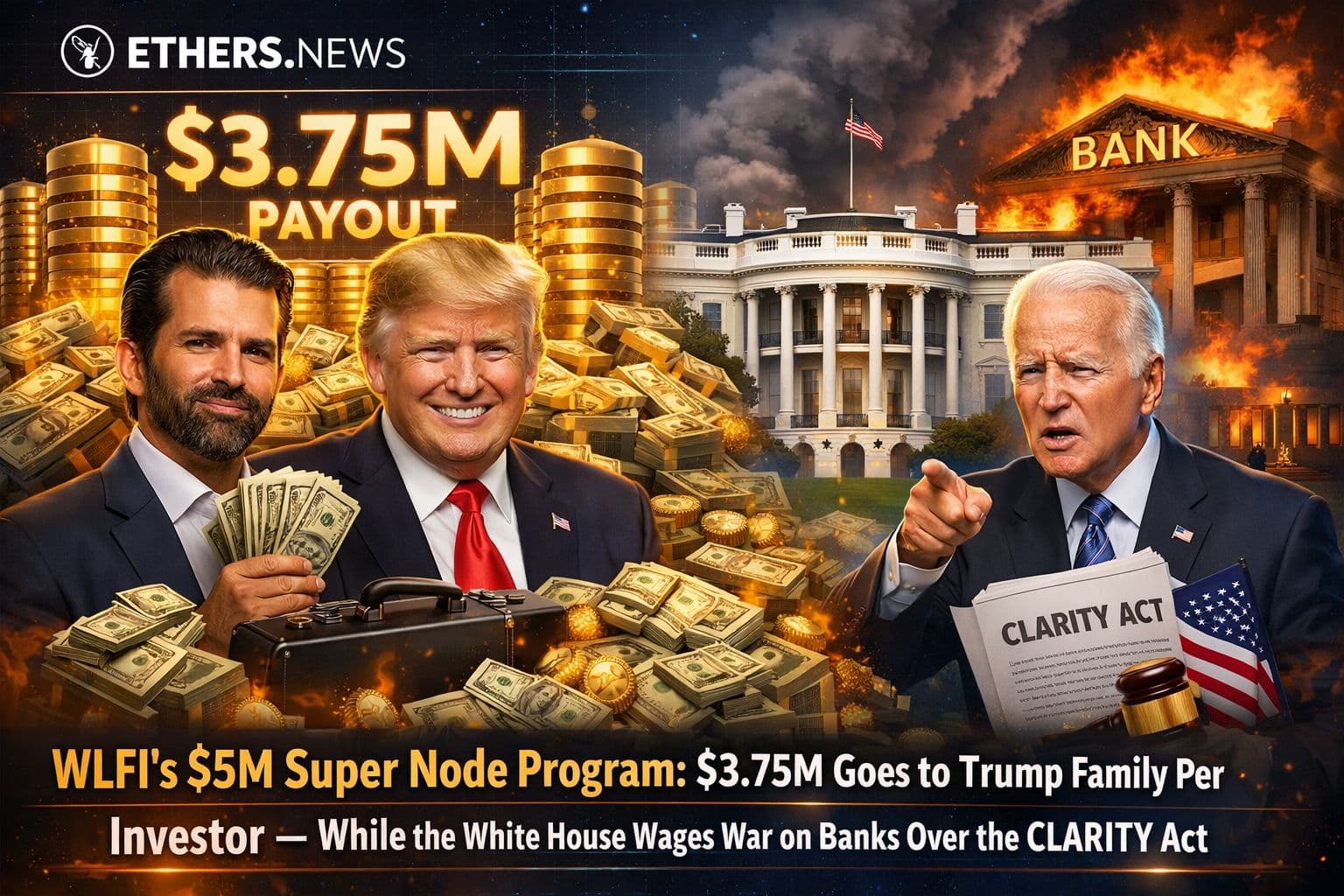
WLFI's $5M Super Node Program Sends $3.75M Per Investment to the Trump Family — As the White House Simultaneously Wages Open War on Banks Over the CLARITY Act's Stablecoin Yield Provisions
World Liberty Financial — the crypto venture co-founded by President Donald Trump, Eric Trump, Donald Trump Jr., and Barron Trump — launched its $5 million Super Node program on March 14, 2026, requiring investors to stake 50 million WLFI tokens for 180 days in exchange for priority executive access, governance voting rights, and a 2% WLFI token yield. Under WLFI's 75% token-sale distribution to Trump family entities, each $5 million Super Node investment sends approximately $3.75 million directly to the Trump family. WLFI has generated at least $1.2 billion in cash and $2.25 billion in paper gains for the Trump and Witkoff families since November 2024, per Wall Street Journal analysis. WLFI applied for a US banking charter through OCC in March 2026. Concurrently, the White House is openly accusing the banking lobby of "hijacking" the CLARITY Act over stablecoin yield — a bill that, if passed, would materially benefit WLFI's own planned stablecoin products.

America's Crypto Reckoning: The CLARITY Act's March 1 White House Deadline Arrives — What the Most Consequential Digital Asset Bill in US History Means for Bitcoin, DeFi and Institutional Capital
The White House's March 1, 2026 internal deadline to resolve the stablecoin yield dispute holding up the Digital Asset Market Clarity Act has arrived. The Senate Banking Committee has already passed its component. SEC Chairman Paul Atkins publicly endorses the bill. Treasury Secretary Scott Bessent has urged Spring passage. Ripple CEO Brad Garlinghouse gives it 80% odds of enactment by April. Polymarket odds have surged. The CLARITY Act is the most consequential digital asset legislation in US history — and its final obstacle is a single question that has divided the crypto industry from traditional banking for months.
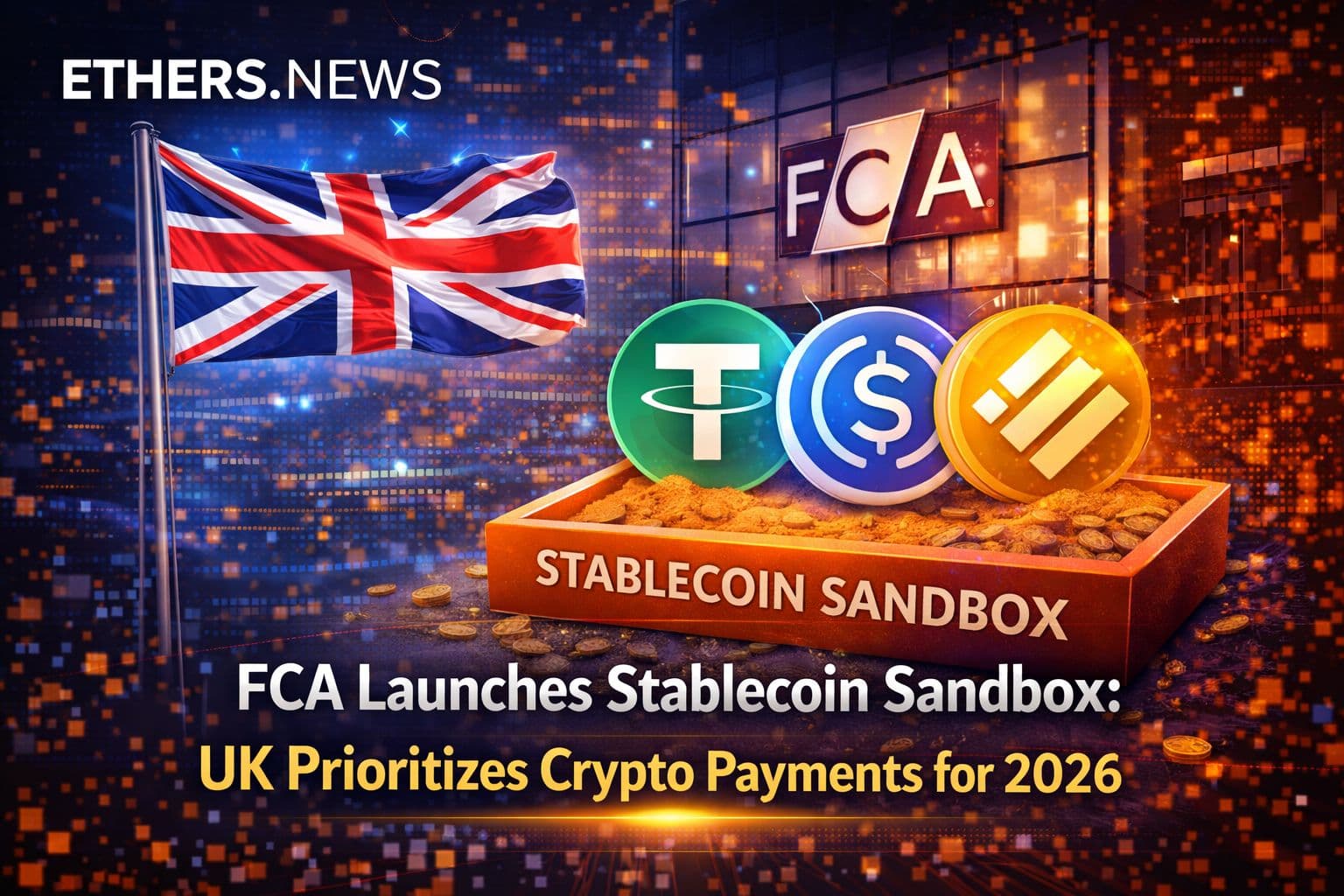
FCA's Stablecoin Sandbox Goes Live: UK Positions for Regulated Crypto Payments Leadership
The Financial Conduct Authority (FCA) has launched a stablecoin-specific cohort within its flagship Regulatory Sandbox, inviting issuers to test live GBP-pegged stablecoins under supervision—ahead of the full regime rollout expected in late 2026. With applications closed on January 18, selected firms are now live-testing issuance, redemption, and payments using real market data, directly informing prudential rules, reserve requirements, and consumer protections for what FCA Executive Director David Geale calls a "priority" for faster, more convenient UK payments.

Project Crypto Goes Live: SEC and CFTC Formally Launch America's Most Ambitious Crypto Regulatory Initiative — DeFi Safe Harbors and Perpetual Contracts Coming Within Weeks
On January 29, 2026, the SEC and CFTC jointly launched Project Crypto — a formal cross-agency harmonization initiative that pursues DeFi safe harbors for software developers, innovation exemptions for non-custodial protocol builders, and the first-ever onshoring of perpetual futures contracts to US regulated markets. CFTC Chair Selig confirmed to Bloomberg on March 2 that the regulatory path for US crypto perpetuals will clear in weeks. SEC Chairman Paul Atkins is executing a definitive shift from enforcement to structured innovation guidance. The most consequential joint regulatory action in American crypto history is formally in motion — and the DeFi and derivatives industries will never be the same.
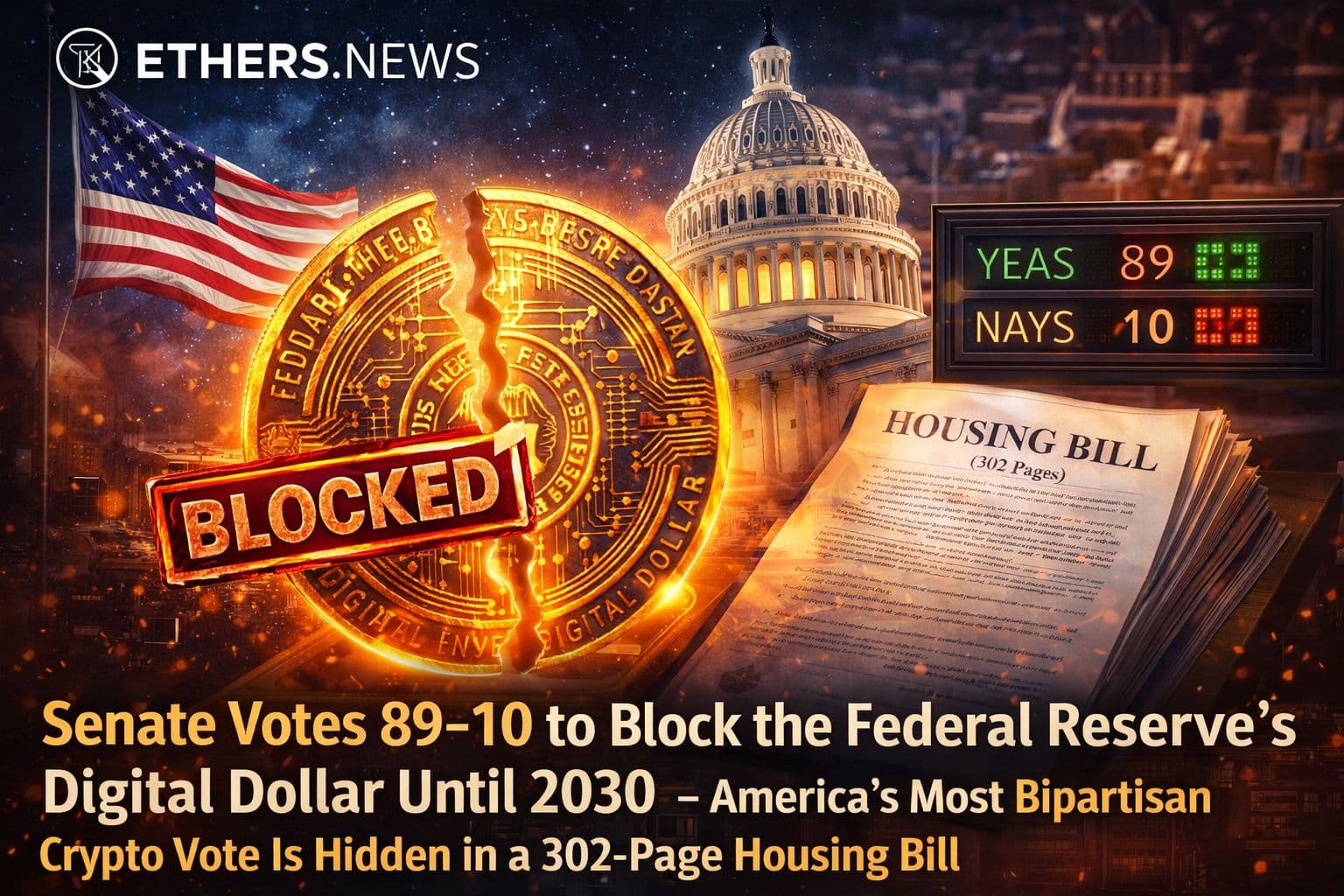
Senate Votes 89–10 to Block the Federal Reserve's Digital Dollar Until 2030 — America's Most Bipartisan Crypto Vote Is Hidden in a 302-Page Housing Bill
On March 12, 2026, the US Senate passed the 21st Century ROAD to Housing Act 89–10. Embedded within the 302-page housing bill is a landmark provision prohibiting the Federal Reserve from issuing a CBDC directly or indirectly until December 31, 2030. The ban forbids pilot programs without explicit Congressional approval and requires Congressional Financial Technology requirements for any future digital dollar initiative. Private stablecoins including USDC and USDT are explicitly excluded. H.R.1919 (Anti-CBDC Surveillance State Act) passed the House 219-210 on July 17, 2025. Senator Ted Cruz sought a permanent ban but his standalone amendment failed. The bill now goes to the House for reconciliation. Trump signed an executive order halting CBDC research in January 2025. Circle and Tether are positioned to benefit from the stablecoin tailwinds.

Nations Are Buying the Dip: Abu Dhabi's $1 Billion BlackRock Bitcoin ETF Bet Rewrites the Institutional Playbook
Fresh SEC filings reveal that Abu Dhabi's two largest sovereign‑linked investors — Mubadala Investment Company and Al Warda Investments — ended 2025 with a combined $1.04 billion stake in BlackRock's iShares Bitcoin Trust (IBIT), having added aggressively through a quarter in which Bitcoin lost 23% of its value. The disclosure, landing during a week when BTC briefly crashed below $65,000 and broader ETF outflows hit $5.8 billion, has crystallized a powerful new macro narrative: while Western institutions trim exposure, Gulf sovereign capital is treating the crash as a generational entry point.

Bombs and Bets: Polymarket's $529M Iran Strike Market Exposes Six Wallets That Turned $61K Into $493K — Hours Before the First Explosions Hit Tehran
Polymarket's "US strikes Iran by February 28" contract accumulated $529 million in total trading volume — one of the largest single prediction markets the platform has ever hosted. Bubblemaps SA identified six newly created wallets that collectively netted $1.2 million by purchasing contracts hours before the first explosions hit Tehran, with the largest wallet converting $61,000 into $493,000. Israeli authorities have arrested military personnel for similar insider betting. US legislators are now pushing a bill targeting prediction market abuse. The questions this case raises about anonymous markets and information asymmetry may define the regulatory future of decentralized prediction platforms.
Tether's $4.2 Billion Enforcement Record: The World's Largest Stablecoin Has Frozen More Illicit Funds in Three Years Than Most Nations Seize in a Decade
Tether disclosed on February 27, 2026 that it has frozen $4.2 billion in USDT linked to criminal activity — with $3.5 billion of that total immobilized since January 2023. The disclosure followed a $61 million DOJ-assisted pig-butchering fraud action, a $500 million Turkey illegal gambling and money laundering freeze earlier in February, and a $182 million Tron wallet freeze in January. Elliptic's data shows stablecoin issuers have collectively blacklisted 5,700 wallets. With 84% of illicit crypto transactions passing through dollar-pegged stablecoins and USDT operating at $11.9 trillion in quarterly on-chain volume, the compliance question has become the defining governance challenge of the global stablecoin industry.

Stablecoin Vulnerabilities: The Hidden Risks Threatening Crypto's $200B Lifeline
Stablecoins underpin $200B+ in DeFi TVL and trillions in annual volume, but Chainalysis reports $3.41B stolen in 2025 alone through exploits, phishing, and bridge hacks—making them the crypto ecosystem’s most targeted asset class. The Saga 2026 exploit, which depegged its stablecoin to $0.75 and wiped 55% of TVL in 24 hours, exemplifies cross‑chain vulnerabilities in modular ecosystems, while classics like Euler ($197M) and Curve ($100M+) expose smart contract flaws that persist despite audits.

Morgan Stanley Digital Trust: Wall Street’s $9 Trillion Giant Moves to Custody, Trade and Stake Crypto
In a quiet but potentially era-defining move, Morgan Stanley has filed for an OCC national trust bank charter that would allow it to custody, trade and stake crypto assets for clients under a fully regulated banking umbrella — positioning the Wall Street powerhouse to become the first megabank with a dedicated crypto trust subsidiary.