
Senate's Stablecoin Yield Deal Is Sealed: The CLARITY Act's Tillis-Alsobrooks-White House Compromise Bans Passive Yield, Permits Activity Rewards, and Sets a Late April Markup — The Most Consequential Regulatory Line in US Crypto Finance Since the GENIUS Act Is Now on Paper
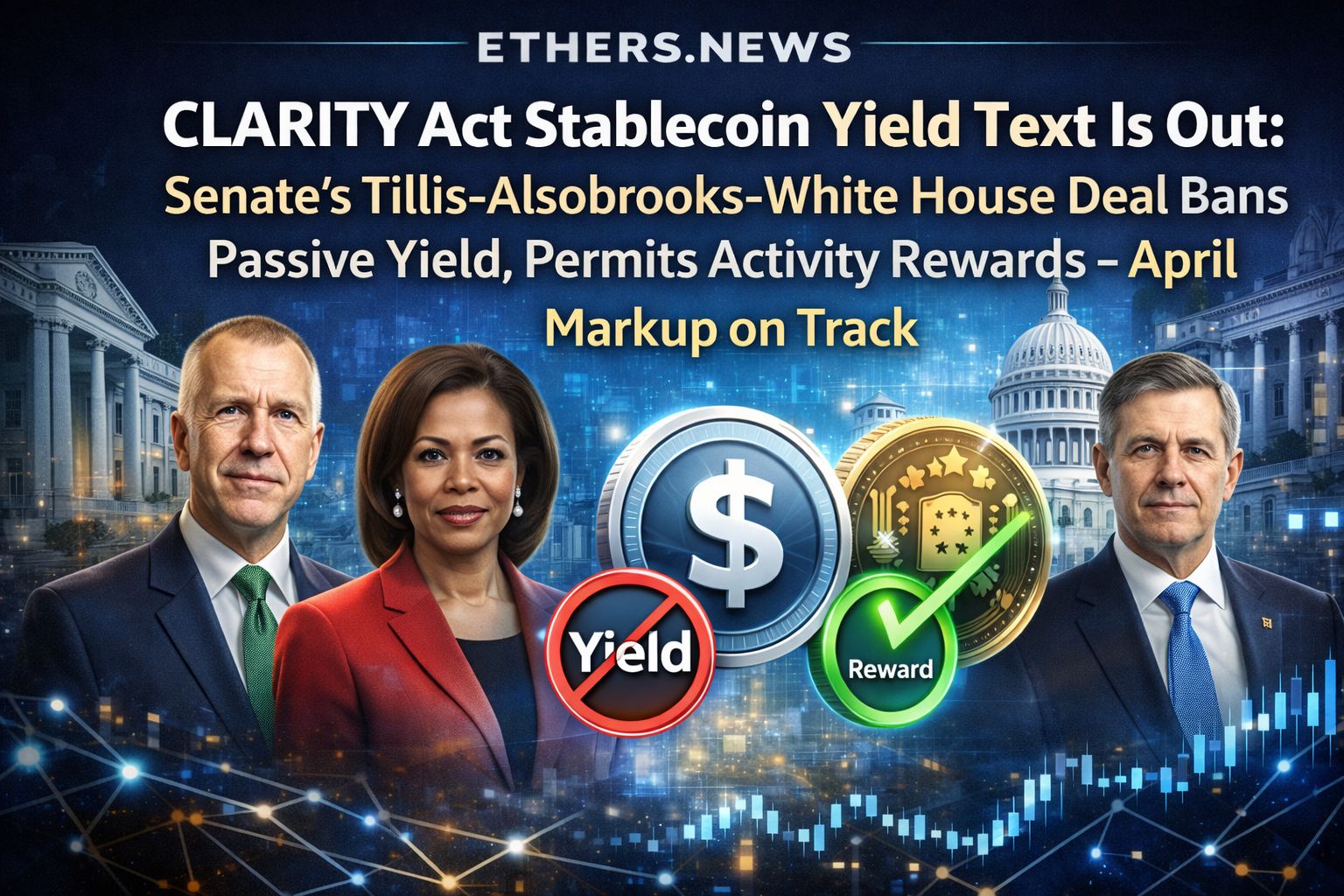
The legislative battle that has defined US crypto policy in the first half of 2026 — the question of whether American crypto exchanges and platforms can pay yield to stablecoin holders — has produced its most definitive answer to date. The compromise draft text of the Digital Asset Market CLARITY Act's stablecoin yield provision, reviewed by industry stakeholders and bank representatives in consecutive closed-door Capitol Hill sessions on March 24 and March 25, codifies a structural division that will reshape business models across the entire US stablecoin industry: passive yield on stablecoin balances is prohibited. Activity-based rewards are permitted. This is not a conceptual framework or a legislative intent summary. It is, per FinTech Weekly's March 23 reporting drawing on Eleanor Terrett's internal stakeholder email citation, actual draft language that will proceed to a Senate Banking Committee markup targeted for late April 2026. The legislation it is embedded within — the CLARITY Act — has already passed the House of Representatives 294 to 134 in July 2025 and cleared the Senate Agriculture Committee in January 2026. The only obstacle between the CLARITY Act and a Senate floor vote has been this yield language dispute. As of March 20, 2026, that obstacle has been formally resolved at the principle level — and as of April 6, 2026, OurCryptoTalk confirmed that banks and crypto firms have finalised the deal.
The Yield Dispute's Origins: How Stablecoin Interest Became the GENIUS Act's Unfinished Business
To understand why the CLARITY Act's stablecoin yield compromise matters so profoundly, it is necessary to understand what the GENIUS Act — the US's first federal stablecoin law, signed by President Trump on July 18, 2025 — explicitly left unresolved. The Latham and Watkins US Crypto Policy Tracker confirms the precise statutory boundary the GENIUS Act drew: "A stablecoin issuer may not offer any form of interest or yield to stablecoin holders." The GENIUS Act addressed issuer-level yield prohibition. What it did not address — and what the CLARITY Act's yield dispute has been entirely about — is the distributor-level question: can exchanges, brokers, and platforms that do not issue stablecoins but hold and distribute them on behalf of users offer yield or rewards on those balances? Coinbase had structured its USDC rewards program specifically as a distributor-level product rather than an issuer-level one, arguing it sat outside the GENIUS Act's issuer prohibition. The American Bankers Association challenged this directly at its March 2026 summit, where Senator Alsobrooks publicly announced her collaboration with Senator Tillis to close what she described as "a loophole that could allow crypto companies to circumvent the GENIUS Act's ban on interest payments." Yahoo Finance's March 11 reporting confirms the OCC had reinforced the banks' position by indicating in recent rulemaking that platform-level rewards might face stricter limitations than the crypto industry expected — a regulatory signal that tipped the balance of the negotiation before the formal Tillis-Alsobrooks agreement was reached.
The Compromise Text: Section 404, the Passive Yield Ban, and the Activity Rewards Carve-Out
The draft compromise language — identified by CryptoRank's March 30 analysis as specifically contained in Section 404 of the CLARITY Act — is structured around a binary classification that applies to every digital asset service provider in the United States. FinTech Weekly's March 23 deep-dive on the draft text confirms the prohibition's architectural breadth: "Digital asset service providers — including exchanges, brokers, and affiliated entities — are prohibited from offering yield directly or indirectly on stablecoin balances, or in any manner that is economically or functionally equivalent to bank interest. The prohibition is broad by design, closing workarounds through affiliates and structuring arrangements." The "affiliated entities" and "structuring arrangements" language is the provision that closes Coinbase's existing USDC rewards programme structure — a rewards product that Coinbase had specifically designed to route through an entity with a different compliance designation from the exchange itself. CCN's March 25 reporting confirms Coinbase's response: the company has publicly pushed back on the compromise text, recognising that Section 404 would directly impact a stablecoin rewards programme that contributed to Coinbase's $364.1 million in stablecoin revenue in Q4 2025 alone, per CryptoRank's data. The activity-based rewards carve-out — permits rewards tied to payments, transfers, or other platform activity — preserves a narrower but commercially viable yield mechanism. Rewards paid for using stablecoins to make purchases, execute transfers, or perform verifiable platform actions are structurally distinguishable from interest on a parked balance — and the compromise text preserves this distinction explicitly.
"Sen. Tillis and I do have an agreement in principle. We've come a long way. And I think what it will do is to allow us to protect innovation, but also gives us the opportunity to prevent widespread deposit flight."
— Senator Angela Alsobrooks (D-MD) — interview with Politico, published March 20, 2026, announcing the agreement in principle reached with Senator Thom Tillis (R-NC) and White House officials on stablecoin yield language for the Digital Asset Market CLARITY Act, resolving the legislative stalemate that had prevented the Senate Banking Committee from scheduling a markup since January 2026
The Banking Industry's Win and the White House's Role
FinTech Weekly's March 24 analysis — published the day after the closed-door stakeholder session at which crypto industry leaders reviewed the draft text — carries a headline that captures the negotiation's outcome with precision: "It Looks Like the Banks Are Still Winning." The analysis documents why: the ABA's core demand from the beginning of the CLARITY Act stablecoin yield negotiations was that no mechanism — regardless of how it was structured, named, or routed — should allow a crypto platform to pay returns on held stablecoin balances that function like bank interest. The Section 404 language delivers exactly that outcome. The GENIUS Act's issuer-level yield prohibition plus Section 404's distributor-level yield prohibition together create a complete stack of federal prohibition on stablecoin interest payments — eliminating the structural gap that allowed Coinbase's USDC rewards programme to operate in the GENIUS Act's shadow. The White House's direct involvement in the March 20 agreement is documented by Politico's first-report of the deal: Patrick Witt, identified as "a top White House crypto policy adviser," posted on X following Politico's publication to specifically credit Tillis and Alsobrooks "for bridging the partisan divide to tackle a difficult issue" — a public endorsement from the executive branch that carries both political weight and a signal that the White House will not oppose the current compromise language at the presidential signature stage. Elliptic's March 31 regulatory analysis confirms that the compromise text is the "product of more than two months of debate" and notes that the Senate Banking Committee's January cancellation — triggered specifically by this yield dispute — has now been structurally resolved.
Market Impact: Circle's 20% Drop, Coinbase's Revenue Exposure, and the Investor Calculus
The financial market's response to the yield restriction news was immediate and material. CryptoRank's analysis confirms that Circle — whose NYSE listing as CRCL had just been completed and whose USDC ecosystem products include yield-generating mechanisms that would be directly affected by Section 404 — fell approximately 20% when the passive yield restriction language first surfaced publicly. Investors.com confirmed the Circle stock response on March 24, placing it in the context of Cathie Wood's ARK Investment Management taking a position in the dip — a public validation from one of the market's most visible growth-technology investors that the long-term Circle thesis remains intact despite the yield restriction. Coinbase's revenue exposure is quantified precisely by CryptoRank's data: $364.1 million in stablecoin revenue in Q4 2025 alone — a figure that represents a substantial share of Coinbase's overall fee and revenue base. CCN's March 25 analysis documents Coinbase's public pushback against the compromise text, framing the company's opposition as driven by direct financial impact rather than abstract policy concern. The disconnect between Coinbase's public pushback and the ultimate confirmation by OurCryptoTalk on April 6 that "banks and crypto firms have reportedly finalized a deal" suggests that Coinbase's opposition was either insufficient to change the outcome or was ultimately resolved through modifications to the activity-based rewards carve-out that preserved a commercially viable yield pathway for the company's product structure.
The Legislative Calendar: April Markup, May Floor Deadline, and the Midterm Cliff
The CLARITY Act's legislative calendar following the March 20 yield deal is the most precisely defined and consequential window in the bill's eighteen-month congressional history. CryptoRank's March 30 analysis maps the timeline in its starkest terms: "Senate Banking targets a late-April 2026 markup of the Digital Asset Market CLARITY Act with a May 2026 Senate-floor deadline; missing that window could push major crypto legislation past the 2026 midterms." The five remaining legislative steps after a late-April markup — full committee report, Senate floor scheduling, floor debate and cloture vote, conference with the House on any text differences introduced in Senate markup, and presidential signature — must be completed before the Senate's pre-midterm recess creates the political dynamics that historically freeze bipartisan legislation. Senator Bernie Moreno's statement — that if the CLARITY Act does not reach the Senate floor by May, digital asset legislation may not move again for years — provides the most explicit articulation of the bill's existential timeline constraint. The Disruption Banking analysis of the March 20 agreement adds the broader market context: JPMorgan had forecast a "significant influx of institutional investment" in crypto by late 2026, contingent on the CLARITY Act's passage — a forecast that Yahoo Finance's March 2 reporting confirmed could be replaced by SEC and OCC enforcement actions filling the regulatory vacuum if legislative resolution fails. With the yield deal finalised by April 6 and the Senate Banking Committee markup target locked for late April, the CLARITY Act has never been closer to the Senate floor — and the crypto market's 2026 institutional adoption trajectory has never been more directly dependent on a legislative calendar's execution.
Bottomline
March 20, 2026: Senators Thom Tillis (R-NC) and Angela Alsobrooks (D-MD), with White House crypto adviser Patrick Witt, announced agreement in principle on CLARITY Act stablecoin yield language (Politico, March 20 — direct Alsobrooks quote). Draft text circulated: crypto industry leaders March 24 (closed-door Capitol Hill session, FinTech Weekly March 23, citing Eleanor Terrett internal email); banks March 25 (FinTech Weekly March 24). April 6: banks and crypto firms confirmed deal finalized (OurCryptoTalk April 6, citing CoinDesk). Core provisions: Section 404 — passive yield on stablecoin balances prohibited (direct or indirect; economically/functionally equivalent to bank interest); prohibition covers exchanges, brokers, and affiliated entities; structural workarounds and affiliate routing closed; activity-based rewards tied to payments, transfers, platform activity remain permitted. Background: GENIUS Act signed by President Trump July 18, 2025 — prohibits stablecoin issuer-level interest/yield (Latham & Watkins US Crypto Policy Tracker). Section 404 closes the distributor-level gap GENIUS Act did not address. CLARITY Act passed House 294–134 July 2025; cleared Senate Agriculture Committee January 2026; Senate Banking Committee markup cancelled January 2026 due to yield dispute (Elliptic March 31). Senate Banking markup: late April 2026. Senate floor deadline: May 2026. Post-deadline risk: legislation fails past 2026 midterms (CryptoRank March 30, Moreno warning). Market reaction: Circle (NYSE: CRCL) fell ~20% on yield restriction news (CryptoRank); Coinbase Q4 2025 stablecoin revenue $364.1M (CryptoRank); Coinbase publicly pushed back (CCN March 25); Cathie Wood/ARK bought Circle dip (Investors.com March 24). Sources: Politico (March 20); FinTech Weekly (March 23–24); OurCryptoTalk (April 6); Elliptic (March 31); CryptoRank (March 30); Yahoo Finance (March 2, 11); CCN (March 25); Investors.com (March 24); crypto.news (April 3); Disruption Banking (March 21); Latham & Watkins Crypto Policy Tracker.
The CLARITY Act's stablecoin yield compromise is the most consequential piece of US crypto regulatory text since the GENIUS Act itself — and the market's initial reaction, pricing it as a loss for Circle and Coinbase, is partially correct but strategically incomplete. At Ethers News, our reading of Section 404 is that its impact is asymmetric across the stablecoin ecosystem in a way the market has not yet fully priced. Coinbase's USDC rewards programme — the specific product that Section 404 is architecturally designed to terminate — generated $364.1 million in Q4 2025 revenue. That revenue disappears under Section 404 in its current form. But Circle's cirBTC launch, its Arc blockchain, and its institutional custody and settlement infrastructure are entirely unaffected by a passive yield prohibition. Circle is not a yield platform. It is a financial infrastructure company. The 20% stock decline when the yield restriction surfaced reflects the market pricing the loss of a specific product line rather than the company's long-term infrastructure value — which is exactly the kind of dislocation that Cathie Wood's ARK team identified and moved on immediately. The deeper question for the CLARITY Act's passage is whether Coinbase's pushback has sufficient Senate Banking Committee leverage to materially alter the Section 404 language before the April markup. Our assessment is that it does not. The White House's direct co-authorship of the compromise, Patrick Witt's public credit to Tillis and Alsobrooks, and the ABA's position as the more politically embedded institutional voice in the Senate Banking Committee all point toward Section 404 surviving the markup in substantially its current form. The crypto industry's window for influencing this outcome passed in March. The April markup will confirm it.
Key Sources and References
Politico — Senators, White House Strike 'Agreement in Principle' to Resolve Bank-Crypto Clash, March 20, 2026 (Primary Source, Pull Quote): politico.com — Alsobrooks direct quote confirmed; Tillis-Alsobrooks agreement in principle; White House Patrick Witt X post credit; "protect innovation, prevent widespread deposit flight"; passive balance yield bar; stablecoin yield as Senate Banking Committee stalling issue since January

FinTech Weekly — The CLARITY Act Stablecoin Yield Text Is Out, March 23, 2026: fintechweekly.com — Eleanor Terrett internal stakeholder email cite; March 24 crypto industry closed-door session confirmed; draft language: exchanges/brokers/affiliates prohibited; broad prohibition closing workarounds; Senate Banking markup second half April targeted; banks reviewing Tuesday March 25

FinTech Weekly — CLARITY Act: It Looks Like the Banks Are Still Winning, March 24, 2026: fintechweekly.com — Bank representatives reviewed text March 25; "banks winning"; Coinbase structural workaround closed; CLARITY Act House 294–134 July 2025; Senate Agriculture January 2026; Fairshake PAC context

OurCryptoTalk — CLARITY Act Yield Deal Finalized by Banks, Crypto Firms, April 6, 2026: ourcryptotalk.com — Deal finalised confirmed April 6; passive yield banned; activity rewards legal; CoinDesk observers: "protecting innovation while addressing deposit-flight concerns"

CryptoRank — CLARITY Act Deadline in Weeks Could Kill Stablecoin Earnings, March 30, 2026: cryptorank.io — Section 404 named; passive yield ban confirmed; Senate Banking late-April markup; May floor deadline; post-midterm legislative risk; Circle fell ~20%; Coinbase Q4 2025 stablecoin revenue $364.1M; GENIUS Act 100% reserves requirement

Elliptic — CLARITY Act Senate Compromise Meets Mixed Reception, March 31, 2026: elliptic.co — "Product of more than two months of debate"; Senate Banking Committee cancelled January session on yield dispute confirmed; banking and cryptoasset industries at odds; CLARITY Act regulatory perimeter scope

CCN — Coinbase Pushback Throws New CLARITY Act Compromise Into Doubt, March 25, 2026: ccn.com — Coinbase public pushback confirmed; direct/indirect yield prohibition confirmed; affiliate and structuring arrangement closure confirmed; Coinbase revenue impact recognised

Yahoo Finance — CLARITY Act Fails March 1 Deadline, March 2, 2026: yahoo.com — OCC rulemaking reinforcing bank position; JPMorgan institutional investment forecast conditional on CLARITY Act; SEC/OCC enforcement action alternative if legislation fails; April negotiations, July soft deadline

Latham & Watkins — US Crypto Policy Tracker: Legislative Developments (GENIUS Act): lw.com — GENIUS Act signed July 18, 2025 confirmed; "stablecoin issuer may not offer any form of interest or yield"; 1:1 reserve requirement; Bank Secrecy Act financial institution status

Investors.com — CLARITY Act Clock Is Ticking; Cathie Wood Buys Diving Circle, March 24, 2026: investors.com — Circle stock decline on yield restriction; Cathie Wood ARK buys dip confirmed; ABA argument on parked funds; GENIUS Act passed year prior contextAbout the Author
Ethers News
Ether News Team - Highly dedicated to provide up to date crypto related news and upcoming events.
-At Ethers.News, we are committed to delivering accurate, transparent, and well-researched information related to cryptocurrency, blockchain, and digital assets. Our content is created for educational and informational purposes only and should not be considered financial, investment, or legal advice. We encourage readers to conduct their own research and consult with qualified professionals before making any financial decisions. Market conditions can change rapidly, and past performance does not guarantee future results. Our goal is to promote informed decision-making through responsible journalism.