
Category: stablecoins
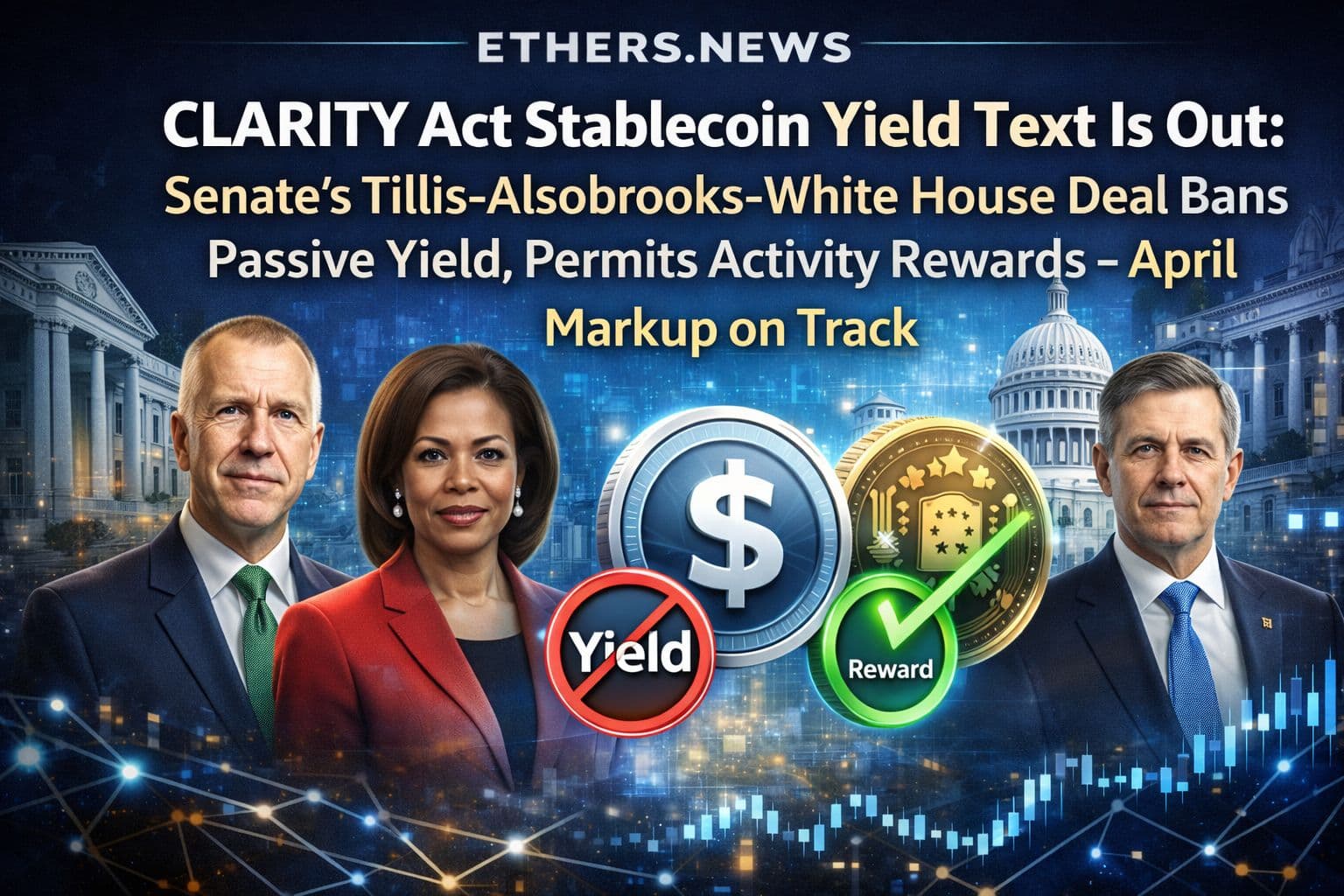
Senate's Stablecoin Yield Deal Is Sealed: The CLARITY Act's Tillis-Alsobrooks-White House Compromise Bans Passive Yield, Permits Activity Rewards, and Sets a Late April Markup — The Most Consequential Regulatory Line in US Crypto Finance Since the GENIUS Act Is Now on Paper
On March 20, 2026, Senators Tillis and Alsobrooks, with White House adviser Patrick Witt, agreed in principle on stablecoin yield language for the CLARITY Act. Compromise text reviewed by crypto firms March 24, banks March 25. Section 404: passive yield on stablecoin balances prohibited; activity-based rewards permitted. CLARITY Act passed House 294–134 July 2025; cleared Senate Agriculture Committee January 2026. GENIUS Act (signed July 18, 2025) already bans issuer-level yield. Senate Banking markup targeted late April 2026. Senate floor deadline: May 2026. Missing May window risks legislative failure past 2026 midterms. Circle fell ~20% on yield restriction news. Coinbase stablecoin revenue: $364.1M Q4 2025. Coinbase has pushed back publicly.

EY-Parthenon and Coinbase's 2026 Institutional Survey Confirms the Structural Shift: 73% of Global Institutions Are Increasing Crypto Allocations, 86% Are Adopting Stablecoins, and Asset Manager Tokenization Interest Has Surged 60% Year-on-Year — Volatility Sharpens Discipline Rather Than Dampening Conviction
The 2026 EY-Parthenon and Coinbase survey (351 institutional investors, January 2026): 73% plan to increase crypto allocations in 2026; 74% expect prices to rise in 12 months. 86% use or explore stablecoins — 85% cite payments/treasury as primary use cases. USDC overtook USDT as most-used stablecoin. 83% say GENIUS Act will increase financial institution stablecoin engagement; 69% expect broader stablecoin transaction adoption. Asset manager tokenization interest: 40% (2025) to 64% (2026). 63% interested in tokenized assets. 78% cite market structure as top regulatory clarity need. 81% favor regulated spot vehicles. 66% prioritize compliance/security in custody. 61% use multi-custodian strategies.

Senate Votes 89–10 to Block the Federal Reserve's Digital Dollar Until 2030 — America's Most Bipartisan Crypto Vote Is Hidden in a 302-Page Housing Bill
On March 12, 2026, the US Senate passed the 21st Century ROAD to Housing Act 89–10. Embedded within the 302-page housing bill is a landmark provision prohibiting the Federal Reserve from issuing a CBDC directly or indirectly until December 31, 2030. The ban forbids pilot programs without explicit Congressional approval and requires Congressional Financial Technology requirements for any future digital dollar initiative. Private stablecoins including USDC and USDT are explicitly excluded. H.R.1919 (Anti-CBDC Surveillance State Act) passed the House 219-210 on July 17, 2025. Senator Ted Cruz sought a permanent ban but his standalone amendment failed. The bill now goes to the House for reconciliation. Trump signed an executive order halting CBDC research in January 2025. Circle and Tether are positioned to benefit from the stablecoin tailwinds.

Resolv Protocol's $25M AWS Key Compromise: How a $100K USDC Deposit Generated 80 Million Unbacked USR, Crashed the Stablecoin 95%, and Delivered DeFi's Clearest Warning Yet About Off-Chain Admin Key Security
On March 22, 2026, an attacker compromised Resolv Labs' SERVICE_ROLE private key — stored on Amazon Web Services — and used it to mint 80 million unbacked USR tokens using $100K–$200K in USDC. USR crashed 95.2% from $1.00 to $0.04751. The attacker extracted ~$23–$25M in ETH (9,100–11,409 ETH). Resolv had $500M+ TVL pre-hack. The SERVICE_ROLE was controlled by a single EOA with no multisig. The minting contract had no oracle checks, no amount validation, and no maximum mint cap. Resolv Labs paused all protocol functions and burned ~9M USR. Aave and Euler confirmed no exposure. Root cause: compromised AWS off-chain signer, not smart contract code.
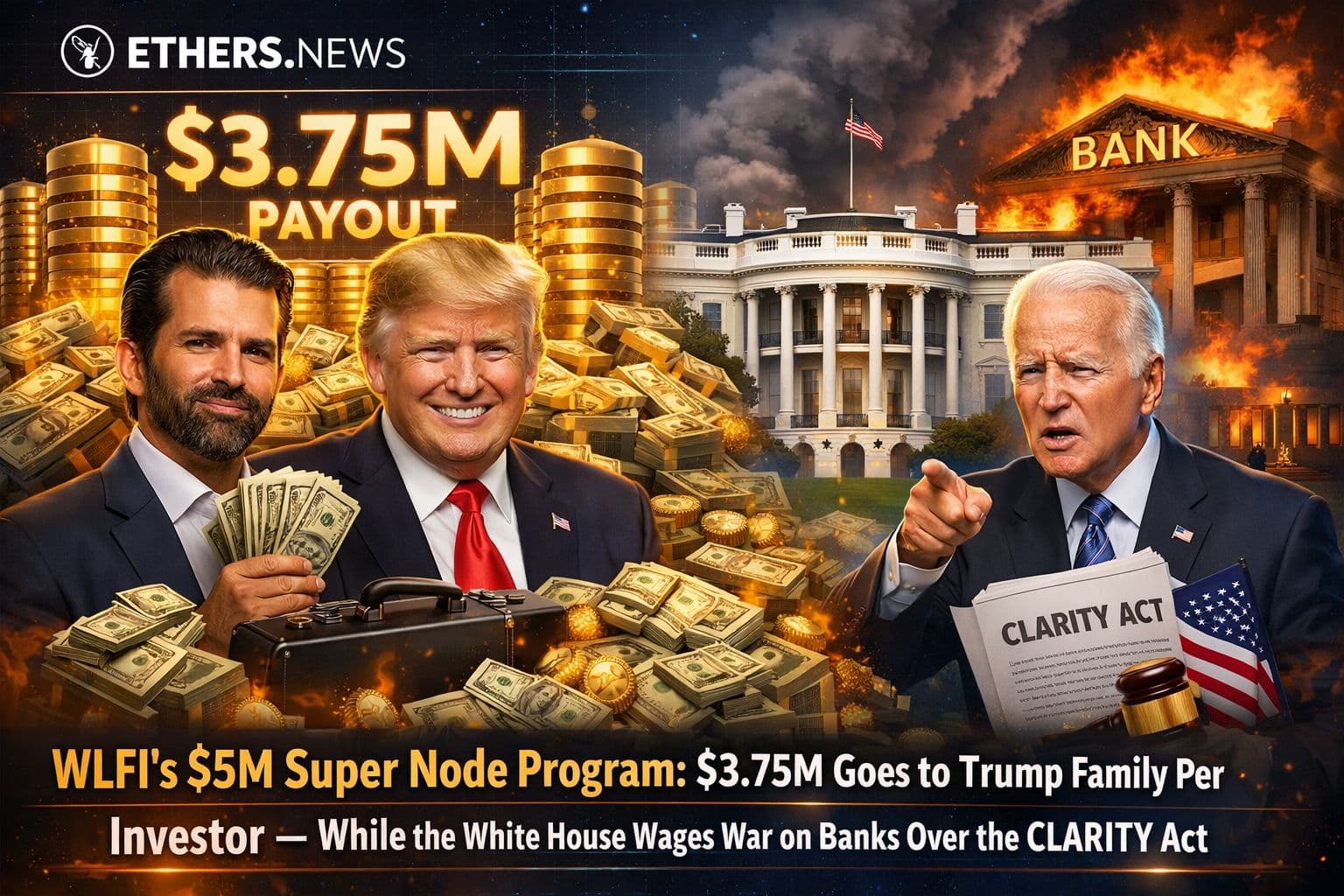
WLFI's $5M Super Node Program Sends $3.75M Per Investment to the Trump Family — As the White House Simultaneously Wages Open War on Banks Over the CLARITY Act's Stablecoin Yield Provisions
World Liberty Financial — the crypto venture co-founded by President Donald Trump, Eric Trump, Donald Trump Jr., and Barron Trump — launched its $5 million Super Node program on March 14, 2026, requiring investors to stake 50 million WLFI tokens for 180 days in exchange for priority executive access, governance voting rights, and a 2% WLFI token yield. Under WLFI's 75% token-sale distribution to Trump family entities, each $5 million Super Node investment sends approximately $3.75 million directly to the Trump family. WLFI has generated at least $1.2 billion in cash and $2.25 billion in paper gains for the Trump and Witkoff families since November 2024, per Wall Street Journal analysis. WLFI applied for a US banking charter through OCC in March 2026. Concurrently, the White House is openly accusing the banking lobby of "hijacking" the CLARITY Act over stablecoin yield — a bill that, if passed, would materially benefit WLFI's own planned stablecoin products.

Tether's $4.2 Billion Enforcement Record: The World's Largest Stablecoin Has Frozen More Illicit Funds in Three Years Than Most Nations Seize in a Decade
Tether disclosed on February 27, 2026 that it has frozen $4.2 billion in USDT linked to criminal activity — with $3.5 billion of that total immobilized since January 2023. The disclosure followed a $61 million DOJ-assisted pig-butchering fraud action, a $500 million Turkey illegal gambling and money laundering freeze earlier in February, and a $182 million Tron wallet freeze in January. Elliptic's data shows stablecoin issuers have collectively blacklisted 5,700 wallets. With 84% of illicit crypto transactions passing through dollar-pegged stablecoins and USDT operating at $11.9 trillion in quarterly on-chain volume, the compliance question has become the defining governance challenge of the global stablecoin industry.

The Rulebook Has Arrived: OCC Drops 376-Page GENIUS Act Stablecoin Framework — Bank-Grade Capital, Yield Prohibition and a $5M Floor That Will Reshape the $200B Stablecoin Industry
The OCC's 376-page proposed rule under the GENIUS Act — published February 25, 2026 as NR-OCC-2026-9 — is the first comprehensive federal stablecoin implementing regulation in US history. It requires 1:1 reserve backing, imposes a $5 million minimum capital floor for de novo issuers, mandates a formal bank-charter-style licensing application, and introduces a near-blanket yield prohibition backed by a rebuttable presumption that places Coinbase's USDC rewards program directly in the regulatory crosshairs. A 60-day public comment period runs until approximately May 1. This document will reshape the economics and competitive structure of the $200 billion stablecoin industry.

America's Crypto Reckoning: The CLARITY Act's March 1 White House Deadline Arrives — What the Most Consequential Digital Asset Bill in US History Means for Bitcoin, DeFi and Institutional Capital
The White House's March 1, 2026 internal deadline to resolve the stablecoin yield dispute holding up the Digital Asset Market Clarity Act has arrived. The Senate Banking Committee has already passed its component. SEC Chairman Paul Atkins publicly endorses the bill. Treasury Secretary Scott Bessent has urged Spring passage. Ripple CEO Brad Garlinghouse gives it 80% odds of enactment by April. Polymarket odds have surged. The CLARITY Act is the most consequential digital asset legislation in US history — and its final obstacle is a single question that has divided the crypto industry from traditional banking for months.

USDC's Unstoppable Quarter: Circle Shares Surge as Q4 Results Shatter Wall Street Estimates
Circle Internet Group demolished analyst estimates in Q4 2025 — $770 million in revenue up 77% year-over-year, adjusted EPS of $0.43 against a consensus of $0.35, and USDC in circulation growing 72% to $75.3 billion. Shares surged sharply in pre-market trading on February 25, 2026, in the company's most powerful earnings performance since its blockbuster NYSE debut in June 2025. For the stablecoin sector, the message from these numbers is unambiguous: regulated digital dollar infrastructure is not a coming opportunity — it is an already-exploding revenue reality.

The Ghost of Libra Is Gone: How Meta Is Quietly Building a Payments Empire It Will Never Call Crypto
Meta killed Libra and buried Diem — but it never abandoned the ambition. In 2026, it is rebuilding a global payments infrastructure across its 3.3 billion daily active users through WhatsApp Pay, Instagram checkout and Messenger peer-to-peer transfers, this time without uttering the word crypto once. The strategy is deliberate, the infrastructure is real, and the regulatory lesson from 2019 has been fully absorbed. What emerges looks less like a tech company doing payments and more like a bank that refuses to call itself one.

Dollar on the Blockchain: Trump's Board of Peace Eyes Stablecoins as the Financial Rail for Gaza's Rebuilding
Trump's Board of Peace is reportedly exploring USD-backed stablecoins to power Gaza's reconstruction economy — a move that would simultaneously solve the territory's banking exclusion problem and deepen American financial influence through blockchain infrastructure.

X Trading & X Money Countdown: Elon Musk’s ‘Everything App’ Is About to Go Live
Years after Elon Musk promised to turn Twitter into an “everything app,” crypto and stock trading on X is finally moving from rumor to countdown: product lead Nikita Bier says Smart Cashtags with in‑feed trading will roll out “in a couple of weeks,” while X Money — the platform’s Visa‑backed wallet and payments rail — is shifting from internal to external beta with a limited public launch targeted within the next two months. For a platform boasting more than a billion users, that combination could turn timelines into trading terminals and make X one of the most powerful on‑ramps into Bitcoin, DOGE and other digital assets in 2026.

Q2 2026 Crypto Regulatory Countdown: How Two Landmark U.S. Rulesets Could Reshape Global Markets
As Q2 2026 approaches, the crypto industry faces a pivotal regulatory moment. Two landmark U.S. rulesets — the GENIUS Act’s stablecoin framework and the CLARITY Act’s digital asset market-structure reforms — are moving from legislative text to practical enforcement, with implications that will reverberate across global markets and interact with Europe’s MiCA regime and new Basel banking standards.

Stablecoin Vulnerabilities: The Hidden Risks Threatening Crypto's $200B Lifeline
Stablecoins underpin $200B+ in DeFi TVL and trillions in annual volume, but Chainalysis reports $3.41B stolen in 2025 alone through exploits, phishing, and bridge hacks—making them the crypto ecosystem’s most targeted asset class. The Saga 2026 exploit, which depegged its stablecoin to $0.75 and wiped 55% of TVL in 24 hours, exemplifies cross‑chain vulnerabilities in modular ecosystems, while classics like Euler ($197M) and Curve ($100M+) expose smart contract flaws that persist despite audits.

FCA's Stablecoin Sandbox Goes Live: UK Positions for Regulated Crypto Payments Leadership
The Financial Conduct Authority (FCA) has launched a stablecoin-specific cohort within its flagship Regulatory Sandbox, inviting issuers to test live GBP-pegged stablecoins under supervision—ahead of the full regime rollout expected in late 2026. With applications closed on January 18, selected firms are now live-testing issuance, redemption, and payments using real market data, directly informing prudential rules, reserve requirements, and consumer protections for what FCA Executive Director David Geale calls a "priority" for faster, more convenient UK payments.

MiCA Stablecoin Cliff: EU Set to Lock Out Non‑Compliant Tokens on March 1, 2026
As the EU’s MiCA rulebook moves from theory to enforcement, March 1, 2026 has emerged as a de‑facto “stablecoin cliff” date: by then, EU‑facing businesses must either use MiCA‑authorised ARTs and EMTs through fully licensed payment setups, or restrict non‑compliant tokens to tightly controlled sell‑only wind‑downs. With the ECB estimating stablecoins at roughly 8% of the entire crypto market—about $280 billion in value dominated by USDT and USDC—this shift will reshape payouts, trading, and treasury operations across Europe’s crypto economy.

Stablecoins in Business: The 2026 Revolution Transforming Global Operations
Stablecoins have matured into essential business infrastructure in 2026, powering instant cross-border payments, programmable treasury management, supply chain automation, and AI-driven micropayments for enterprises worldwide. With $300B+ in market cap and regulatory clarity from MiCA, GENIUS Act, and FCA priorities, companies like Shopify, JPMorgan, Stripe, and Visa leverage USDC, PYUSD, and USDT to slash costs by 80%, eliminate remittance friction, and unlock $4T in tokenized opportunities.