
Dollar on the Blockchain: Trump's Board of Peace Eyes Stablecoins as the Financial Rail for Gaza's Rebuilding
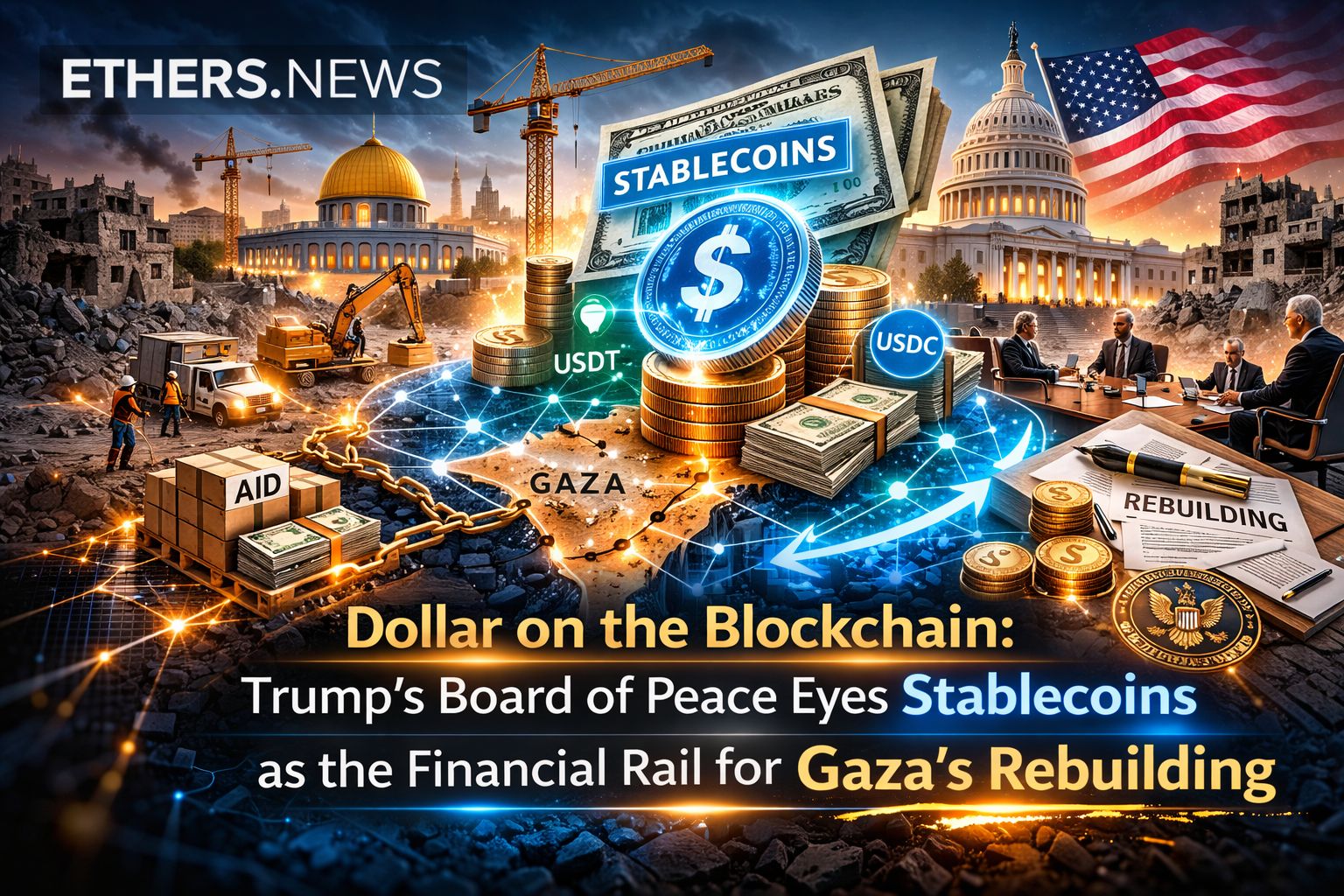
The intersection of geopolitics and digital finance rarely arrives with this much strategic weight. The Trump administration's newly constituted Board of Peace — the advisory body tasked with developing the United States' reconstruction blueprint for Gaza following the ceasefire agreement — is actively exploring whether USD-pegged stablecoins could serve as the foundational financial infrastructure for disbursing reconstruction aid, paying contractors, and establishing a functional payment economy in a territory that has been almost entirely cut off from the global banking system for years. If implemented, it would represent the largest and most geopolitically consequential deployment of blockchain-based stablecoins in history — and a defining signal of where the Trump administration intends to take U.S. digital currency policy on the world stage.
What Is the Board of Peace and Why Is It Exploring Crypto?
The Board of Peace was established under President Donald Trump's second-term Middle East diplomatic architecture, designed as a civilian-led advisory and coordination body to oversee post-conflict reconstruction in Gaza following the January 2025 ceasefire. The Board operates under the broader oversight of the administration's Special Envoy for the Middle East, Steve Witkoff, and draws on both government agency representation and private sector expertise. Its mandate is explicitly economic as much as political: to design a reconstruction finance model that is implementable rapidly, resistant to corruption, and capable of operating in a territory where conventional banking infrastructure has been largely destroyed or rendered inaccessible.
That last requirement — operating without conventional banking — is where stablecoins enter the equation with logical force. Gaza's financial sector was already deeply constrained before the 2023–2025 conflict. The Palestinian banking system operated under severe restrictions, with most international correspondent banking relationships severed due to compliance risk aversion by Western financial institutions under anti-money laundering and counter-terrorist financing frameworks. By early 2025, the physical destruction of bank branches, ATM networks and payment infrastructure compounded what was already a de-facto exclusion from the global financial system. Reconstruction finance, to be effective, needs a payment rail that functions without a branch network, without correspondent banking, and without the legacy infrastructure that no longer exists. A stablecoin running on a public blockchain requires only internet connectivity and a digital wallet — both of which are far faster and cheaper to restore than a banking system.
The Stablecoin Policy Context: Trump's Washington Is Already All-In
The Gaza stablecoin exploration does not exist in a vacuum — it is a direct extension of the most aggressive pro-stablecoin federal policy posture in U.S. history. The Trump administration entered office in January 2025 with an explicit mandate to establish U.S. dollar stablecoins as the dominant global digital currency. In March 2025, President Trump signed an executive order directing the President's Working Group on Digital Asset Markets to develop a federal stablecoin regulatory framework within 180 days — a mandate that accelerated Congressional work on the GENIUS Act, a bipartisan stablecoin bill that passed the Senate Banking Committee in March 2025 and has been advancing toward a full Senate floor vote throughout the back half of 2025 and into early 2026.
The administration has been explicit about the geopolitical motivation behind stablecoin promotion. Treasury Secretary Scott Bessent testified before the Senate Finance Committee in February 2025 that stablecoins represent "a generational opportunity to extend dollar dominance into digital financial infrastructure globally before other currencies or CBDCs fill that space." The Gaza reconstruction context operationalizes exactly that thesis: by deploying USD-backed stablecoins as the payment infrastructure for a major reconstruction economy, the United States would simultaneously solve a humanitarian finance problem and cement the dollar's role as the default currency for digital finance in one of the world's most watched geopolitical theaters.
"Stablecoins are not just a financial product — they are a foreign policy instrument. Every dollar-backed stablecoin that circulates in a developing economy is a vote for the American financial system over its alternatives."
— U.S. Treasury Secretary Scott Bessent, testimony before the Senate Finance Committee, February 2025
How Stablecoins Would Actually Work in Gaza's Reconstruction Economy
The practical architecture being discussed within Board of Peace working groups centers on a multi-layered stablecoin deployment model. At the top layer, international reconstruction donors — including Gulf Cooperation Council states that have committed financial support as part of the broader peace framework, alongside European Union pledge funds and U.S. bilateral aid allocations — would convert contributions into a designated USD-pegged stablecoin through regulated issuers. USDC, issued by Circle, and potential government-endorsed instruments are the most frequently cited candidates, given their regulatory standing and compliance infrastructure.
The second layer involves disbursement: stablecoin allocations flow to verified contractors, construction firms, materials suppliers and humanitarian organizations via smart contract-governed distribution protocols. This is the transparency mechanism that makes the model compelling to donors wary of aid diversion — a persistent problem in conflict-zone reconstruction. Every disbursement is recorded permanently on a public ledger, auditable in real time by international oversight bodies, USAID counterparts, and donor governments without requiring access to the disbursing bank's internal systems. The Palestinian Authority or an internationally sanctioned successor governance body would hold a treasury wallet, with multi-signature controls requiring approvals from both Palestinian administrators and international oversight representatives before large disbursements can be executed.
Wallet Infrastructure and Financial Inclusion at the Ground Level
At the retail and civilian level, the model envisions mobile wallet distribution — smartphone applications or SIM-based wallet solutions for feature phones — that allow Gazan residents, business owners and service providers to receive payments, pay for goods and exchange stablecoins for local currency through a network of licensed exchange agents. This mirrors the model deployed successfully in conflict-affected and financially excluded economies including Ukraine's e-hryvnia aid distribution program, which used blockchain-adjacent infrastructure to disburse civilian support payments during active hostilities in 2022 and 2023. In Somalia, USAID-backed mobile money solutions demonstrated that digital payment infrastructure can reach civilians in destroyed-banking environments within weeks rather than the years required to rebuild conventional branches.
Gulf State Alignment: UAE, Saudi Arabia and the Arab Stablecoin Stack
A critical dimension of the Board of Peace's stablecoin exploration is the degree to which Gulf Cooperation Council member states — particularly the UAE and Saudi Arabia — are being consulted as co-architects rather than passive donors. The UAE has the most developed stablecoin regulatory framework in the Arab world, with the Abu Dhabi Global Market and Dubai Financial Services Authority both having licensed USD-backed stablecoin issuers and digital asset payment service providers under frameworks established in 2023 and 2024. AE Coin, a UAE dirham-backed stablecoin regulated by the UAE Central Bank, and USDC-ADGM arrangements already demonstrate the technical and regulatory maturity for stablecoin use at scale in the region.
Saudi Arabia's Public Investment Fund, which has committed to significant reconstruction finance involvement as part of the broader peace framework negotiated in early 2025, has its own digital transformation agenda under Vision 2030 that includes digital finance infrastructure. A reconstruction economy running on USD stablecoins — with Gulf states as co-issuers or co-custodians of the disbursement infrastructure — would represent a genuine multilateral digital finance architecture rather than a unilateral American imposition, giving the model the political legitimacy it requires from Arab stakeholders. That alignment is being actively cultivated at the Board of Peace level according to reporting from Axios and Bloomberg covering the Witkoff-led Middle East diplomatic track.
The Counterarguments: Sanctions Complexity, Hamas Designation and Compliance Risk
The obstacles to a stablecoin reconstruction economy in Gaza are significant and cannot be minimized by enthusiasm for the technology. The most acute is the U.S. Office of Foreign Assets Control (OFAC) sanctions framework. Hamas remains designated as a Foreign Terrorist Organization and a Specially Designated Global Terrorist entity under U.S. law, and any payment infrastructure deployed in Gaza must include technical controls robust enough to prevent stablecoin flows from reaching sanctioned individuals or entities. Circle, Tether and any other stablecoin issuer involved would face existential legal liability if their instruments were found to have facilitated transactions involving designated parties — a risk that requires sophisticated on-chain monitoring, wallet blacklisting infrastructure, and real-time OFAC screening protocols embedded at the protocol level.
Critics from the international development finance community also raise the dependency argument: building Gaza's reconstruction economy on a U.S.-dollar-denominated digital instrument further entrenches Palestinian economic dependence on a currency they do not control, issued by institutions they cannot influence, and subject to sanctions decisions made in Washington. The Palestinian Authority has historically preferred the development of a distinct Palestinian monetary identity — a discussion that has been largely academic given the absence of a functioning Palestinian central bank — but the stablecoin model forecloses that trajectory entirely in favor of dollar-denominated infrastructure.
Precedent and Pathway: What Comes After Gaza?
If the Board of Peace successfully pilots stablecoin-based reconstruction finance in Gaza, the template would be immediately applicable to other conflict-zone reconstruction contexts — Ukraine's ongoing rebuild, Sudan, Yemen — wherever conventional banking infrastructure is absent and international donor accountability requirements are high. The World Bank has estimated that Gaza reconstruction will require between USD 50 billion and USD 80 billion over a decade. Managing even a fraction of that flow through transparent, auditable, blockchain-based stablecoin infrastructure would constitute the largest proof-of-concept for digital finance in humanitarian contexts ever executed. Its success or failure will shape the entire trajectory of stablecoin adoption in sovereign and multilateral finance for the next decade.
Bottom Line
The Trump administration's Board of Peace is actively exploring USD-backed stablecoins as the financial backbone for Gaza reconstruction — a development that sits at the intersection of the administration's aggressive domestic stablecoin legislation agenda, U.S. dollar dominance strategy, and the practical necessity of building a payment economy in a territory with no functioning banking infrastructure. Treasury Secretary Bessent has publicly framed stablecoins as a foreign policy instrument for dollar extension. The GENIUS Act stablecoin bill advances through Congress. Gulf state digital finance frameworks — particularly the UAE's — provide the multilateral architecture for implementation. OFAC compliance and Palestinian economic sovereignty concerns represent the primary unresolved obstacles. Gaza's reconstruction need, estimated at USD 50–80 billion, makes this the highest-stakes stablecoin deployment ever contemplated, with global precedent implications for humanitarian finance, digital dollar policy and blockchain's role in post-conflict economies.
The Board of Peace's stablecoin exploration is arguably the single most consequential crypto policy development of 2026 that the mainstream financial press is still treating as a footnote. Let us be direct: if USD stablecoins become the default financial infrastructure for Gaza's reconstruction, the geopolitical battle over digital currency dominance — between the U.S. dollar stablecoin ecosystem, China's digital yuan, and Europe's potential digital euro — effectively ends its first major chapter with an American victory by institutional deployment rather than by regulatory debate. That is a strategic outcome the Trump administration understands deeply, which is precisely why Treasury's language around stablecoins sounds more like the State Department than the Fed. At Ethers News, we believe the technical case for stablecoins in Gaza is genuinely strong — transparent, auditable, fast to deploy, accessible without branch infrastructure — but the governance architecture must be multilateral and the compliance controls must be credible before any issuance moves forward. The technology is ready. The policy design still needs work. And the world is watching.
Key Sources and References
U.S. Treasury — Digital Assets Policy: home.treasury.gov — Official Treasury position on stablecoins, dollar dominance and digital asset frameworks
U.S. Congress — GENIUS Act Stablecoin Bill: congress.gov — Full text and committee progress of the Guiding and Establishing National Innovation for U.S. Stablecoins Act
OFAC — SDN and Sanctions Compliance: ofac.treasury.gov — Hamas FTO and SDGT designations, stablecoin issuer compliance obligations
White House — Executive Order on Digital Assets (March 2025): whitehouse.gov — Trump's digital asset and stablecoin executive order directing the President's Working Group
World Bank — Gaza Reconstruction Cost Estimates: worldbank.org — USD 50–80 billion reconstruction cost assessment for Gaza
Reuters — Trump Stablecoin Policy and Treasury Testimony: reuters.com — Bessent testimony coverage and stablecoin foreign policy framing
About the Author
Ethers News
Ether News Team - Highly dedicated to provide up to date crypto related news and upcoming events.
-At Ethers.News, we are committed to delivering accurate, transparent, and well-researched information related to cryptocurrency, blockchain, and digital assets. Our content is created for educational and informational purposes only and should not be considered financial, investment, or legal advice. We encourage readers to conduct their own research and consult with qualified professionals before making any financial decisions. Market conditions can change rapidly, and past performance does not guarantee future results. Our goal is to promote informed decision-making through responsible journalism.