
Tag: defi
Q2 2026 Crypto Regulatory Countdown: How Two Landmark U.S. Rulesets Could Reshape Global Markets
As Q2 2026 approaches, the crypto industry faces a pivotal regulatory moment. Two landmark U.S. rulesets — the GENIUS Act’s stablecoin framework and the CLARITY Act’s digital asset market-structure reforms — are moving from legislative text to practical enforcement, with implications that will reverberate across global markets and interact with Europe’s MiCA regime and new Basel banking standards.

UAE’s Hidden Bitcoin Reserve and Crypto Rulebook: The Macro Context Behind Abu Dhabi’s $1B ETF Bet
Abu Dhabi’s $1B BlackRock Bitcoin ETF position is only half the story: new Arkham Intelligence data shows UAE‑linked miners quietly holding 6,782 BTC worth about $453–454 million, with an estimated $344 million in unrealized profit, while the country’s regulators knit together one of the most comprehensive digital‑asset frameworks in the world. Taken together, the on‑chain reserve, ETF exposure and licensing sprint turn the Emirates into a front‑line macro signal for sovereign‑level conviction in Bitcoin and the broader crypto stack.

Grayscale's AAVE ETF Filing Ignites DeFi TVL Boom: Analyzing the $896M Catalyst for Explosive Growth
As DeFi TVL hits new highs with Aave leading at over $50B, the AAVE ETF emerges as a game-changer, bridging TradFi and decentralized lending for unprecedented growth. Grayscale's February 13, 2026, S-1 filing to convert its $858K Aave Trust into a spot ETF—holding AAVE tokens directly—has analysts projecting a potential 2–5x TVL boost for the DeFi lending leader, drawing parallels to BTC/ETH ETF inflows that added $57B to crypto markets. With Aave dominating 40% of DeFi lending at $15B+ TVL and $100M+ annualized revenue, ETF approval could flood the protocol with fresh liquidity, but governance centralization risks loom as institutions buy voting power.

Mortgage on the Blockchain: Better-com's Tokenized Home Loan Play Could Rewrite How America Borrows
Better.com is exploring whether home mortgages — America's largest and most illiquid asset class at over USD 13 trillion in outstanding balances — can be tokenized on-chain, opening them to DeFi liquidity pools, fractional institutional investment and automated smart contract servicing. If it works, the implications stretch far beyond one digital lender and into the structural foundations of how housing finance is originated, held, traded and settled globally.

X Turns Timelines Into Trading Terminals: Smart Cashtags, X Money and the Next Wave of Crypto Adoption
Elon Musk’s X platform is gearing up to let users trade cryptocurrencies and stocks directly from their timelines via “Smart Cashtags,” with the first rollout slated for the coming weeks and powered by a new payments layer called X Money. By fusing real‑time market data, social feeds, and an in‑app wallet backed by Visa, X is positioning itself as a WeChat‑style “everything app” that could significantly lower the friction for global crypto adoption.

Dollar on the Blockchain: Trump's Board of Peace Eyes Stablecoins as the Financial Rail for Gaza's Rebuilding
Trump's Board of Peace is reportedly exploring USD-backed stablecoins to power Gaza's reconstruction economy — a move that would simultaneously solve the territory's banking exclusion problem and deepen American financial influence through blockchain infrastructure.

Cardano’s Fast‑Track to a Spot ADA ETF: SEC’s 75‑Day Shortcut Starts the Clock
On February 9, 2026, CME Group officially launched Cardano futures, quietly starting a six‑month regulatory clock that could enable the first US spot Cardano ETF as early as August 9, 2026 — a 75‑day faster path than Bitcoin had under the prior SEC framework. Under the SEC’s new “generic futures‑based” listing standards, if ADA futures remain listed and active on a CFTC‑regulated designated contract market for at least six months, a spot ADA ETF filing can follow on a 75‑day review track rather than the 240‑day maximum window that once defined the race to bring BTC and ETH to Wall Street.

Bitcoin’s Sudden Break Below $65,000: Inside the Tariff Shock, Flow Dynamics and Critical Technical Levels
Bitcoin has abruptly broken below the $65,000 mark after a 4–5% daily slide, extending an already painful drawdown that has wiped out roughly half of its value since the October 2025 peak around $125,000. A confluence of Trump’s surprise move to hike global tariffs to 15%, renewed risk‑off in equities, heavy ETF redemptions and visible whale selling into thin weekend liquidity has dragged BTC into a technically fragile zone where $60,000–$65,000 now separates a standard cycle correction from a full‑blown trend reversal.
Supreme Court’s Trump Tariff Ruling Sends Mixed Signals to the Crypto Market
The US Supreme Court’s 6–3 decision to invalidate President Donald Trump’s emergency global tariffs under the International Emergency Economic Powers Act (IEEPA) has scrapped one of his signature economic tools and opened the door to potential refunds on more than $100 billion in duties—just as the White House races to reinstall a 10–15% blanket tariff under a different statute. Traditional markets initially cheered the legal curb on tariff powers, while crypto, which sold off sharply on earlier tariff headlines in January, has so far taken the ruling and Trump’s rapid 15% counter‑move in stride, with Bitcoin holding near $68,000 and volatility far below the panic seen during previous trade shocks.

The Ghost of Libra Is Gone: How Meta Is Quietly Building a Payments Empire It Will Never Call Crypto
Meta killed Libra and buried Diem — but it never abandoned the ambition. In 2026, it is rebuilding a global payments infrastructure across its 3.3 billion daily active users through WhatsApp Pay, Instagram checkout and Messenger peer-to-peer transfers, this time without uttering the word crypto once. The strategy is deliberate, the infrastructure is real, and the regulatory lesson from 2019 has been fully absorbed. What emerges looks less like a tech company doing payments and more like a bank that refuses to call itself one.

Grayscale's Spot AAVE ETF Filing: DeFi Goes Institutional
Grayscale Investments submitted Form S-1 to the U.S. SEC on February 13, 2026, to convert its existing Aave Trust (GAVE) into a spot exchange-traded fund, marking the first proposal to bring a DeFi lending protocol's governance token to NYSE Arca. With Coinbase as custodian and a 2.5% sponsor fee payable in AAVE, the filing—following Bitwise's December bid—ignited a 22% token rally from $106 to $128, as markets price in institutional DeFi access and potential SEC clarity on altcoin ETFs.

The Floor Holds: Bitcoin's 9% Surge Toward $70,000 Is Where Technicals and Structural Demand Finally Converge
Bitcoin has jumped roughly 9% intraday to retest the $70,000 threshold — its largest single-session percentage gain since early February — as a leverage flush, negative funding rates, and persistent spot buying at the $62,000–$65,000 demand floor converged into a classic technical squeeze. The question now is whether bulls can hold this level and convert the move into a structural breakout, or whether thin liquidity and lingering ETF outflows will allow sellers to reassert control.

FCA's Stablecoin Sandbox Goes Live: UK Positions for Regulated Crypto Payments Leadership
The Financial Conduct Authority (FCA) has launched a stablecoin-specific cohort within its flagship Regulatory Sandbox, inviting issuers to test live GBP-pegged stablecoins under supervision—ahead of the full regime rollout expected in late 2026. With applications closed on January 18, selected firms are now live-testing issuance, redemption, and payments using real market data, directly informing prudential rules, reserve requirements, and consumer protections for what FCA Executive Director David Geale calls a "priority" for faster, more convenient UK payments.

Stablecoin Vulnerabilities: The Hidden Risks Threatening Crypto's $200B Lifeline
Stablecoins underpin $200B+ in DeFi TVL and trillions in annual volume, but Chainalysis reports $3.41B stolen in 2025 alone through exploits, phishing, and bridge hacks—making them the crypto ecosystem’s most targeted asset class. The Saga 2026 exploit, which depegged its stablecoin to $0.75 and wiped 55% of TVL in 24 hours, exemplifies cross‑chain vulnerabilities in modular ecosystems, while classics like Euler ($197M) and Curve ($100M+) expose smart contract flaws that persist despite audits.
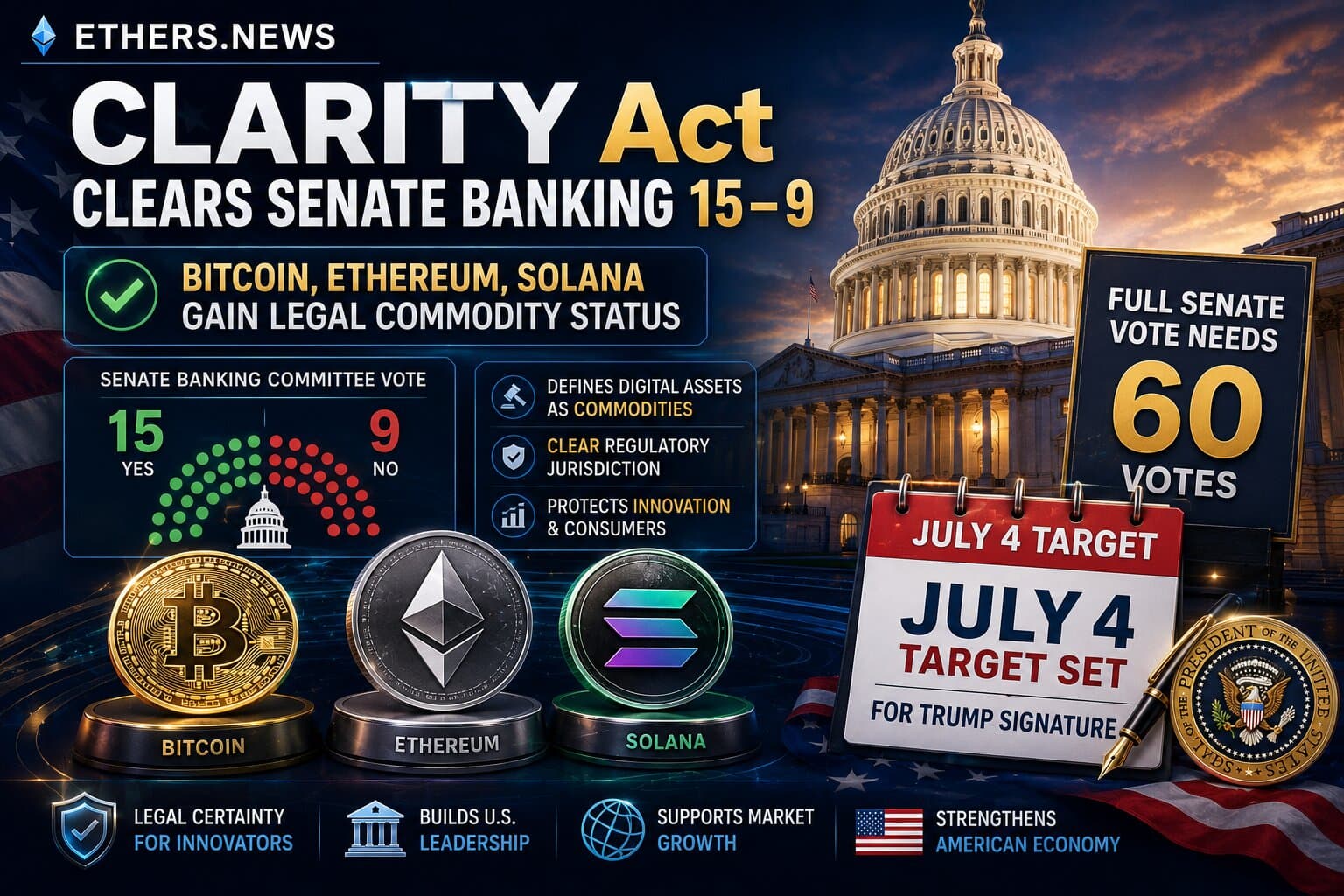
CLARITY Act Clears Senate Banking 15–9: Bitcoin, Ethereum, Solana Gain Legal Commodity Status — Full Senate Vote Needs 60, July 4 Target Set for Trump Signature
CLARITY Act Senate Banking Committee 15-9 vote May 14 2026, Bitcoin Ethereum Solana XRP permanent commodity status CFTC federal law, Ruben Gallego Angela Alsobrooks Democrat crossover CLARITY Act vote, Section 404 passive stablecoin yield ban exchanges intermediaries, CLARITY Act 60 vote Senate floor threshold July 4 Trump signature, Senate Agriculture Committee CLARITY Act merge January 2026 version, Coinbase 9 percent Strategy 8 percent Robinhood Galaxy Digital rally, CLARITY Act DeFi developer protections non-custodial protocols, GENIUS Act stablecoin issuer yield ban intermediary extension loophole, CLARITY Act House reconciliation 2025 version midterm election deadline