
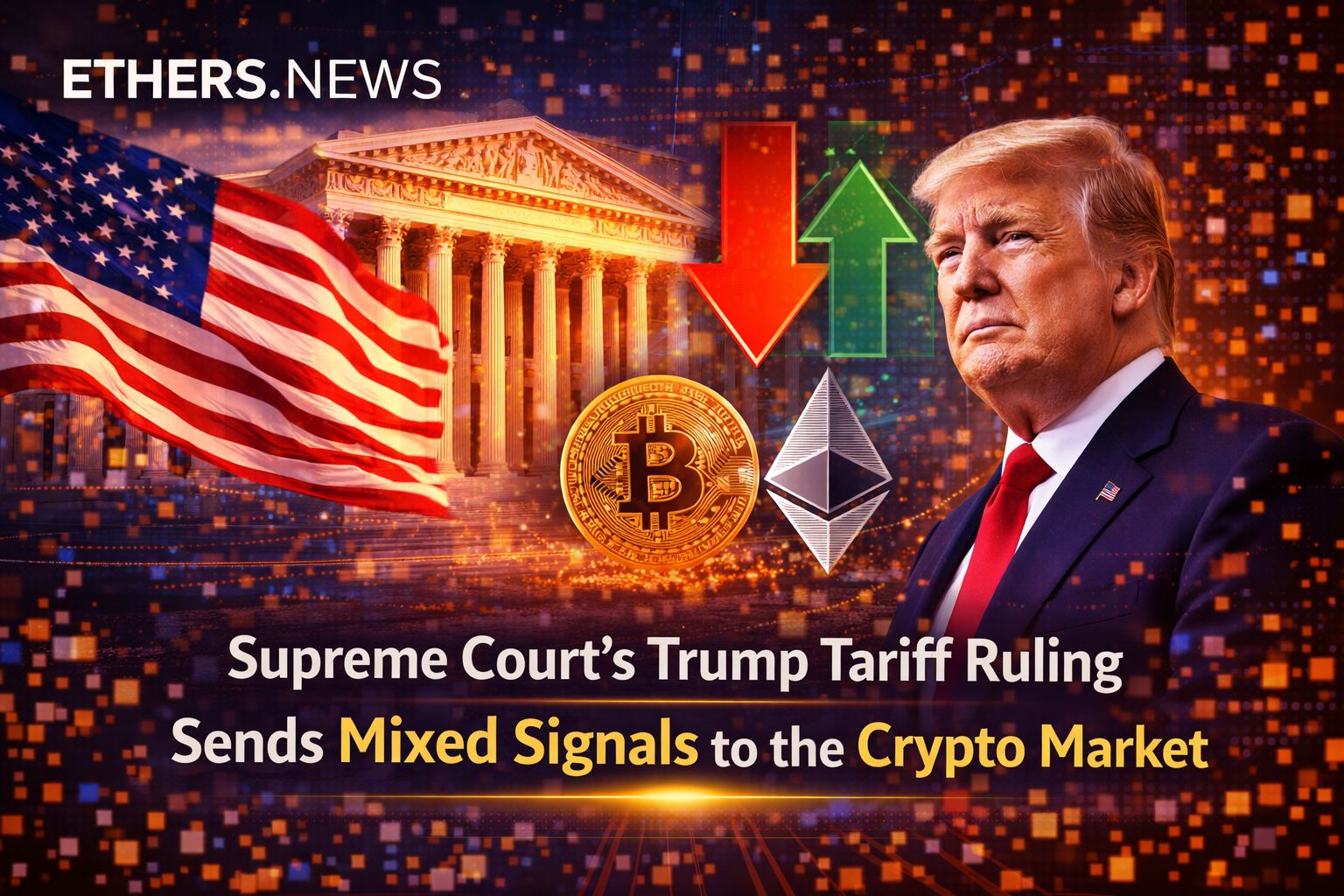
Supreme Court’s Trump Tariff Ruling Sends Mixed Signals to the Crypto Market
What the Supreme Court Actually Decided
On February 20, 2026, the US Supreme Court struck down the legal foundation of President Trump’s sweeping “reciprocal” global tariffs, ruling that IEEPA—the 1977 emergency powers statute he relied on—does not authorize the president to impose broad import duties on nearly all trading partners. In a 6–3 majority opinion written by Chief Justice John Roberts, the court held that IEEPA’s grant of authority to regulate importation in emergencies was never meant to include the power to levy across‑the‑board tariffs of the scale Trump had enacted. CNBC
The decision invalidates the most expansive part of Trump’s tariff program, which had layered a baseline 10% levy on almost all imports and higher “reciprocal” rates on countries seen as unfair traders, all justified under a self‑declared national emergency. It does not automatically resolve whether importers are entitled to refunds on duties already paid, but lower courts are now expected to grapple with claims that could exceed $100–200 billion, according to estimates cited by analysts and trade groups. Reuters
Trump’s Rapid Counter‑Move: A New 10–15% Tariff Under Section 122
Within hours of the ruling, Trump publicly denounced the justices as “fools” and “lapdogs” and promised to find “great alternatives” to keep tariffs in place, framing them as a pillar of American manufacturing and a revenue source that could “replace income tax.” The next day, he invoked an obscure provision of the 1974 Trade Act—Section 122—to impose a new 10% global tariff, later raising it to the maximum 15% allowed under that law.
Section 122 tariffs are legally distinct from the IEEPA duties the court struck down: they are time‑limited to 150 days unless Congress extends them, and they must coexist with already‑negotiated country‑specific rates, which in some cases remain higher than the new global baseline. That patchwork means trade policy is now in flux, with some exporters still facing pre‑existing negotiated rates around 19%, while others fall under the 15% blanket tariff, and lawyers warning that Section 122’s use could face its own challenges. BBC
Traditional Markets’ Reaction: Relief With Caveats
Equity markets initially welcomed the Supreme Court’s decision, which reduces the president’s ability to unilaterally escalate tariffs via emergency declarations and trims one source of headline risk for global trade. US stock indices, which had been volatile around the decision window, closed higher after the ruling, while Treasury yields ticked up modestly as investors weighed the possibility of future refund‑related government borrowing.
“Investors were broadly expecting this ruling… there’s an expectation that the administration will attempt to use other tools to impose its tariff policy. In sum, I don’t think today’s ruling is much of a market moving event.”
— Jurrien Timmer, Director of Global Macro, Fidelity Investments
Asset managers note that if courts ultimately require the Treasury to return a meaningful share of previously collected duties, the resulting fiscal hit could force higher bond issuance, reinforcing steepening pressure at the long end of the US yield curve even as trade‑policy uncertainty eases. That mix—less legal room for abrupt emergency tariffs, but lingering fiscal and supply risks—creates a nuanced backdrop for all risk assets, including crypto.
How Crypto Has Reacted So Far
January Tariff Shocks Triggered Classic Risk‑Off
The crypto market already had a taste of tariff‑driven turbulence in January, when Trump threatened new duties on eight European countries, with rates rising from 10% to 25% if a controversial side deal failed. In response, Bitcoin dropped as much as 3.6%, briefly breaking below $92,000, while Ether slid nearly 5% and Solana fell more than 8%, erasing roughly $100 billion from total crypto market capitalization in less than 24 hours.
That episode followed a familiar pattern: US equity‑index futures sold off, safe‑haven flows lifted gold and silver to record highs, and nearly $800 million in leveraged long crypto positions were liquidated as traders de‑risked across correlated assets. It underscored how tightly Bitcoin and major altcoins now trade with macro risk sentiment, particularly when headlines threaten growth, trade volumes, and inflation expectations.
February Court Ruling and New Tariffs Leave Crypto “Unfazed”
By contrast, the Supreme Court’s February 20 ruling and Trump’s subsequent 10–15% Section 122 tariff move have so far produced a much more muted response in digital assets. Commentary from major exchanges and derivatives desks on February 21 described crypto markets as “unfazed,” with Bitcoin hovering around $68,000, Ether roughly tracking broader risk sentiment, and no sign of the mass liquidations seen in January.
Part of the reason is positioning: after several weeks of ETF‑driven volatility, deleveraging, and macro uncertainty, funding rates and open interest in BTC and ETH had already normalized, leaving less hot money exposed to headline shocks. Another factor is expectations—analysts had been flagging for months that the Supreme Court was likely to rein in IEEPA tariffs and that Trump would pivot to alternative authorities, meaning the broad contours of this week’s outcome were already in many macro playbooks.
Why Trade Policy Matters for Crypto in the First Place
Even when price reactions are muted, trade policy shifts affect crypto via several channels. First, tariffs influence inflation and growth: higher import costs can push up prices and squeeze corporate margins, prompting central banks to maintain tighter monetary policy for longer, which historically weighs on high‑beta assets like BTC and altcoins. Second, tariff uncertainty amplifies equity volatility and risk‑off episodes, encouraging leveraged crypto traders to de‑risk alongside stocks and high‑yield credit.
On the other hand, persistent trade frictions and fears of currency debasement can, over time, support the narrative of Bitcoin as a non‑sovereign store of value, especially if tariffs feed into broader concerns about inflation or fiscal stress. Crypto’s reaction therefore tends to be two‑stage: a short‑term correlation with risk assets during shocks, and a slower‑burn bid from investors looking to hedge structural macro risks.
How the Ruling Changes the 2026 Macro Setup for Crypto
Less “Tariff by Tweet,” More Process
The most direct implication of the Supreme Court’s decision is that it sharply limits the president’s ability to use emergency statutes to impose sweeping, rapid‑fire tariffs without Congress, making future trade escalations slower and more procedurally constrained. For crypto, this likely reduces the frequency of sudden “tariff shock” days like those seen in April and January, when BTC and ETH plunged alongside equities on surprise announcements.
That does not mean trade tensions disappear; sector‑specific duties and more targeted measures under other laws remain on the table, and Trump’s new 15% Section 122 tariff shows his willingness to push remaining levers to the legal limit. But the path to new all‑encompassing duties is now narrower, which should modestly dampen one source of headline‑driven volatility for crypto markets over the rest of 2026.
Refunds, Yields and Liquidity
The unresolved question of tariff refunds adds a second‑order macro twist. If lower courts eventually compel the Treasury to repay tens of billions of dollars in unlawfully collected duties to importers, corporate balance sheets could see a one‑off windfall, potentially supportive for equities and risk appetite. At the same time, the government would likely need to issue more debt to plug the fiscal gap, exerting upward pressure on long‑term yields and possibly tightening financial conditions at the margin.
Crypto has tended to struggle in environments where real yields grind higher and dollar liquidity tightens, as seen in late 2025 and early 2026. If refund‑driven issuance contributes to a steeper US yield curve on top of existing borrowing needs and quantitative tightening, it could counteract some of the risk‑on relief from reduced trade‑policy uncertainty, keeping the macro backdrop choppy for BTC, ETH and high‑beta altcoins.
Short‑Term Outlook: What Crypto Traders Should Watch
In the near term, crypto traders are likely to focus on three overlapping themes. First, the actual implementation of the new 15% Section 122 tariff—how broad it is in practice, whether trading partners retaliate, and whether legal challenges emerge—will shape how much the ruling truly reduces trade‑policy risk versus simply shifting it into a new legal framework. Any surprise retaliatory measures from Europe or Asia that hit growth expectations could still trigger risk‑off waves that drag on digital assets.
Second, watch US yields and the dollar. If markets begin to price in large‑scale tariff refunds and associated issuance, long‑end Treasury yields could move higher, weighing on the most speculative parts of the crypto complex even if Bitcoin itself holds up better as “digital macro beta.” Conversely, a weaker dollar and narrowing trade‑policy tail risks tend to support global risk sentiment and could help crypto stabilize after recent ETF‑driven turbulence.
Third, sentiment around Trump’s broader economic agenda—including further tariff threats, chip‑specific duties, and ongoing battles with the Supreme Court and Congress—will influence how investors view US policy stability. A perception that institutional checks are constraining the most extreme policy swings, as this ruling suggests, is mildly positive for long‑duration, high‑volatility assets that thrive on predictable liquidity conditions.
Bottom Line: Symbolic Win, Nuanced Crypto Impact
The Supreme Court’s rejection of Trump’s emergency tariff powers is a landmark constitutional moment that trims one of the president’s most controversial economic tools and injects new uncertainty into US trade and fiscal planning. For crypto, however, the impact so far is more symbolic than seismic: markets largely priced in a legal rebuke, and Bitcoin’s calm response—even as Trump raced to reinstall a 15% global tariff through another statute—shows how much of this macro story was already in the tape.
Over 2026, the ruling’s true importance for digital assets will hinge less on one day’s headlines and more on how it shapes the trajectory of growth, inflation, yields and dollar liquidity. If trade‑policy tail risks fade and refund‑related fiscal jitters stay manageable, the decision could turn out to be a quiet positive for crypto by reducing one source of shock risk. If instead it ushers in a new phase of legal and fiscal uncertainty while Trump finds fresh ways to weaponize tariffs, traders should be ready for more macro‑driven whiplash—even if the first reaction was a shrug.
About the Author
Jeffrey Mathew
Jeffrey is a blockchain journalist for ethers.news, specializing in decentralized finance (DeFi) and Ethereum governance and Cryptocurrencies
-At Ethers.News, we are committed to delivering accurate, transparent, and well-researched information related to cryptocurrency, blockchain, and digital assets. Our content is created for educational and informational purposes only and should not be considered financial, investment, or legal advice. We encourage readers to conduct their own research and consult with qualified professionals before making any financial decisions. Market conditions can change rapidly, and past performance does not guarantee future results. Our goal is to promote informed decision-making through responsible journalism.