
Resolv Protocol's $25M AWS Key Compromise: How a $100K USDC Deposit Generated 80 Million Unbacked USR, Crashed the Stablecoin 95%, and Delivered DeFi's Clearest Warning Yet About Off-Chain Admin Key Security
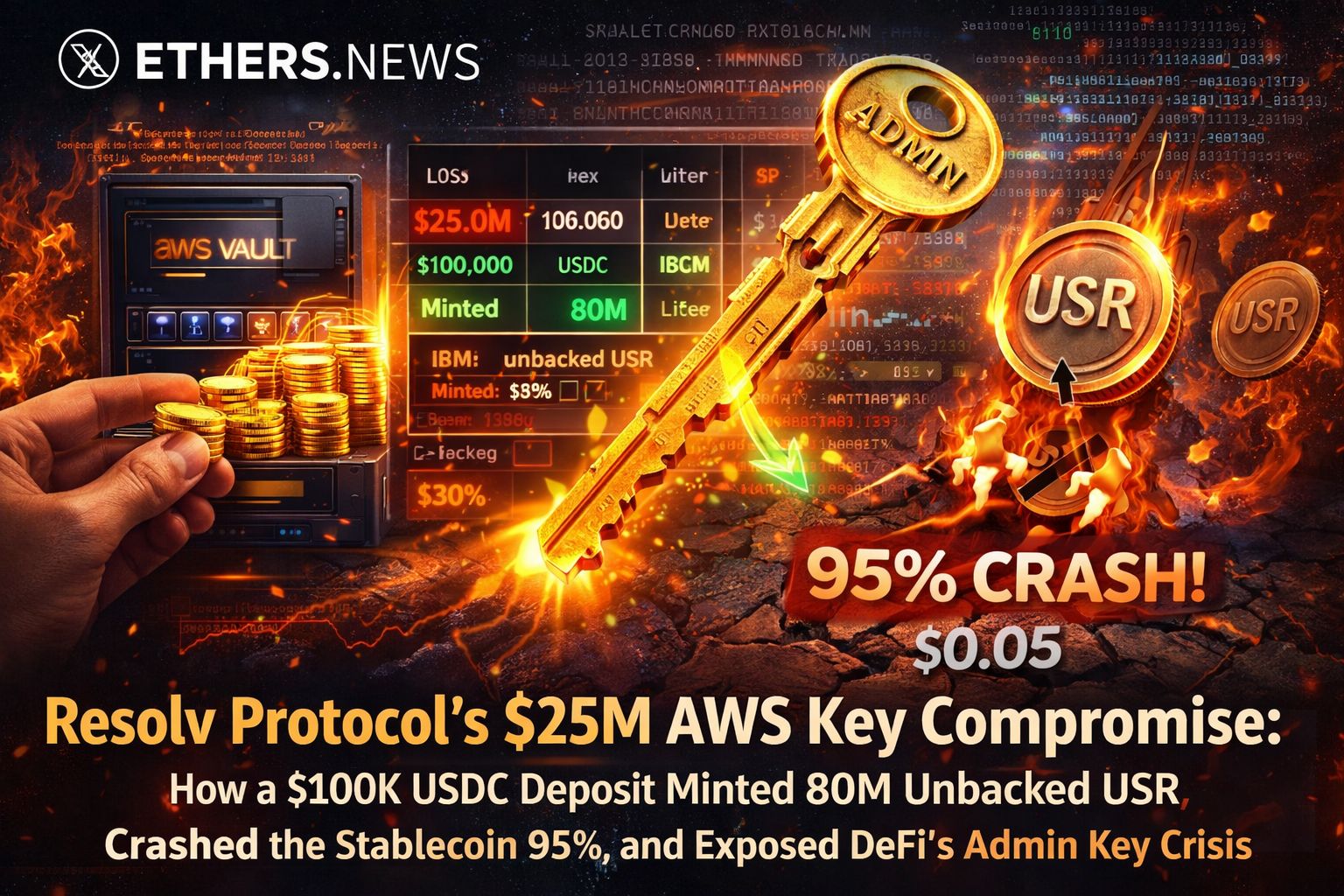
The most dangerous exploits in decentralised finance are not the ones that reveal previously unknown cryptographic vulnerabilities or breakthrough zero-day smart contract bugs. They are the ones that exploit security assumptions so basic, and governance choices so elementary, that the post-mortem reads less like a sophisticated attack narrative and more like a checklist of infrastructure decisions that should never have been made. On March 22, 2026, in the early hours of a Sunday morning, the Resolv DeFi protocol became the latest and most visceral demonstration of this principle. An attacker compromised a single private key — the SERVICE_ROLE signing key that authorised the completion of USR stablecoin swap requests — and used it to mint approximately 80 million USR tokens using between $100,000 and $200,000 in USDC collateral. They then converted those unbacked tokens into approximately $23–$25 million in real ETH, extracted the funds from the protocol, and left USR trading at $0.04751 — a 95.2% crash from its dollar peg — before Resolv Labs could execute the emergency contract pause. The protocol, which had over $500 million in total value locked before the attack, was functionally halted within minutes of detection. The damage was not theoretical or recoverable at the smart contract code level. It was the direct financial consequence of a single externally owned account holding administrative minting authority over a protocol managing hundreds of millions of dollars in user collateral.
The Attack Anatomy: How $100K Became 80 Million USR in Two Transactions
Chainalysis published the most authoritative technical reconstruction of the attack on March 21, 2026 — confirming the precise mechanical sequence that transformed a $100,000–$200,000 USDC deposit into an $80 million mint. Step one: the attacker gained control of Resolv's SERVICE_ROLE private key, which was stored in Amazon Web Services' key management service. DL News confirmed that the compromise involved "accessing Resolv's key management service on Amazon Web Services" — meaning the attack vector was not a blockchain-layer exploit but an off-chain infrastructure compromise targeting the cloud-hosted signing infrastructure that Resolv had centralised into a single administrative account. Step two: armed with the SERVICE_ROLE key, the attacker submitted two swap requests through the protocol's USR Counter contract using the standard requestSwap function, depositing a total of approximately $100,000 to $200,000 in USDC across a handful of transactions. Under normal operation, this deposit should have generated an equivalent $100,000–$200,000 in USR. Step three: the attacker then called the completeSwap function using the compromised SERVICE_ROLE key — the privileged administrative function that authorises and finalises the swap — with a critically inflated output amount parameter, authorising the minting of approximately 80 million USR tokens against the modest USDC deposit. Chainalysis confirmed: "The SERVICE_ROLE key was then used to call completeSwap with inflated output amounts, authorizing tens of millions of USR in exchange for the USDC deposits."
Three Missing Controls That Made the Exploit Possible
On-chain analyst Andrew Hong's post-attack analysis — cited by Cryptowisser and widely circulated among DeFi security researchers — identified three specific control failures in Resolv's minting architecture that collectively enabled the exploit. The first failure was structural: the SERVICE_ROLE, which held unrestricted authority to complete swap requests and authorise USR minting at any amount, was controlled by a single externally owned account rather than a multisig wallet requiring multiple independent key holders to approve transactions. A multisig structure requiring three-of-five or two-of-three key holders would have made this specific attack impossible — a single compromised key would be insufficient to execute the completeSwap call that authorised the 80 million USR mint. The second failure was mechanical: the minting contract contained no oracle checks comparing the output USR amount against the input USDC collateral value, meaning the contract performed no on-chain verification that the output amount was proportionate to the deposited collateral. In a properly designed collateralised stablecoin system, the mint function should verify that the collateral value supports the proposed mint amount — Resolv's contract skipped this check entirely. The third failure was architectural: the contract contained no maximum mint limit per transaction or per time period, meaning there was no circuit breaker that would have flagged or blocked a single transaction attempting to mint 80 million tokens against $100,000 in collateral. Any one of these three missing controls, implemented independently, would have prevented the exploit.
"The attacker started by depositing a relatively small amount (around $100K–$200K in USDC) and used it to interact with Resolv's USR stablecoin minting system. Normally, users deposit USDC and receive an equivalent amount of USR in return. However, in this case, the attacker was able to mint around 80 million USR tokens, far beyond what their deposit should have allowed. The SERVICE_ROLE key was then used to call completeSwap with inflated output amounts, authorizing tens of millions of USR in exchange for the USDC deposits."
— Chainalysis Research — published March 21, 2026, in "The Resolv Hack: How One Compromised Key Printed $23M," providing the definitive technical reconstruction of the SERVICE_ROLE private key compromise that enabled the 80 million USR mint against $100K–$200K in USDC collateral
Extraction Path: wstUSR to ETH, 9,100 Coins and $25 Million Out the Door
Once the 80 million USR tokens were minted, the attacker's extraction strategy was methodical and rapid. Chainalysis documents the sequence: the attacker first converted the freshly minted USR into wstUSR — the staked, yield-bearing variant of the token — which in the initial moments after minting still retained some redemption value before the market recognised the scale of the unbacked issuance. The attacker then progressively swapped wstUSR for other stablecoins through decentralised exchanges, converting the stablecoin exposure into liquid, exchange-tradeable assets before the protocol's emergency pause could freeze the funds. The final step was converting the acquired stablecoins into ETH — the liquid, pseudonymous, and maximally fungible asset that represents the standard extraction vehicle for DeFi exploits. KuCoin's real-time data reported that the attacker purchased approximately 9,100 ETH through the DEX swap chain, while Cryptowisser's analysis cited a figure of 11,409 ETH. The discrepancy likely reflects different on-chain tracking methodologies and partially completed swap transactions captured at different points in the attack timeline. The ETH value at extraction prices of approximately $2,500–$2,700 per coin produces the $23–$25 million final extraction figure that Chainalysis, ForkLog, KuCoin, and CCN all confirm across their respective analyses. The attacker's ETH holdings remain in the associated wallet as of March 22, 2026, with no bridge transfers or mixer activity detected in the immediate aftermath.
USR Depeg Mechanics: $0.04751 Floor, Partial Recovery, and the Collateral Pool Claim
USR's price action during and immediately following the exploit produced the most severe stablecoin depeg event of 2026 to date. KuCoin's real-time data confirmed the floor: USR crashed from its $1.00 dollar peg to $0.04751 — a 95.2% depeg — at the depth of the selling pressure created by the attacker dumping 80 million newly minted tokens onto DEX liquidity pools that had never been sized to absorb that volume. ForkLog's March 22 reporting captured USR trading at $0.44 at time of publication, reflecting partial recovery after Resolv Labs' emergency protocol pause reduced active sell pressure. MEXC's March 22 analysis noted USR at $0.20 by mid-morning on March 22, with the token's price action remaining extremely volatile as the market attempted to price the probability and timeline of Resolv Labs' announced recovery process. Resolv Labs' official statement on X, cited by Cryptowisser and Whale Alert, made a claim that analysts received with significant scepticism: "The collateral pool remains fully intact. No underlying assets have been lost. The issue appears isolated to USR issuance mechanics." This is technically accurate in a narrow sense — the ETH and derivative positions backing the broader Resolv collateral pool were not directly drained by the exploit. The exploit specifically targeted the USR issuance layer and extracted value through the minting-and-dump mechanism rather than by directly accessing the collateral vault. However, with USR trading at $0.04751 at its floor, existing USR holders had suffered 95.2% losses on a stablecoin that they held with an expectation of dollar-equivalent value — a real economic harm that Resolv Labs' "collateral intact" framing does not address.
Pre-Hack Scale, Aave and Euler Exposure Assessment, and Protocol Response
The context in which this exploit occurred is important for understanding its systemic risk implications. KuCoin confirmed that Resolv Protocol had over $500 million in total value locked before the hack — making it a significant DeFi protocol rather than a peripheral experimental project. The protocol had attracted meaningful institutional and retail capital on the basis of its overcollateralised USR design, which combined ETH collateral with delta-neutral derivatives positions to maintain its dollar peg. The immediate concern following USR's 95.2% depeg was contagion to lending protocols that had accepted USR or related LP tokens as collateral. Both Aave and Euler — two of the most prominent DeFi lending platforms — confirmed independently that they had no material exposure to the Resolv exploit, preventing a wider liquidation cascade. Resolv Labs' response sequence, as documented by Chainalysis and MEXC: the team detected the anomalous minting activity within minutes of the exploit commencing; executed an emergency pause on the relevant smart contract, freezing further minting and transfer capabilities; executed a burn transaction destroying approximately 9 million of the fraudulently created USR tokens that remained in the attacker's wallet at the time of the pause; and published an initial incident statement confirming the pause and that the collateral pool was unaffected. The team advised all users to refrain from trading USR and related liquidity pool tokens pending completion of the investigation and recovery plan publication.
Ethers News Summary and Editorial Perspective
Ethers News Summary: On March 22, 2026, Resolv Labs — operator of overcollateralised USR stablecoin backed by ETH and delta-neutral derivatives — suffered a $23–$25 million exploit via compromise of the SERVICE_ROLE private key, stored on Amazon Web Services key management service. Attack sequence (Chainalysis, March 21): attacker deposited $100K–$200K USDC; called completeSwap with inflated output parameter using compromised SERVICE_ROLE; minted 80 million USR (worth $80M); converted to wstUSR; swapped into 9,100–11,409 ETH worth $23–$25M. USR price: peak crash to $0.04751 (95.2% depeg); partial recovery to $0.20–$0.44 (ForkLog, MEXC). Three root cause failures (Andrew Hong/Cryptowisser): SERVICE_ROLE controlled by single EOA (no multisig); minting contract had no oracle/collateral ratio check; no maximum mint limit per transaction. Alternative root cause framing (MEXC, KuCoin): oracle manipulation, leaked signer key, or missing amount validation. Resolv Labs response: emergency contract pause; burned ~9M USR from attacker wallet; collateral pool "fully intact" — no underlying assets lost. Protocol pre-hack TVL: $500M+ (KuCoin). Aave and Euler: no exposure confirmed. Attacker ETH remains in wallet — no bridge or mixer activity. Official Resolv Labs statement: "The issue appears isolated to USR issuance mechanics." Sources: Chainalysis (March 21), KuCoin (March 22), MEXC (March 22), Cryptowisser (March 22), DL News (March 22), CryptoRank/CryptoPolitan (March 22), ForkLog (March 22), QuillAudits (March 22), Whale Alert (March 22), CCN (March 22).
Ethers News Editorial Opinion: The Resolv exploit is not primarily a story about a $25 million theft. It is a story about a governance architecture failure so fundamental that it will define the DeFi security conversation for the remainder of 2026. A protocol managing $500 million in user collateral gave a single externally owned account — not even a two-of-three multisig, just one private key — the unrestricted ability to authorise stablecoin mints at any amount, with no oracle check and no maximum mint cap. That is not a sophisticated attack surface. It is a single point of failure so obvious that any security audit examining the minting contract's administrative control structure would have flagged it in the first pass. At Ethers News, the detail that demands the broadest DeFi industry response is the AWS storage of the SERVICE_ROLE key. Multiple DeFi protocols — particularly newer, VC-funded ones that have moved quickly from testnet to significant TVL — are running critical administrative signing infrastructure on cloud platforms with centralised key management services. The Resolv exploit proves that a cloud infrastructure compromise translates directly and immediately into a nine-figure-scale unbacked mint event. The industry's response cannot be limited to post-mortems and bug bounties after the fact. The SERVICE_ROLE model — single EOA administrative authority over privileged minting functions in any protocol with more than $10 million in TVL — should be treated as an unacceptable governance risk. Multisig or it is not secure. That standard needs to become the minimum bar for protocol deployment, not an aspirational security improvement to be implemented after the first major exploit.
Key Sources and References
Chainalysis — The Resolv Hack: How One Compromised Key Printed $23M, March 21, 2026 (Primary Technical Source): chainalysis.com — Pull quote source; $100K–$200K USDC deposit; completeSwap inflated output; 80M USR minted; wstUSR conversion; ETH extraction; SERVICE_ROLE compromise; full attack sequence reconstruction

DL News — Resolv Labs Stablecoin Plummets 80% as Exploiter Mints Millions, March 22, 2026: dlnews.com — AWS key management service compromise confirmed; "$100K–$200K collateral"; SERVICE_ROLE access method; Chainalysis attribution

Cryptowisser — Resolv's USR Stablecoin Depegs After Attacker Mints 80 Million Unbacked Tokens, March 22, 2026: cryptowisser.com — Andrew Hong SERVICE_ROLE EOA (not multisig) analysis; no oracle checks; no amount validation; no max mint limits; 11,409 ETH extraction figure; official Resolv Labs X statement "collateral pool fully intact"

KuCoin — Resolv Protocol Hacked: $80M in USR Minted With $100K, $25M Stolen, March 22, 2026: kucoin.com — USR dumped 95.2% to $0.04751; recovered to $0.20 (-80%); 9,100 ETH purchased; $500M+ TVL pre-hack; Aave and Euler no exposure; broken oracle/compromised signer/missing validation root cause framing

MEXC — In-Depth Research Report on the Resolv Protocol Hacking, March 22, 2026: mexc.co — $100K USDC exploit; 80M USR minted out of thin air; oracle manipulation/signer leak/amount verification failure analysis; $141M current AUM; $500K confirmed loss before pause; 9M USR burned; team emergency pause

ForkLog — Hacker Attack on Resolv Crashes USR Stablecoin, March 22, 2026: forklog.com — Resolv Labs official X statement (50M USR, paused all functions); $0.44 USR partial recovery; D2 researchers 500x deposit discrepancy analysis; $100K USDC requestSwap 49.95M USR output

CryptoRank/CryptoPolitan — Resolv Hacker Sits on $25M Loot, March 22, 2026: cryptorank.io — "$200K USDC deposit; 80M USR minted" confirmed; overcollateralised stablecoin characterization; DeFi protocol loss assessment

QuillAudits — Resolv Labs $25M Exploit: Unchecked Mint Explained, March 22, 2026: quillaudits.com — Unchecked mint flaw technical analysis; step-by-step attack breakdown; DeFi prevention recommendationsAbout the Author
Ethers News
Ether News Team - Highly dedicated to provide up to date crypto related news and upcoming events.
-At Ethers.News, we are committed to delivering accurate, transparent, and well-researched information related to cryptocurrency, blockchain, and digital assets. Our content is created for educational and informational purposes only and should not be considered financial, investment, or legal advice. We encourage readers to conduct their own research and consult with qualified professionals before making any financial decisions. Market conditions can change rapidly, and past performance does not guarantee future results. Our goal is to promote informed decision-making through responsible journalism.