
WLFI's $5M Super Node Program Sends $3.75M Per Investment to the Trump Family — As the White House Simultaneously Wages Open War on Banks Over the CLARITY Act's Stablecoin Yield Provisions
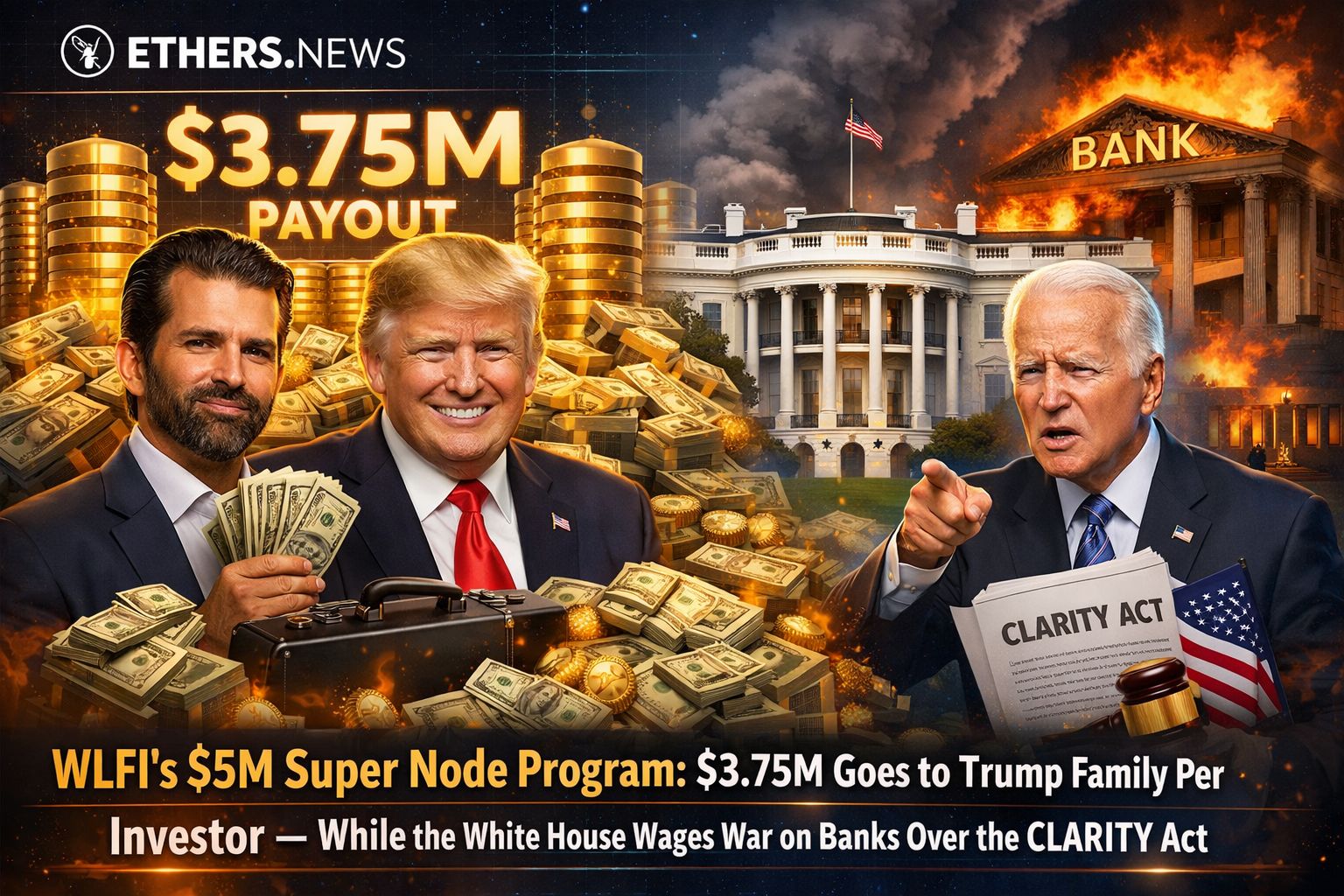
On March 14, 2026, World Liberty Financial — the cryptocurrency venture co-founded by President Donald Trump and three of his sons — announced its Super Node program: a tiered access mechanism in which investors who lock $5 million in WLFI tokens for 180 days receive "priority contact" with the company's business development team and executives, governance voting rights over the WLFI protocol, and a 2% WLFI token reward after participating in at least two governance votes. The proposal passed by a reported 99% community approval from 1,786 votes, a figure that Reuters was unable to independently verify. Under WLFI's tokenomics structure, 75% of all new WLFI token sales flow directly to a Trump family entity — meaning that the mechanics of the Super Node program, which requires investors to purchase and lock WLFI tokens, route approximately $3.75 million of every $5 million invested directly to Trump family accounts. This is not a construction of critics. It is the mathematical product of the token sale terms that Economic Times and Bloomberg have separately confirmed. The Super Node program is unfolding as the White House simultaneously pressures the US banking industry to remove its opposition to stablecoin yield provisions in the CLARITY Act — a legislative fight whose outcome would directly benefit WLFI's own planned stablecoin operations and the broader competitive positioning of crypto ventures in which the Trump family has a 75% revenue stake.
The Super Node Structure: What $5 Million Actually Buys
The Super Node program, as documented in WLFI's March 14 proposal and reported by Reuters, Economic Times, Unlock-BC, and KuCoin, creates a privileged tier of WLFI token holders who commit approximately 50 million WLFI tokens — valued at $5 million per CoinGecko data at the time of announcement — to a 180-day lock-up period. In exchange, Super Nodes receive three specific benefits: priority access to WLFI's business development team and executives to discuss "collaboration opportunities"; governance voting rights on WLFI protocol decisions; and a 2% WLFI token yield for investors who participate in at least two governance votes during the lock-up period. The name "Super Node" deliberately evokes the validator node infrastructure of proof-of-stake blockchain networks — a framing that suggests participants are performing a network infrastructure function analogous to staking validators on Ethereum or Cardano. However, WLFI's Super Nodes perform no blockchain validation function. They are governance participants and relationship-access purchasers. WLFI spokesperson David Wachsman, responding to Reuters' questions, clarified that Super Nodes "do not receive guaranteed access to founders" but instead engage with "designated business and compliance teams" — a clarification that prompted WLFI to remove the "Meet our team" section from its website, which had previously featured Eric Trump, Donald Trump Jr., and Barron Trump's photographs, following Reuters' queries about the founders' involvement in the access arrangement.
The 75% Distribution: How $3.75 Million of Every $5 Million Goes to the Trumps
The financial architecture that makes the Super Node program a direct Trump family revenue mechanism is WLFI's token sale distribution structure. Economic Times' March 13, 2026 reporting states the arrangement unambiguously: "under the terms of World Liberty's business, 75% of all new token sales go to the family of President Trump, meaning that those who have purchased $5 million of the tokens effectively sent $3.75 million to the Trumps." AOL's February 11 analysis, based on a Wall Street Journal investigation, provides the full corporate structure underlying this distribution: WLFI's disclosures show 75% of token sales flow to a Trump entity, 12.5% to the Witkoff family, and 12.5% to co-founders Zak Folkman and Chase Herro. President Trump owns 70% of the Trump entity itself, while unnamed family members own the remaining 30%. The White House legal advisor has stated publicly that Trump "had no involvement in the transaction" — a formulation that denotes operational distance rather than beneficial ownership separation, since Trump's 70% stake in the Trump entity that receives 75% of WLFI token proceeds means he receives approximately 52.5 cents of every dollar of WLFI token sales regardless of his personal involvement in individual transactions.
"The banks are holding the Clarity Act hostage over stablecoin yield. They don't want Americans earning more money on their money. If we don't pass this bill, crypto will go to China and other countries. We need CLARITY NOW!"
— President Donald J. Trump — Truth Social post, February 2026, publicly accusing the US banking lobby of blocking the CLARITY Act over stablecoin yield provisions, as reported by CoinGeek on March 11, 2026, during the ongoing White House–banking industry standoff over the Digital Asset Market Clarity Act's Senate Banking Committee stall
WLFI's Full Financial Profile: $1.4 Billion and the Abu Dhabi Deal
The Super Node program's $3.75 million per investor flow to the Trump family exists within a broader financial portrait of extraordinary scale that Wall Street Journal's investigative reporting and AOL's February 11 analysis document in precise detail. Since November 2024, WLFI has generated at least $1.4 billion for the Trump and Witkoff families combined — $1.2 billion in cash for the Trump family alone, plus $2.25 billion in paper gains from WLFI's cryptocurrency portfolio holdings. AOL notes this exceeds what Trump's entire real estate empire generated in the eight years between 2010 and 2017. The most structurally significant single transaction was on January 16, 2026, when Sheikh Tahnoon bin Zayed Al Nahyan's investment team — representing Abu Dhabi sovereign interests — purchased a 49% stake in WLFI for $500 million. The Trump family received $187 million upfront from that transaction while Witkoff entities received $31 million. A secondary financial mechanism involved Alt5 Sigma — a small Nasdaq-listed firm — in which World Liberty acquired a controlling stake. Alt5 subsequently raised $750 million from investors at $7.50 per share and directed nearly all of it into purchasing WLFI tokens at 20 cents per token — 60% above the prevailing private market price — with proceeds flowing to WLFI founders. Over $500 million from this mechanism went to Trump entities and $90 million to the Witkoffs. WLFI tokens subsequently dropped to 10 cents, and Alt5 shares fell over 75% to $1.70, with hedge funds including Point72 and Soul Ventures liquidating their positions.
WLFI Applies for OCC Banking Charter: The Regulatory Conflict of Interest
The Super Node program was announced within days of WLFI filing an application for a US banking charter through the OCC — a development that AOL confirmed on March 13, 2026. WLFI's OCC banking charter application creates a direct and explicit conflict of interest in the context of the Trump administration's crypto-friendly regulatory posture. The OCC, whose Acting Comptroller Jonathan Gould was appointed by President Trump, has in recent months approved 11 crypto bank charter applications in 83 days — including applications from Ripple, Circle, BitGo, and Fidelity Digital Assets. The Bank Policy Institute — representing JPMorgan Chase, Goldman Sachs, and 38 other major banks — is currently evaluating a lawsuit against the OCC over this charter expansion, arguing the approvals were made without proper notice-and-comment rulemaking. WLFI's application for the same OCC national trust bank charter, while the President who appointed the OCC's Acting Comptroller is simultaneously the beneficial owner of 52.5 cents of every WLFI token sale dollar, is the most direct presidential financial conflict of interest in the history of US banking regulation.
The CLARITY Act Stall: White House vs. Banks Over Stablecoin Yield
The broader legislative context for WLFI's Super Node program and OCC application is the ongoing White House-versus-banking-industry confrontation over the CLARITY Act — the Digital Asset Market Clarity Act of 2025. KuCoin's March 3 analysis documents the CLARITY Act's current status: passed by the House in July 2025 with bipartisan support of 294-134, but indefinitely stalled in the Senate Banking Committee as of March 2026 over a single irreconcilable dispute — whether platforms can pay yield or rewards to stablecoin holders. The banking lobby's position, represented by the American Bankers Association and the Bank Policy Institute, is that permitting stablecoin yield constitutes unlicensed deposit-taking that would allow crypto platforms to compete directly with insured bank deposits while operating under materially lighter regulatory burdens. Standard Chartered's analysts estimate the yield provision, if enacted, could redirect up to $1 trillion in deposits away from traditional banks toward stablecoin products by 2028 — the precise number that explains the existential quality of banking lobby opposition. CoinGeek's March 11, 2026 reporting confirms that the White House moved from mediation to open accusation, with a White House statement characterizing the banking lobby's position as "hijacking" the crypto market structure bill and President Trump's February Truth Social post directly calling out the banks by name.
FinTech Weekly's March 6 analysis documents the compromise that the White House spent weeks brokering and that the ABA subsequently rejected on March 5: allow stablecoin yield in limited contexts specifically tied to peer-to-peer payment activity, while prohibiting yield on idle balances. Crypto firms accepted the compromise. Banks did not. The ABA's rejection means the Senate Banking Committee stall continues with no clear path to resolution, as Senate Banking Committee Chairman Tim Scott has declined to schedule a markup without some form of banking industry acceptance. The conflict is now a direct White House-versus-American-banking-establishment confrontation — fought simultaneously in the Senate Banking Committee over the CLARITY Act, in the federal courts over the OCC charter expansion, and in the executive branch over the Trump administration's crypto regulatory posture.
Ethers News Summary and Editorial Perspective
Ethers News Summary: World Liberty Financial (WLFI) — co-founded by President Donald Trump, Eric Trump, Donald Trump Jr., and Barron Trump — launched its Super Node program on March 14, 2026. Investors who lock 50 million WLFI tokens (~$5 million per CoinGecko) for 180 days receive: priority access to WLFI business development and executives; governance voting rights; 2% WLFI token yield after two governance votes. Proposal passed 99% community vote from 1,786 votes (Reuters unable to independently verify). Under WLFI's 75% Trump-entity token-sale distribution: each $5M investment sends ~$3.75M to the Trump family. WLFI has generated at least $1.4B for the Trump and Witkoff families since November 2024 ($1.2B cash + $2.25B paper gains, per Wall Street Journal). Abu Dhabi Sheikh Tahnoon bin Zayed Al Nahyan purchased 49% of WLFI for $500M on January 16, 2026 — Trump family received $187M upfront. Alt5 Sigma raised $750M to buy WLFI tokens at $0.20 (60% premium); Trump entities received $500M+; Alt5 fell 75%; WLFI tokens fell to $0.10. WLFI applied for OCC banking charter in March 2026. White House accused banks of "hijacking" the CLARITY Act on March 11. CLARITY Act: passed House 294-134 July 2025; stalled Senate Banking Committee over stablecoin yield. ABA rejected White House compromise (yield on P2P payments only) on March 5. Standard Chartered: stablecoin yield could redirect $1T in bank deposits by 2028. Sources: Economic Times (March 13), AOL/WSJ (February 11), KuCoin (March 13, March 3), CoinGeek (March 11), FinTech Weekly (March 6), Unlock-BC (March 12), Phemex (March 13), Reuters via Unlock-BC.
Ethers News Editorial Opinion: The WLFI Super Node program is the most explicit illustration yet of the structural conflict of interest at the heart of the Trump administration's crypto policy. The President's family entity receives 75% of every dollar invested in WLFI tokens. The President simultaneously directs the OCC — whose Acting Comptroller he appointed — to grant banking charters to crypto firms including WLFI. The President simultaneously wages a public campaign to pass the CLARITY Act, whose stablecoin yield provisions would materially benefit WLFI's planned stablecoin products. And the President simultaneously pressures the banking lobby to withdraw opposition to the OCC charter expansion that WLFI has just applied for. At Ethers News, we are not suggesting that beneficial regulatory reform for the crypto industry is wrong because the President's family profits from it. The CLARITY Act has genuine merit for the broader crypto ecosystem, and OCC charter expansion is a substantively defensible policy. What we are noting — and what government ethics experts quoted by Reuters have flagged — is that the financial flows between WLFI's token sale architecture and the Trump family make it structurally impossible to separate regulatory motivation from personal financial interest in the current crypto policy environment. That conflation, more than any single policy decision, is the enduring governance challenge that WLFI has created for the administration that houses it.
Key Sources and References
Economic Times / BFSI Economic Times — Trump Crypto Venture Offers Guaranteed Direct Access for $5 Million, March 13, 2026: bfsi.economictimes.indiatimes.com — 75% token sale to Trump family confirmed; $3.75M per $5M calculated; Witkoffs receive portion of 25%; White House legal advisor no involvement statement

Unlock-BC — World Liberty Financial Offers $5M Super Node Access, March 12, 2026: unlock-bc.com — Eric, Donald Jr., Barron listed as Supporting Team; website section removed after Reuters questions; 1,786 votes 99%; $460M first half 2025; qualified purchasers context; banking charter application

AOL / Wall Street Journal — Trump Family-Affiliated World Liberty Financial Generated $1.4 Billion, February 11, 2026: aol.com — $1.4B total (Trump+Witkoff); $1.2B Trump cash; $2.25B paper gains; Abu Dhabi $500M deal January 16; $187M Trump upfront; Alt5 Sigma $750M mechanism; Point72 $37M; Soul Ventures $85M; Alt5 -75%; WLFI $0.10

KuCoin — Trump-Linked Crypto Project Launches $5M Super Node Program, March 13, 2026: kucoin.com — 50 million tokens; 180-day lock; 2% reward after two votes; 99% community support; White House legal advisor no involvement

CoinGeek — White House Accuses Banks of Hijacking Crypto Market Structure Push, March 11, 2026: coingeek.com — "Hijacking" accusation from White House; stablecoin rewards provision key dispute; Senate Banking Committee stall; pull quote Trump Truth Social February 2026

KuCoin — CLARITY Act Battle, March 3, 2026: kucoin.com — House 294-134 July 2025; Senate Banking Committee stalled; stablecoin yield core dispute; Standard Chartered $1T deposit redirect 2028; Trump Truth Social February post

FinTech Weekly — The Banks Are Winning One Battle, March 6, 2026: fintechweekly.com — ABA rejected White House P2P yield compromise March 5; crypto firms accepted; banks did not; Standard Chartered $1T estimate; CLARITY Act stall confirmed

AOL — Trump Family Crypto Company Applies for Banking Charter, March 13, 2026: aol.com — WLFI OCC banking charter application March 2026; Super Node investor definition $5M locked tokensAbout the Author
Ethers News
Ether News Team - Highly dedicated to provide up to date crypto related news and upcoming events.
-At Ethers.News, we are committed to delivering accurate, transparent, and well-researched information related to cryptocurrency, blockchain, and digital assets. Our content is created for educational and informational purposes only and should not be considered financial, investment, or legal advice. We encourage readers to conduct their own research and consult with qualified professionals before making any financial decisions. Market conditions can change rapidly, and past performance does not guarantee future results. Our goal is to promote informed decision-making through responsible journalism.