
Senate Votes 89–10 to Block the Federal Reserve's Digital Dollar Until 2030 — America's Most Bipartisan Crypto Vote Is Hidden in a 302-Page Housing Bill
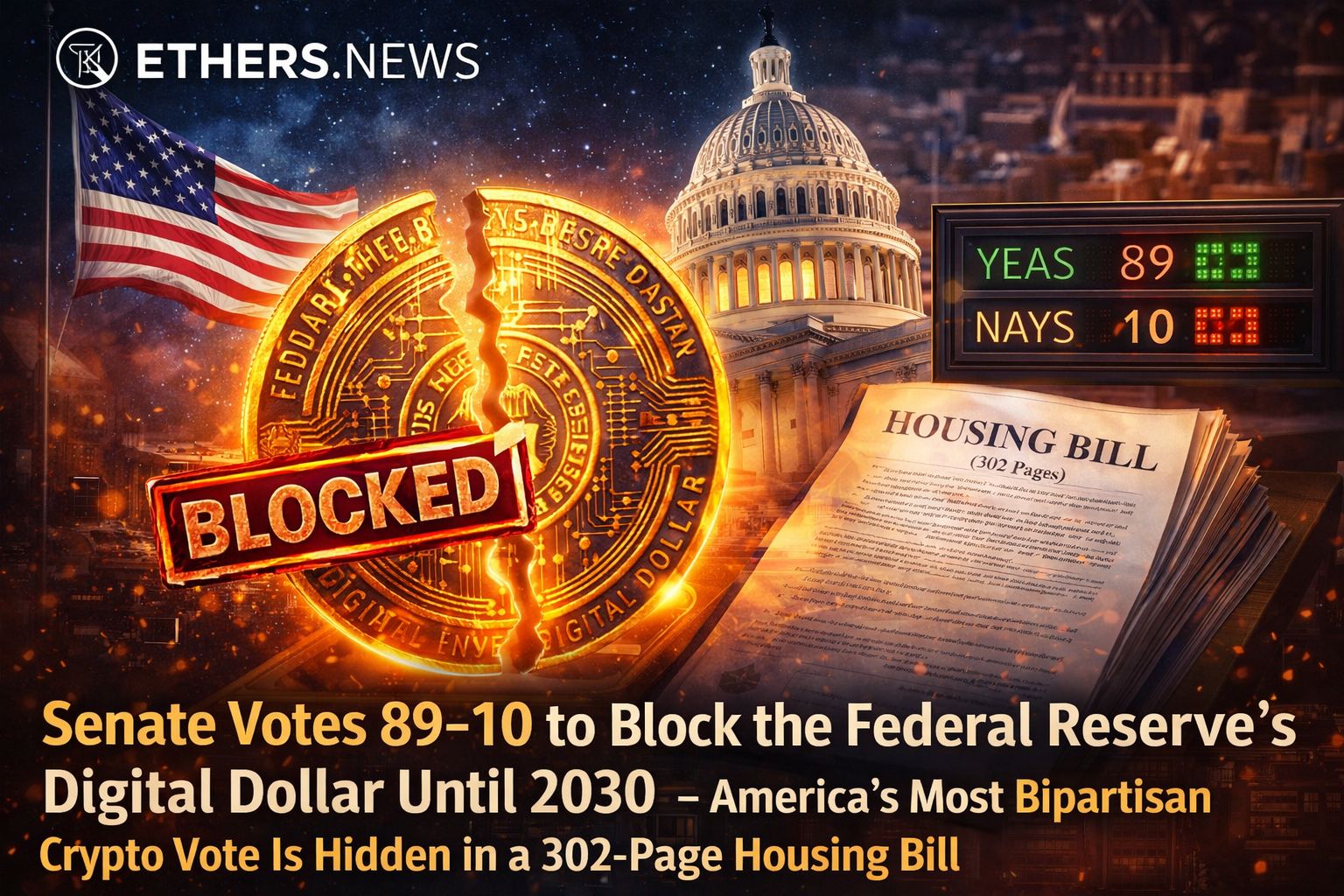
In a city defined by legislative gridlock and partisan entrenchment, a vote of 89-to-10 is not merely a majority — it is a statement of near-total institutional consensus. On March 12, 2026, the United States Senate produced precisely that: a vote that would have been unremarkable as a housing affordability measure but carried embedded within it one of the most consequential financial technology policy decisions in the history of American monetary regulation. The 21st Century ROAD to Housing Act — a 302-page bill addressing affordable housing construction, zoning reform, and Federal Housing Administration financing — contains a provision, buried in its final sections, that prohibits the Federal Reserve from issuing a central bank digital currency until December 31, 2030. The prohibition applies directly, indirectly through banks, and through any other financial institution intermediaries. It bans pilot programs without explicit Congressional approval. It attaches Congressional Financial Technology reporting requirements to any future digital dollar initiative the Fed might attempt after the moratorium expires. Private stablecoins — USDC, USDT, and all other dollar-denominated digital assets issued by private entities — are explicitly carved out and protected from the prohibition's scope. With 89 senators voting in favour, the measure represents the most bipartisan cryptocurrency-related vote in the history of the US Senate and the most decisive legislative action against Federal Reserve monetary technology expansion since the Federal Reserve Act itself.
What the Provision Actually Says: Direct Ban, Indirect Ban, and the Pilot Program Prohibition
The CBDC prohibition's legal text, as documented in Reddit's posting of the bill language citing Title X, Section 1001, Section 16A(b), is precise in its scope: "The Board of Governors of the Federal Reserve System or any Federal Reserve bank may not issue or create a central bank digital currency or any digital asset that is substantially similar to a central bank digital currency, either directly or indirectly, through a financial institution or other intermediary." The "or indirectly through a financial institution" clause is the provision's most technically significant component. Prior CBDC design discussions had proposed an "intermediated" model in which the Federal Reserve would issue digital dollar wholesale to commercial banks, which would then distribute it to retail customers — a structure that critics argued would achieve most of the surveillance and control capabilities of a direct retail CBDC while technically remaining "indirect." The Senate provision's explicit prohibition on indirect issuance through financial institution intermediaries closes this design loophole completely. KuCoin's March 13 analysis confirms the bill also "blocks pilot programs without Congressional approval" — meaning the Fed cannot even conduct limited-scale testing of CBDC infrastructure without first obtaining a specific Congressional authorisation for each pilot, a requirement that effectively creates a legislative veto over any future CBDC experimentation before the 2030 moratorium expires. AMBCrypto confirmed the bill also specifically failed to adopt Senator Ted Cruz's proposed amendment for a permanent ban — the 2030 end date represents the compromise that secured the 89-vote supermajority over Cruz's more aggressive permanent prohibition.
"A CBDC would give unelected bureaucrats unprecedented power over Americans' finances and threaten fundamental economic freedom. There will be no privacy, and it's a very effective government control mechanism."
— Representative Ralph Norman — statement to the Senate circulated as part of the letter from thirty Congressional signatories calling for a permanent ban on a Federal Reserve digital dollar, cited in CoinTribune's March 12, 2026 analysis of the 89-10 Senate vote on the 21st Century ROAD to Housing Act's CBDC prohibition provision, with the second sentence drawing from Ray Dalio's widely circulated description of the core CBDC surveillance risk
The Legislative Trojan Horse: A Housing Bill Carrying Monetary Policy
The strategic decision to attach the CBDC prohibition to the 21st Century ROAD to Housing Act rather than advancing it as a standalone measure is the most tactically sophisticated element of the March 12 vote. CoinTribune's analysis describes the maneuver precisely: a 302-page housing bill where monetary policy reform "hides in the last lines of the text." Senators voting in favour of the bill were, primarily, voting for affordable housing construction policy — a genuinely bipartisan priority in a Congress dealing with a national housing affordability crisis. The CBDC provision's attachment to that vehicle explains how the measure achieved 89 votes in a chamber where standalone cryptocurrency legislation routinely struggles to reach cloture. Forbes' March 13 analysis notes that this maneuver "forces the House of Representatives to clearly position itself on this thorny topic" — the House must now either accept the CBDC provision as part of the housing bill package or reject the entire bill in conference, a politically costly choice given the housing bill's broad popular support. KuCoin's reporting notes the bill may face presidential objections, with some reports of "lack of enthusiasm from the president" — despite Trump's January 2025 Executive Order having already halted federal CBDC research and the White House having issued a Statement of Strong Support for H.R.1919 in January 2026.
The Legislative Lineage: From H.R.1919 to S.1124 to the Housing Bill
The March 12 Senate CBDC provision did not emerge in isolation — it is the culmination of a two-year bipartisan legislative campaign to prohibit Federal Reserve CBDC development that had already produced one significant legislative victory. The Anti-CBDC Surveillance State Act, designated H.R.1919 and introduced by Representative Tom Emmer (R-MN), passed the House of Representatives on July 17, 2025 by a vote of 219-210 — a narrow but decisive House majority. Yahoo Finance's July 2025 reporting confirmed H.R.1919's core prohibitions: no Federal Reserve retail banking accounts for individuals, no direct or indirect CBDC issuance, and no CBDC pilot programs without future Congressional approval. The House passed H.R.1919 as part of what commentators called "Crypto Week" — the same legislative week that produced the CLARITY Act categorising digital assets as securities or commodities and the GENIUS Act establishing stablecoin regulations, creating the most concentrated burst of crypto-positive legislation in US congressional history. The Senate companion, S.1124, sponsored by Senator Ted Cruz, remained in the Senate Banking Committee through early 2026 — explaining why CBDC ban proponents sought the housing bill attachment strategy when Cruz's standalone bill failed to achieve floor priority. KuCoin's March 2026 background analysis confirms that Trump's January 2025 Executive Order, while halting active CBDC development, is reversible by any future administration — making statutory prohibition through the housing bill a durable legal protection that executive orders cannot.
Why Privacy Advocates and Crypto Libertarians Drew the Line at CBDC
The 89-10 vote's overwhelming bipartisan character reflects the unusual political coalition that anti-CBDC sentiment has assembled in the United States. CoinTribune documents the ideological core: opponents of a Federal Reserve digital dollar argue that programmable money would allow the government to tax, freeze, or monitor individual accounts in real time without judicial oversight — a surveillance capability that cuts across traditional left-right political divisions because it threatens financial privacy regardless of political affiliation. Ray Dalio's formulation — "there will be no privacy, and it is a very effective government control mechanism" — is the most frequently cited articulation of the concern, and it resonates precisely because it comes not from a crypto ideologue but from the founder of the world's largest hedge fund. The thirty Congressional representatives who signed the letter calling for a permanent CBDC ban cited the risk of "CCP-style financial surveillance" — a framing that positioned opposition to the digital dollar as a national security issue rather than merely a financial privacy question. Forbes' analysis adds that this anti-CBDC coalition spans libertarian Republicans concerned about government overreach, progressive Democrats concerned about financial discrimination and surveillance of underserved communities, and institutional financial interests concerned about Federal Reserve competition with private sector banking and payment infrastructure.
The Global Race: Digital Yuan, Digital Euro, and the US Competitive Risk
The Senate's 89-10 CBDC ban creates a strategic asymmetry in the global central bank digital currency race that not all observers view positively. While the US Senate was voting to prohibit Federal Reserve CBDC development until 2030, China's digital yuan — the e-CNY — was continuing to expand its domestic pilot programs, with over 260 million digital yuan wallets registered and active pilot programs in over 25 Chinese cities as of early 2026. The European Central Bank's digital euro project, having completed its two-year preparatory phase, is advancing toward a potential issuance decision in 2026 or 2027. KuCoin's analysis directly names the competitive risk: "The US has the risk of losing out in the world currency wars." The counterargument — which the 89 senators voting in favour of the ban have implicitly endorsed — is that the United States' strategic interest is better served by allowing private sector stablecoins to serve as the digital dollar infrastructure rather than developing a government-controlled programmable currency whose surveillance capabilities could undermine dollar adoption in free economies. CoinTribune's analysis frames this explicitly: "A decade-long ban gives private stablecoins a lead in the digital dollar market. This provides companies such as Circle and Tether with more space to grow." With Tether's USDT now exceeding $142 billion in market cap and Circle's USDC approaching $60 billion, the private stablecoin ecosystem has already created a de facto digital dollar infrastructure whose market acceptance significantly exceeds any CBDC pilot the Fed had contemplated.
Bottomline
On March 12, 2026, the US Senate passed the 21st Century ROAD to Housing Act by 89-10. Embedded provision: Federal Reserve prohibited from issuing a CBDC directly or indirectly through financial institution intermediaries until December 31, 2030 (KuCoin notes provision may extend to 2031 based on alternative bill text reading). Pilot programs barred without explicit Congressional approval. Congressional Financial Technology reporting requirements for future digital dollar initiatives. Private stablecoins (USDC, USDT, all dollar-denominated private assets) explicitly excluded. Ted Cruz's permanent ban amendment failed; 2030 moratorium was the compromise securing 89 votes. Legislative lineage: H.R.1919 (Anti-CBDC Surveillance State Act) passed House July 17, 2025 by 219-210 (Tom Emmer, R-MN); companion S.1124 (Ted Cruz) stalled in Senate Banking Committee. Trump Executive Order January 2025 halted federal CBDC research (reversible by future administration; statute is not). White House Statement of Strong Support for H.R.1919 issued January 2026. Bill now goes to House for reconciliation. Potential presidential objection noted (KuCoin). 30 Congressional representatives signed letter calling for permanent ban. Legal text: Title X, Sec. 1001, Sec. 16A(b). Context: Digital yuan — 260M+ wallets, 25+ Chinese cities. Digital euro — ECB preparatory phase complete. Tether USDT $142B+ market cap. Circle USDC ~$60B. Sources: Yahoo Finance (March 12), Forbes (March 13), AMBCrypto (March 12), CoinTribune (March 12), KuCoin (March 13), Finextra (March 12), TradeFinanceGlobal, Reddit bill text, Yahoo Finance July 2025 (H.R.1919), KuCoin March 3 (legislative background).
The 89-10 Senate vote is the most important number in American monetary technology policy in a generation — not because of what it prevents the Federal Reserve from building in the next four years, but because of what it reveals about the political consensus that has formed around the question of government-controlled programmable money. A vote of 89-10 in the United States Senate on any issue touching financial regulation is historically extraordinary. That this margin was achieved for a provision that explicitly limits Federal Reserve authority — an institution that has not faced a statutory constraint of this kind since the Humphrey-Hawkins Act — tells you that the cross-partisan coalition opposing a digital dollar has achieved a depth and stability that extends far beyond the crypto industry's lobbying infrastructure. At Ethers News, the most significant consequence of this vote is not the four-year CBDC moratorium itself — it is the signal it sends to Circle, Tether, Visa, Mastercard, and every other private sector entity competing to build the digital dollar infrastructure that the Federal Reserve is now prohibited from building. The Senate has told the market that private stablecoins are the path forward for US digital currency. That is not a neutral regulatory stance — it is an affirmative endorsement. And with the GENIUS Act establishing stablecoin regulations and the CLARITY Act categorising digital assets, the legislative architecture for a private-sector digital dollar ecosystem is taking shape faster than any government CBDC programme could have delivered it.
Key Sources and References
Yahoo Finance — Senate Overwhelmingly Passes CBDC Ban Attached to Bipartisan Housing Bill, March 12, 2026: yahoo.com — 89-10 vote confirmed; CBDC ban until 2031; 21st Century ROAD to Housing Act; bipartisan characterisation; House reconciliation next step

Forbes — The Senate Just Banned a Digital Dollar. Here Are 3 Things to Watch, March 13, 2026: forbes.com — Three implications analysis; forces House to position on CBDC; privacy/consumer stakes; 2030 ROAD to Housing Act framing

AMBCrypto — US Senate Passes CBDC Ban Amendment: Digital Dollar Plans Paused Until 2030, March 12, 2026: ambcrypto.com — 89-10 vote; March 12 date confirmed; Cruz permanent ban failed; 2030 prohibition in effect; CLARITY Act standoff context

CoinTribune — By 89 Votes to 10, the Senate Blocks the Fed's Digital Dollar Until 2030, March 12, 2026: cointribune.com — Pull quote source (Ralph Norman + Ray Dalio); 302-page housing bill; December 31, 2030 end date; stablecoins explicitly excluded; Circle/Tether beneficiaries; 30 representatives letter

KuCoin — US Senate Passes Housing Bill Banning Fed From Developing CBDC Until 2031, March 13, 2026: kucoin.com — Congressional Financial Technology requirements; pilot programs blocked without Congressional approval; two-tier banking system preservation; digital yuan competition; presidential objection noted

KuCoin — 2026 Anti-CBDC Surveillance State Act Status and Update, March 3, 2026: kucoin.com — H.R.1919 House passage July 2025 219-210; S.1124 Cruz Senate companion; White House Strong Support January 2026; Trump EO January 2025; reversibility of EO vs statute distinction; "CCP-style" surveillance framing

Yahoo Finance — House Passes Anti-CBDC Surveillance State Act, July 17, 2025: yahoo.com — H.R.1919 219-210 July 17, 2025; Tom Emmer (R-MN) introduced; "Crypto Week" context; no retail Fed accounts; no direct/indirect CBDC; no pilot programs without future Congressional approval

Reddit / Bill Text — Title X, Sec. 1001, Sec. 16A(b) exact prohibition language: — "The Board of Governors of the Federal Reserve System or any Federal Reserve bank may not issue or create a central bank digital currency or any digital asset that is substantially similar to a central bank digital currency, either directly or indirectly, through a financial institution or other intermediary"About the Author
Ethers News
Ether News Team - Highly dedicated to provide up to date crypto related news and upcoming events.
-At Ethers.News, we are committed to delivering accurate, transparent, and well-researched information related to cryptocurrency, blockchain, and digital assets. Our content is created for educational and informational purposes only and should not be considered financial, investment, or legal advice. We encourage readers to conduct their own research and consult with qualified professionals before making any financial decisions. Market conditions can change rapidly, and past performance does not guarantee future results. Our goal is to promote informed decision-making through responsible journalism.