
Tether's $4.2 Billion Enforcement Record: The World's Largest Stablecoin Has Frozen More Illicit Funds in Three Years Than Most Nations Seize in a Decade
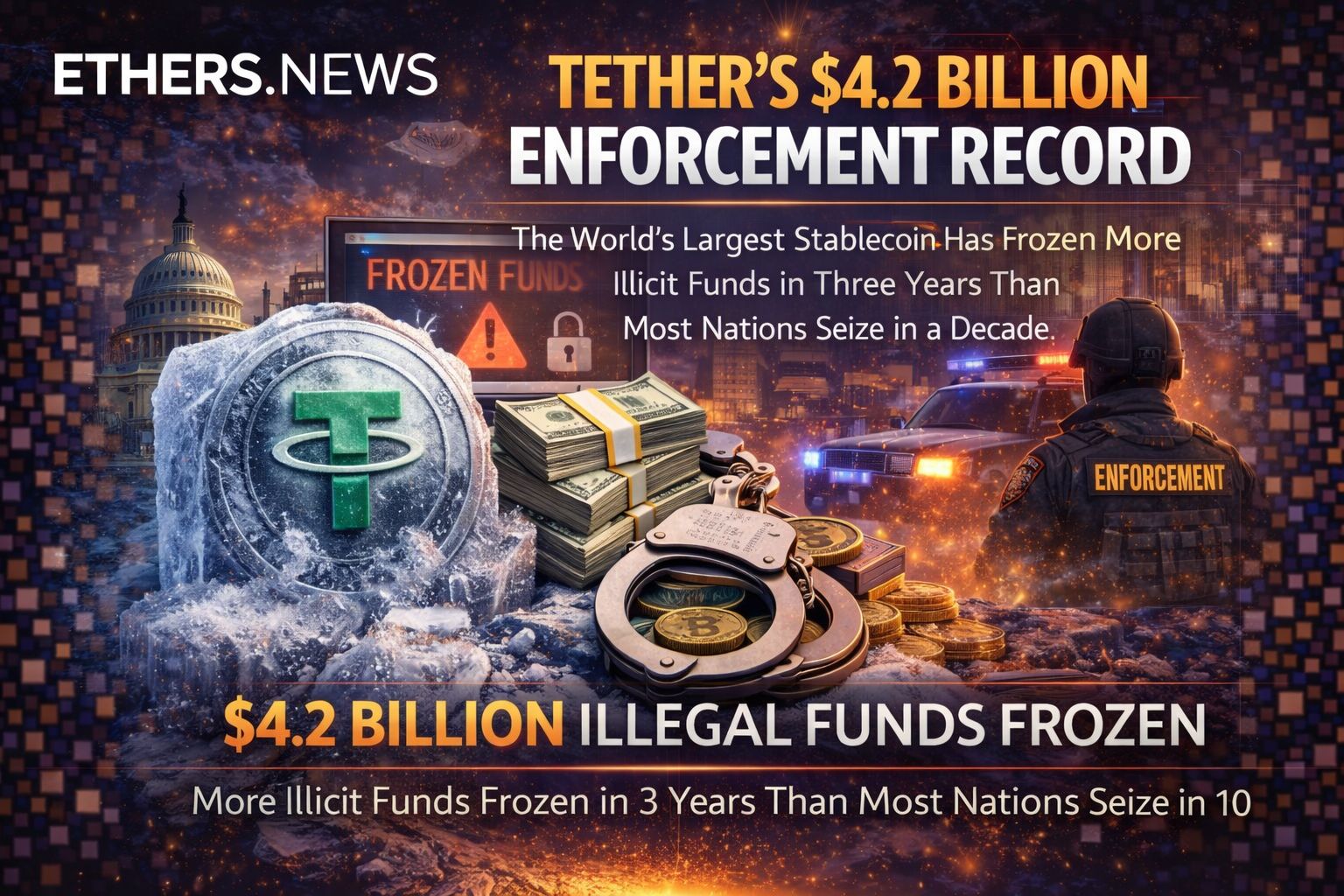
For years, Tether occupied an uncomfortable position at the intersection of two competing narratives: it was simultaneously the world's most widely used stablecoin and the most frequently cited example of the crypto industry's alleged complicity in illicit finance. Critics argued that USDT's permissionless global accessibility made it the preferred instrument of fraudsters, money launderers, sanctioned entities, and terrorist financiers. Defenders argued that Tether's cooperation with law enforcement was deeper and faster than its critics acknowledged. On February 27, 2026, Tether provided the most definitive public evidence in its history that the defender's case has quantifiable substance: a disclosure through Reuters confirming that the company has frozen approximately $4.2 billion in USDT linked to criminal activity — with $3.5 billion of that total immobilized in the three years since January 2023. The figure, which emerged in the context of Tether assisting the US Department of Justice in a $61 million pig-butchering fraud enforcement action, establishes Tether's cumulative enforcement record as one of the most significant compliance achievements in the history of digital asset markets. It also raises questions — about the architecture of centralized control embedded in a supposedly decentralized asset, about whether voluntary cooperation is a sufficient substitute for formal regulatory oversight, and about what comes next as the OCC's GENIUS Act rulebook makes stablecoin compliance mandatory rather than discretionary.
The $61 Million Pig-Butchering Action That Triggered the Disclosure
The immediate catalyst for Tether's February 27 disclosure was a specific and recent enforcement action: Tether's assistance to the US Department of Justice in freezing approximately $61 million in USDT connected to a pig-butchering operation. Pig-butchering — a form of organized fraud in which scammers cultivate personal relationships with victims over weeks or months through messaging apps and romantic overtures before convincing them to invest in fabricated cryptocurrency platforms — has become one of the largest and fastest-growing fraud categories globally, generating an estimated $75 billion in losses between 2018 and 2024. Most pig-butchering operations are organized crime enterprises based in Southeast Asia — primarily in Myanmar, Cambodia and Laos — where trafficked workers are forced to operate the scam infrastructure under conditions of debt bondage and physical coercion. US News and Reuters both confirmed that Tether froze the $61 million in coordination with the DOJ, identifying the wallets through on-chain analytics collaboration. The Paypers' reporting adds that government agents in Oklahoma City separately confiscated approximately $225 million from operators of another pig-butchering scheme in the same general period — making the February 27 action part of a broader DOJ enforcement wave against the fraud category.
The $4.2 Billion Anatomy: Three Years of Accelerating Enforcement
The cumulative $4.2 billion figure requires disaggregation to be properly understood. Reuters and MEXC both confirm the critical structural data point: of the $4.2 billion total, approximately $3.5 billion — or 83% — has been frozen since the beginning of 2023. The remaining $700 million represents freezes from the period before 2023, going back to Tether's earliest enforcement cooperation. The acceleration post-2023 is directly attributable to two factors: the dramatic growth of USDT in global circulation — now at approximately $140 billion, making it larger than the money supply of several small nations — and the intensification of regulatory and law enforcement pressure on crypto platforms following the FTX collapse in November 2022, which created political and institutional momentum for comprehensive enforcement action against illicit crypto finance. AInvest's January 2026 compliance analysis places the number of wallets frozen by Tether between 2023 and mid-2025 at 7,268, representing $3.3 billion in that sub-period alone — a figure that tracks consistently with the Reuters/MEXC disclosure of $3.5 billion through the full 2023-to-present period.
The categories of illicit activity covered by Tether's enforcement record extend across the full spectrum of crypto-facilitated crime. ForkLog's February 28 reporting, drawing on Tether's own disclosed enforcement history, documents freezes connected to pig-butchering fraud, human trafficking proceeds, terrorism financing — including the freezing and reissuing of 1.6 million USDT linked to Hamas financing in Gaza at the request of the US Department of Justice — and war-related financial activity connected to conflicts in Israel and Ukraine. Brazilian authorities collaborated with Tether in blocking $6.2 million in a cross-border money laundering scheme executed through Klever Wallet. The geographic breadth of these actions — spanning the United States, Brazil, Turkey, Israel, Ukraine, and Southeast Asia — reflects both the global reach of USDT and the expanding network of law enforcement relationships that Tether has built since it first began cooperating with the FBI and DOJ in the 2021–2022 period.
"That brought its total frozen assets linked to illicit activity to $4.2 billion, of which $3.5 billion has been frozen since 2023. Tether has previously reported blocking wallets associated with human trafficking and what it describes as terrorist and war-related activity connected to conflicts in Israel and Ukraine."
— Reuters — citing a Tether spokesperson's comments sent via email, February 27, 2026 — on the total cumulative value of USDT frozen by Tether in connection with illicit activity and the acceleration of enforcement since 2023
$500 Million in Turkey, $182 Million on Tron: The February Enforcement Wave
The $61 million pig-butchering action was not an isolated event — it was the most recent in a sequence of large-scale Tether freezes concentrated in the first two months of 2026. The Paypers' March 2 analysis confirms that just two weeks before the February 27 disclosure, Tether froze over $500 million in digital assets linked to an alleged illegal gambling and money laundering operation in Turkey — making it one of the largest single enforcement-related freeze actions in the company's history and the largest cryptocurrency enforcement action in Turkish regulatory history. The Turkey freeze was executed at the request of Turkish financial authorities in coordination with international partners, and the $500 million magnitude reflects the scale of organized gambling and money laundering networks that have identified USDT as their preferred settlement currency due to its dollar-equivalence and global accessibility.
Earlier in January 2026, Tether executed a $182 million freeze across five Tron (TRC-20) network wallets — targeting between $12 million and $50 million per wallet — at the request of US law enforcement agencies. AInvest's January 11, 2026 compliance analysis documented this action as part of the same broader pattern: wallets holding between $12 million and $50 million in USDT were frozen within 24 hours of the law enforcement request, effectively removing the liquidity from circulation. The January 2026 Tron freeze built on earlier Tron-based actions: Tether froze $4.04 million in USDT on Tron in May 2025 and $12.3 million in June 2025. The concentration of enforcement actions on the Tron network is consistent with blockchain analytics data showing that Tron-based USDT accounts for the majority of illicit USDT flows globally — due to Tron's lower transaction fees and historically less stringent address screening relative to Ethereum.
Elliptic's Independent Verification: 5,700 Wallets, $2.5 Billion, 75% USDT
Tether's self-reported $4.2 billion enforcement figure is independently corroborated and contextualized by Elliptic's blockchain analytics research. ForkLog and MEXC both cite Elliptic's data showing that by the end of 2025, stablecoin issuers — primarily Tether and Circle — had blacklisted approximately 5,700 wallets holding approximately $2.5 billion at the time of freezing. Of those 5,700 wallets, approximately 75% contained USDT at the time they were frozen, underscoring Tether's dominant share of stablecoin enforcement activity relative to Circle's USDC. Elliptic's $2.5 billion wallet blacklisting figure and Tether's $4.2 billion frozen total are not contradictory — they measure different things. Elliptic's data tracks the value held in blacklisted wallets at the time of blacklisting, while Tether's $4.2 billion figure may include funds subsequently seized, redistributed, or assessed at peak values. The alignment between Elliptic's independent on-chain verification and Tether's disclosed totals provides meaningful third-party confirmation that Tether's enforcement claims are substantively accurate rather than purely promotional.
The Centralization Paradox: How Tether Freezes Work and What They Reveal
Understanding why Tether can freeze $4.2 billion in USDT requires understanding an architectural feature of stablecoin design that distinguishes it fundamentally from truly decentralized cryptocurrencies like Bitcoin or Ethereum. USDT is not a decentralized asset. It is a liability issued by Tether Operations Limited, a centralized company that controls the smart contract code governing USDT's behavior on every blockchain where it operates. Within that code is a blacklist function — a technical mechanism that allows Tether to remotely freeze the USDT balance in any specific wallet address, preventing that wallet from sending, receiving or interacting with its USDT holdings. This is functionally equivalent to a bank freezing a deposit account, with the critical differences that it can be executed globally across jurisdictions without a court order and takes effect within minutes or hours of the freeze instruction being issued. AInvest notes that this centralized control architecture has "reignited debates about regulatory risk, stablecoin liquidity, and investor confidence" — critics argue that the same technical capability that enables Tether to freeze $61 million in pig-butchering proceeds could theoretically be used to freeze any wallet for any reason, creating a compliance risk for every USDT holder globally that is qualitatively different from anything present in the Bitcoin or Ethereum ecosystems.
84% of Illicit Crypto Transactions, $140 Billion in Circulation: The Scale of the Challenge
The compliance challenge Tether's $4.2 billion enforcement record is addressing is enormous relative even to its own accomplishments. AInvest's compliance analysis documents that by 2025, stablecoins had become the primary vehicle for illicit finance in the crypto ecosystem, with 84% of illicit crypto transactions involving dollar-pegged tokens. Tether, issuing over 60% of all stablecoin supply at approximately $140 billion in USDT circulation, is at the center of that statistic. The $4.2 billion frozen over three years represents approximately 3% of USDT's current total circulation — a number that simultaneously demonstrates the scale of Tether's enforcement commitment and the scale of the ongoing challenge. As USDT supply grows — and The Paypers notes that USDT supply was set for its biggest monthly decline since the FTX collapse in the same period, creating a supply contraction context that partially modifies the growth trajectory — the absolute volume of illicit flows through the stablecoin ecosystem is likely to grow proportionally unless enforcement scales at the same rate.
Editorial Perspective
Tether disclosed on February 27, 2026, via a spokesperson statement cited by Reuters, that it has frozen approximately $4.2 billion in USDT linked to illicit activity — with $3.5 billion of that total frozen since January 2023, representing 83% of the cumulative enforcement figure. The disclosure was triggered by Tether's most recent enforcement action: assisting the US Department of Justice in freezing $61 million in USDT connected to pig-butchering fraud operations. Earlier in February 2026, Tether froze $500 million linked to an illegal gambling and money laundering network in Turkey. In January 2026, Tether froze $182 million across five Tron wallets at US law enforcement request. AInvest's analysis places the number of frozen wallets between 2023 and mid-2025 at 7,268 representing $3.3 billion. Elliptic independently confirms that stablecoin issuers have blacklisted 5,700 wallets holding $2.5 billion, with 75% containing USDT. Additional disclosed freeze categories include Hamas terrorism financing (1.6 million USDT), Brazil cross-border money laundering ($6.2 million via Klever Wallet), and human trafficking proceeds. USDT in circulation: approximately $140 billion. 84% of illicit crypto transactions involve dollar-pegged stablecoins. Tether's freeze mechanism operates via a blacklist function built into USDT smart contract code across all supported blockchains. Sources: Reuters (February 27), US News (February 27), ForkLog (February 28), FinanceFeeds (February 27), The Paypers (March 2), MEXC (February 27–March 2), AInvest (January 11, 2026), Elliptic via MEXC (March 2).
The $4.2 billion figure is simultaneously Tether's strongest argument and its most revealing vulnerability. It is the strongest argument because $4.2 billion in frozen illicit funds — executed in close coordination with the DOJ, FBI, OFAC, Brazilian authorities, Turkish financial regulators, and Israeli law enforcement — is a compliance record that most traditional financial institutions would struggle to match. Tether is not ignoring illicit finance. It is actively and demonstrably fighting it at a scale that regulators have noticed and that law enforcement has come to rely upon. The vulnerability is architectural: the same centralized control that enables that enforcement capability is the feature that makes USDT structurally different from the decentralized monetary assets it is often grouped with. At Ethers News, we believe this distinction will become the defining regulatory question of the stablecoin industry under the OCC's GENIUS Act framework. The compliance record supports the case for formal regulatory recognition of Tether as a systemically important stablecoin issuer under that framework — but formal recognition also means formal oversight, formal reserve auditing, and formal accountability for how and when the blacklist function is used. Tether has been a voluntary compliance partner. The OCC's rulebook will make compliance mandatory. The $4.2 billion proves Tether can operate at that standard. What remains to be demonstrated is whether it will submit to the auditing infrastructure that formal regulatory recognition requires.
Key Sources and References
Reuters — Tether Says It Has Frozen $4.2 Billion of Its Stablecoin Over Crime Links, February 27, 2026: reuters.com — Primary source: Tether spokesperson email; $4.2B total; $3.5B since 2023; $61M pig-butchering DOJ action; human trafficking; Israel/Ukraine terrorism war financing

US News — Tether Says It Has Frozen $4.2 Billion of Its Stablecoin, February 27, 2026: usnews.com — $3.5B since January 2023 confirmation; pig-butchering DOJ collaboration details

ForkLog — Tether Freezes $4.2 Billion in Illicit Funds to Date, February 28, 2026: forklog.com — Hamas 1.6M USDT terrorism financing; Brazil Klever Wallet $6.2M; Oklahoma City $225M pig-butchering; Elliptic 5,700 wallet blacklist data

The Paypers — Tether Freezes USD 4.2 Billion in USDT Over Illicit Use, March 2, 2026: thepaypers.com — $500M Turkey illegal gambling/money laundering two weeks before disclosure; USDT monthly supply contraction context

FinanceFeeds — Tether Freezes $4.2 Billion in USDT Linked to Illicit Activity, February 27, 2026: financefeeds.com — Dual narrative framing; voluntary enforcement vs formal regulatory need; $3.5B since 2023 confirmation

MEXC — Tether Freezes $4.2B in USDT Linked to Crime, February 27 — March 2, 2026: mexc.com — Zero-tolerance policy characterization; law enforcement direction confirmation; Elliptic 5,700 wallet / $2.5B / 75% USDT statistics

AInvest — Tether's $182M USDT Freeze on Tron and Compliance Analysis, January 11, 2026: ainvest.com — $182M Tron freeze mechanics; five TRC-20 wallets; $12M–$50M per wallet; 7,268 wallets $3.3B 2023–mid-2025; $4.04M May 2025; $12.3M June 2025; 84% illicit transactions via stablecoins; Tether 60% of stablecoin supply

BitcoinKE — Tether Has Frozen Over $4 Billion in USDT Since 2023, February 28, 2026: bitcoinke.io — Most recent enforcement reflecting increased scrutiny of crypto's role in illicit finance; technical remote-blocking confirmationAbout the Author
Ethers News
Ether News Team - Highly dedicated to provide up to date crypto related news and upcoming events.
-At Ethers.News, we are committed to delivering accurate, transparent, and well-researched information related to cryptocurrency, blockchain, and digital assets. Our content is created for educational and informational purposes only and should not be considered financial, investment, or legal advice. We encourage readers to conduct their own research and consult with qualified professionals before making any financial decisions. Market conditions can change rapidly, and past performance does not guarantee future results. Our goal is to promote informed decision-making through responsible journalism.