
Congress Holds Its Most Consequential Capital Markets Hearing in a Generation: SIFMA, Blockchain Association, Nasdaq, and DTCC Testify on Tokenization Today as the CLARITY Act Markup Window Narrows and America's $16 Trillion Securities Infrastructure Faces Its Blockchain Reckoning
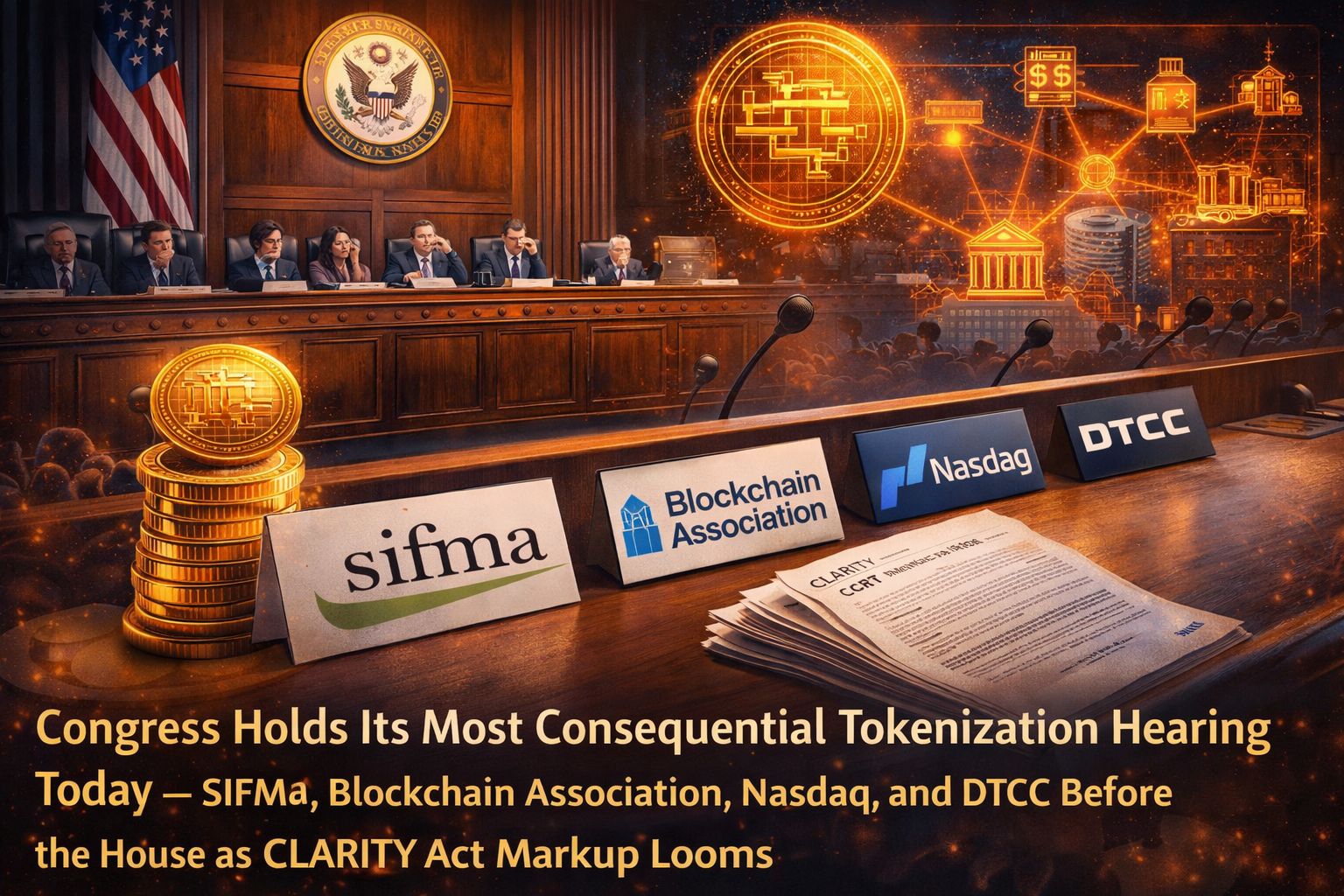
There are congressional hearings that document a debate already settled, and there are congressional hearings that determine the outcome of one still in motion. The House Financial Services Committee's March 25, 2026 full committee session — formally titled "Tokenization and the Future of Securities: Modernizing Our Capital Markets" — belongs unambiguously to the second category. Taking place today at 10:00 AM ET in Room 2128 of the Rayburn House Office Building, the session assembles the most institutionally authoritative witness list in the history of US digital asset policy: Kenneth Bentsen Jr., President and CEO of SIFMA; Summer Mersinger, CEO of the Blockchain Association; and senior executives from Nasdaq and the Depository Trust and Clearing Corporation, the central clearing and settlement institution for virtually every equity, bond, and derivative transaction executed in the United States. The hearing's official committee memorandum, published by Committee Majority Staff on March 20, confirms that the Modernizing Markets Through Tokenization Act of 2026 — a new piece of legislation whose bill number has not yet been assigned — has been formally noticed for the session. FinTech Weekly's March 22 analysis, drawing on the official committee record, describes the convergence of events surrounding this hearing as having "no precedent in US digital asset regulation." This is the hearing where the legal architecture of America's tokenized securities future is put on the record, with binding consequences for what the CLARITY Act's final text will say, and with a legislative deadline that Senator Bernie Moreno has publicly characterised as an existential window for the entire digital asset legislative agenda.
The Witness List: Why SIFMA and the Blockchain Association in the Same Room Matters
The structural significance of today's hearing begins with the two confirmed primary witnesses and what their simultaneous presence before the full committee represents. Kenneth Bentsen Jr., President and CEO of SIFMA, testifies as the representative voice of the institutions whose operational infrastructure would need to change most dramatically to accommodate tokenized securities at scale. SIFMA's membership includes the clearing houses, custodians, transfer agents, prime brokers, and trading venues that process trillions of dollars of securities transactions daily through infrastructure built for a pre-blockchain technical reality. When Bentsen testifies before the House Financial Services Committee on tokenization, he is not speaking as a crypto advocate or a blockchain enthusiast. He is speaking as the representative of the organisations that would need to integrate tokenized securities into DTCC settlement infrastructure, maintain T+0 vs T+2 settlement interoperability across hybrid markets, and redesign custody and reporting systems that have operated on centralised ledger architectures for decades. Summer Mersinger, CEO of the Blockchain Association, provides the counterweight: she has been central to both the CLARITY Act negotiations and the Blockchain Association's direct engagement with the SEC and CFTC on digital asset classification throughout 2025 and 2026. Yahoo Finance's March 23 preview confirms that alongside Bentsen and Mersinger, executives from both Nasdaq — whose SEC-approved tokenized securities proposal became effective four days before this hearing — and the DTCC — the institution whose settlement infrastructure a tokenized US securities market would either replace or require to integrate — are also testifying.
The Modernizing Markets Through Tokenization Act of 2026: What the New Bill Proposes
The formal noticing of the Modernizing Markets Through Tokenization Act of 2026 for today's session is the hearing's most significant procedural development — and the detail receiving the least attention in pre-hearing analysis. The committee majority staff memorandum, published March 20 and publicly available on docs.house.gov, specifically names the legislation alongside the hearing agenda, instructing committee members that the bill will be considered as part of the session's legislative review. The memorandum also states the hearing will "explore potential regulatory gaps, ambiguities, or duplicative requirements that could pose risks to investors or hinder innovation" and "assess the broader implications of tokenization for market integrity, investor protection, and capital formation." These are not exploratory research questions — they are the precise legislative drafting issues that the Modernizing Markets Through Tokenization Act would need to address. FinTech Weekly's analysis identifies the specific legal gap that gives the bill its urgency: every institution currently deploying a tokenized product — BlackRock's BUIDL fund, JPMorgan's tokenized collateral network, Franklin Templeton's BENJI fund, Circle's USDC-denominated settlement infrastructure — is making its own private legal determination of what a tokenized security is and which regulator holds jurisdiction over it. Without statutory backing, that determination is not secure. Each product is one enforcement action away from having that private determination overridden by a federal regulator applying a different interpretation.
"Senator Bernie Moreno has set the outer limit plainly: if the CLARITY Act does not reach the Senate floor by May, digital asset legislation may not move again for years. Wednesday's hearing does not answer whether Congress will meet it. What it does is put the legal architecture of tokenized securities on the record, with institutional witnesses, at the moment the answer matters most."
— FinTech Weekly — March 22, 2026 analysis of the House Financial Services Committee's March 25, 2026 full committee hearing "Tokenization and the Future of Securities: Modernizing Our Capital Markets," characterising the session as the most significant congressional examination of tokenization to date and mapping its position within the CLARITY Act's narrowing legislative window
The Regulatory Runway: SEC Nasdaq Approval, SEC-CFTC Taxonomy, and the Four-Day Convergence
Today's hearing does not arrive in isolation — it is the capstone of a four-day convergence of regulatory and institutional tokenization developments that FinTech Weekly describes as unprecedented in a single legislative quarter. Four days before the hearing, the Securities and Exchange Commission approved Nasdaq's proposal to allow tokenized securities to trade alongside traditional shares on the same order book — the first SEC approval of a tokenized securities trading structure by a major US exchange. Eight days before the hearing, the SEC and CFTC published their landmark joint crypto asset taxonomy — Federal Register document 2026-05635, effective March 23 — establishing the interpretive framework that determines which digital assets are securities (SEC jurisdiction) and which are commodities (CFTC jurisdiction). Twenty-one days before the hearing, the SEC and CFTC signed their historic Memorandum of Understanding on March 11, committing both agencies to coordinated oversight of dually regulated crypto and digital asset platforms. Each of these regulatory developments creates a specific question that today's witnesses must address: if tokenized equities can now trade on Nasdaq's order book, what settlement infrastructure does the DTCC need to build or modify? If the SEC-CFTC taxonomy draws a jurisdictional line between digital securities and digital commodities, where does a tokenized Treasury bond fall? If Nasdaq's approval allows tokenized securities to trade, which custodians are authorised to hold them and under what regulatory framework? The RWA tokenized asset market that has grown past $12 billion, as confirmed by FinTech Weekly, makes these questions financially material today — not hypothetical future-state considerations.
The Stablecoin Yield Deal: Tillis and Alsobrooks Remove the CLARITY Act's Final Hurdle
The legislative context surrounding today's hearing was materially improved on March 21, 2026, when Politico reported that Republican Senator Thom Tillis and Democratic Senator Angela Alsobrooks had reached an agreement in principle on stablecoin yield — the single dispute that had stalled the Digital Asset Market Clarity Act since the Senate Banking Committee cancelled its January markup. FinTech Weekly's March 20 report, which broke the yield deal's substantive terms before the text had circulated, confirms the resolution's architecture: rewards on passive stablecoin balances — paid simply for holding a token without any associated activity — will be prohibited. Activity-based rewards tied to payments, transfers, and platform use remain permitted. Alsobrooks described the deal to Politico directly as "a way to protect innovation while preventing the deposit flight that banks had argued yield-bearing stablecoins would cause." Senator Tillis characterised negotiations as being "in a good place" while noting he intends to review the final text with industry stakeholders before formalising anything. Alsobrooks' communications director confirmed separately to The Block that legislative text would be shared with stakeholders before finalisation. The substance of the compromise — permitted activity-based yield, prohibited passive yield — is precisely the framework that the White House's February mediation attempt had proposed and that the American Bankers Association had rejected in March. The Tillis-Alsobrooks deal represents a Senate-level political resolution of the same compromise that the banking lobby had previously blocked at the administrative level, suggesting the ABA's leverage over the yield question has been circumvented through direct bipartisan legislative negotiation.
The May Deadline: Bernie Moreno's Warning and the Narrowing Legislative Window
The structural urgency that frames today's tokenization hearing is Senator Bernie Moreno's explicit warning that the CLARITY Act's path to the Senate floor closes if it does not advance by May 2026. FinTech Weekly's mapping of this timeline against the official 2026 Senate calendar documents the arithmetic precisely: a late April Senate Banking Committee markup leaves the CLARITY Act with five remaining legislative steps — full committee report, Senate floor scheduling, floor debate and cloture, conference with the House, and presidential signature — that must be completed before the midterm election cycle's political calculus forecloses the bipartisan coalition that the bill currently commands. Today's House hearing accelerates that timeline by placing the bill's institutional justification on the congressional record with the most authoritative possible witnesses — creating the political foundation for a Senate Banking Committee markup in April without reopening the definitional debates about what tokenization is and why it requires statutory clarity. KuCoin's March 24 daily market report specifically lists March 25 as a key calendar event: "U.S. congressional tokenization hearing; Blockchain Association CEO to testify." The hearing is being monitored by institutional market participants not only for its legislative implications but for specific signals about whether the Modernizing Markets Through Tokenization Act's definitional framework will align with the CLARITY Act's existing taxonomy — a harmonisation question whose answer determines whether institutional tokenized product deployments already in market need to be restructured before statutory clarity arrives.
Bottomline
TODAY — March 25, 2026, 10:00 AM ET, Room 2128 Rayburn House Office Building: The US House Financial Services Committee is holding a full committee hearing titled "Tokenization and the Future of Securities: Modernizing Our Capital Markets." Confirmed witnesses: Kenneth Bentsen Jr. (President and CEO, SIFMA); Summer Mersinger (CEO, Blockchain Association); Nasdaq executives; DTCC executives (Yahoo Finance, March 23). Committee Majority Staff Memorandum published March 20 (docs.house.gov). The Modernizing Markets Through Tokenization Act of 2026 (H.R.___) formally noticed for the session (docs.house.gov PDF). The hearing arrives: 4 days after SEC approved Nasdaq's tokenized securities order book proposal; 8 days after SEC-CFTC joint taxonomy (FR 2026-05635) effective March 23; 14 days after SEC-CFTC MOU signed March 11. RWA market: $12B+ (FinTech Weekly). CLARITY Act stablecoin yield deal: Senators Tillis (R-NC) and Alsobrooks (D-MD) confirmed agreement in principle March 21 (Politico via FinTech Weekly, Binance); passive yield prohibited; activity-based yield permitted; text not yet circulated to stakeholders. Senator Bernie Moreno (CLARITY Act): if bill does not reach Senate floor by May, legislation may not move for years. Senate Banking Committee expected CLARITY Act markup: late April 2026. Sources: Official House Financial Services Committee website (financialservices.house.gov); Committee Majority Staff Memorandum (docs.house.gov); FinTech Weekly (March 20, 22, 23); Yahoo Finance (March 23); KuCoin market report (March 24); Binance Square (March 21); Politico (March 21, via FinTech Weekly, Binance).
Today's House Financial Services Committee hearing is the single most important hour in US digital asset policy in 2026 — and it is happening this morning. Ethers News was first to connect the full legislative context surrounding this hearing: the Nasdaq SEC approval four days ago, the SEC-CFTC taxonomy eight days ago, the Tillis-Alsobrooks stablecoin yield deal four days ago, and Senator Moreno's May deadline. These are not coincidental. They are the product of a deliberate legislative sequencing strategy by Committee Chairman French Hill and Senate Banking Committee Chairman Tim Scott to compress the final phase of the CLARITY Act's legislative calendar into a single quarter before the midterm election cycle closes the bipartisan window. The detail that institutional market observers should be monitoring most carefully today is not the testimony itself — it is whether the Modernizing Markets Through Tokenization Act's definitional framework for tokenized securities aligns with the CLARITY Act's existing digital commodity and digital security taxonomy. A misalignment between the two bills — one House, one Senate — creates the conference committee negotiation risk that has historically been where digital asset legislation dies. If Bentsen and Mersinger's testimony today signals that SIFMA and the Blockchain Association have reached preliminary agreement on the definitional boundary between tokenized securities and tokenized commodities, the CLARITY Act's April markup becomes achievable. If it signals continued definitional conflict, Senator Moreno's May warning may become a self-fulfilling prophecy. The hearing begins at 10:00 AM ET. Ethers News will be monitoring every word.
Key Sources and References
House Financial Services Committee — Official Hearing Page, "Tokenization and the Future of Securities: Modernizing Our Capital Markets," March 25, 2026 (Primary Source): financialservices.house.gov — 10:00 AM ET, Room 2128 Rayburn; Kenneth Bentsen Jr. (SIFMA) confirmed witness; Summer Mersinger (Blockchain Association) confirmed witness; full committee hearing designation; livestream link

Committee Majority Staff Memorandum — March 20, 2026 (Official Legislative Document, docs.house.gov): docs.house.gov — Modernizing Markets Through Tokenization Act of 2026 formally noticed; regulatory gaps/ambiguities/investor protection mandate; market integrity and capital formation scope

FinTech Weekly — Congress Is Holding Its Most Important Tokenization Hearing on March 25, 2026, March 22, 2026: fintechweekly.com — Pull quote source; "no precedent in US digital asset regulation"; SEC Nasdaq approval 4 days prior; SEC-CFTC taxonomy 8 days prior; RWA market $12B+; Senator Moreno May floor deadline; late April Banking Committee markup; BlackRock/JPMorgan/Franklin Templeton/Circle context

FinTech Weekly — The CLARITY Act's Biggest Obstacle Just Fell, March 20, 2026: fintechweekly.com — Tillis-Alsobrooks agreement in principle on stablecoin yield March 21 (Politico first report); passive yield prohibited; activity-based yield permitted; Alsobrooks quote; text not yet circulated; 4 remaining legislative steps identified

Yahoo Finance — What to Expect from This Week's House Committee Hearing, March 23, 2026: yahoo.com — Nasdaq and DTCC executives as additional witnesses confirmed; "lawmakers will question executives on how to move trillions in securities onto blockchain"

Binance Square — Tillis, Alsobrooks' Tentative Deal on Stablecoin Yield May Revive CLARITY Act, March 21, 2026: binance.com — Politico first report attribution; Alsobrooks "passive balances" yield prohibition confirmed; Tillis industry review intent; GENIUS Act-to-CLARITY Act legislative sequencing

KuCoin — Crypto Daily Market Report March 24, 2026: kucoin.com — March 25 tokenization hearing listed as key calendar event; Blockchain Association CEO testimony noted; Bitcoin dominance 59.1%; market extremeAbout the Author
Ethers News
Ether News Team - Highly dedicated to provide up to date crypto related news and upcoming events.
-At Ethers.News, we are committed to delivering accurate, transparent, and well-researched information related to cryptocurrency, blockchain, and digital assets. Our content is created for educational and informational purposes only and should not be considered financial, investment, or legal advice. We encourage readers to conduct their own research and consult with qualified professionals before making any financial decisions. Market conditions can change rapidly, and past performance does not guarantee future results. Our goal is to promote informed decision-making through responsible journalism.