
Ethereum's Pioneering Role in Tokenization: A Revolutionary Leap Forward
Introduction to Tokenization and Ethereum
The global financial system is undergoing a profound structural transformation. Assets once confined to paper contracts, private ledgers, or centralized registries are increasingly being represented as programmable digital tokens. At the center of this shift stands Ethereum — a decentralized platform that has redefined how value is issued, transferred, and managed.
Ethereum’s contribution goes far beyond cryptocurrency. While Bitcoin introduced decentralized money, Ethereum introduced decentralized logic. Through smart contracts, it made tokenization programmable, scalable, and interoperable. The result is a revolutionary leap forward that is reshaping finance, ownership, governance, and digital identity.
This post explores how Ethereum pioneered tokenization, why it remains the dominant infrastructure layer for digital assets, and what its future trajectory suggests for global markets.
Understanding Tokenization: More Than Digital Representation
Tokenization refers to the process of converting rights to an asset into a digital token recorded on a blockchain. These assets can include:
Currencies
Real estate
Equities
Bonds
Commodities
Art and collectibles
Intellectual property
Carbon credits
Identity credentials
However, tokenization is not simply digitization. Traditional digital assets rely on centralized databases. Tokenized assets on Ethereum are:
Immutable (secured by blockchain consensus)
Programmable (managed by smart contracts)
Compliant-capable (embedded regulatory logic)
Globally transferable (without traditional intermediaries)
Fractionalizable (allowing partial ownership)
Ethereum enabled these capabilities through its smart contract framework, fundamentally altering the infrastructure of ownership.
Ethereum's Recent Performance and Market Sentiment
As of the latest updates, Ethereum has shown resilience in the face of market volatility, with its price fluctuating in response to broader cryptocurrency market trends. Despite these fluctuations, the overall sentiment around Ethereum remains positive, driven by its strong fundamentals, ongoing development, and the growing adoption of its ecosystem. The launch of Ethereum 2.0, with its transition to proof-of-stake (PoS), has been a significant factor in shaping market sentiment, as it promises to enhance the network's scalability, security, and sustainability.
Smart Contracts: The Backbone of Tokenization on Ethereum
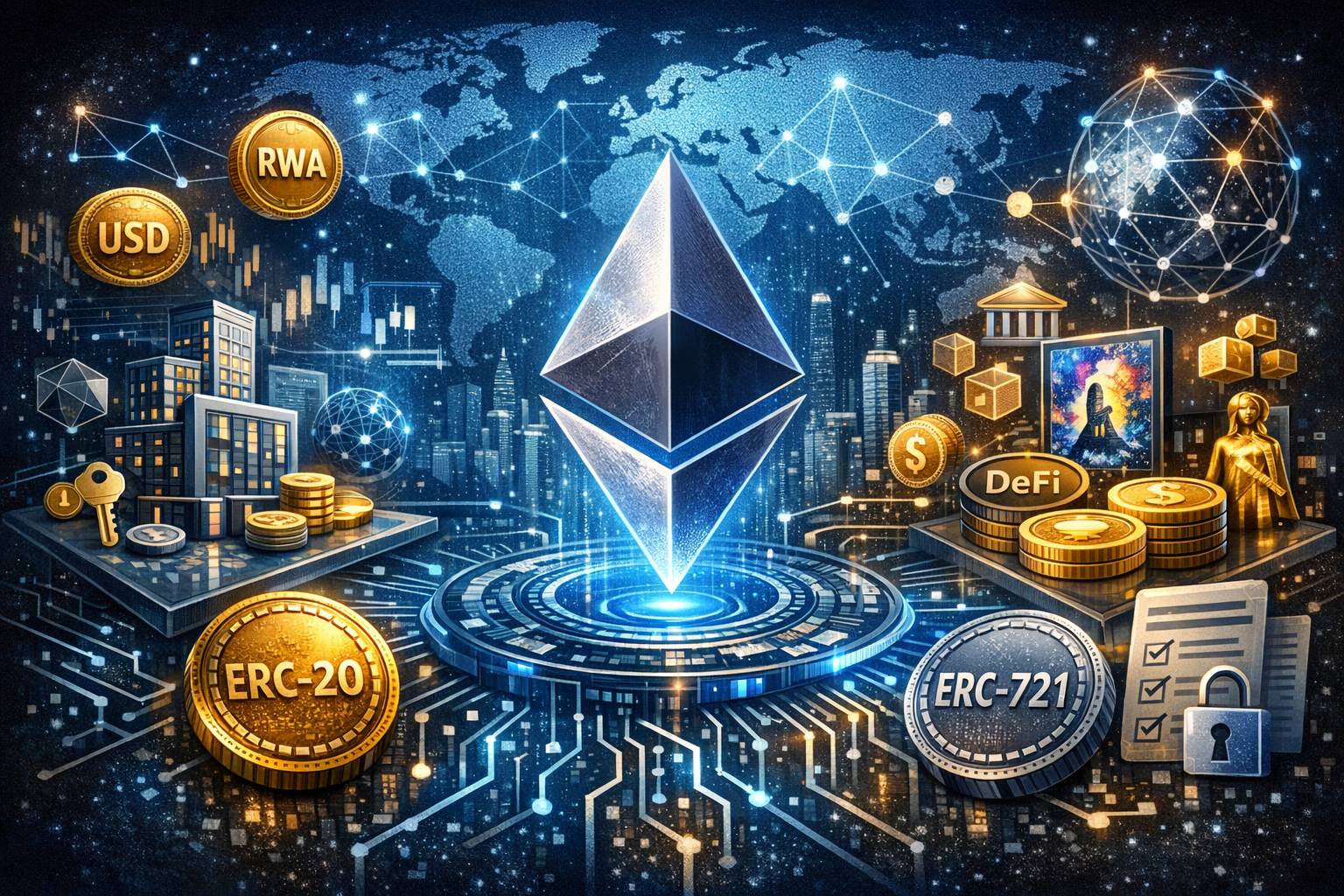
Ethereum's smart contract platform is the backbone of tokenization, allowing developers to create self-executing contracts with the terms of the agreement directly written into lines of code. These smart contracts automate the enforcement and execution of token rules and transactions, ensuring transparency, efficiency, and trustlessness. The standardization of token contracts through protocols like ERC-20 for fungible tokens and ERC-721 for non-fungible tokens (NFTs) has further streamlined the process, making it easier for projects to issue and manage their tokens.
Decentralized Finance (DeFi) and Tokenization
The DeFi ecosystem on Ethereum has been a catalyst for tokenization, offering a suite of financial services and applications that leverage blockchain technology. From lending and borrowing platforms to decentralized exchanges (DEXs) and stablecoins, DeFi has created new opportunities for token holders to utilize their assets productively. The integration of tokenized assets into DeFi applications has expanded the scope of financial services, enabling the creation of complex financial instruments and yielding opportunities that were previously inaccessible.
Real-World Applications of Tokenization on Ethereum
Beyond the digital realm, Ethereum's tokenization capabilities are being explored for real-world assets such as real estate, art, and commodities. Tokenizing these assets allows for fractional ownership, increased liquidity, and reduced barriers to entry. Platforms leveraging Ethereum for real-world asset tokenization are emerging, providing a glimpse into a future where blockchain technology could fundamentally alter the way we own and interact with physical assets.
Challenges and Future Outlook
Despite the advancements in tokenization on Ethereum, several challenges persist, including regulatory uncertainty, scalability issues, and the need for greater user adoption. The upcoming developments in Ethereum 2.0, along with advancements in Layer 2 scaling solutions, are expected to address some of these challenges, paving the way for more widespread adoption of tokenized assets. Furthermore, as regulatory frameworks begin to take shape, we can expect to see more institutional participation in the tokenization space, driving growth and maturity.
Conclusion: Ethereum's Pioneering Role in Tokenization
In conclusion, Ethereum is playing a pivotal role in the development and growth of tokenization, offering a robust and flexible platform for the creation, issuance, and management of digital assets. As the ecosystem continues to evolve, with advancements in technology and regulatory clarity, we can anticipate seeing more innovative applications of tokenization. Ethereum's commitment to decentralized finance and its thriving DeFi ecosystem position it uniquely to drive the future of tokenization, bridging traditional finance with the digital asset economy and redefining the boundaries of financial inclusion and access.
About the Author
Jeffrey Mathew
Jeffrey is a blockchain journalist for ethers.news, specializing in decentralized finance (DeFi) and Ethereum governance and Cryptocurrencies
-At Ethers.News, we are committed to delivering accurate, transparent, and well-researched information related to cryptocurrency, blockchain, and digital assets. Our content is created for educational and informational purposes only and should not be considered financial, investment, or legal advice. We encourage readers to conduct their own research and consult with qualified professionals before making any financial decisions. Market conditions can change rapidly, and past performance does not guarantee future results. Our goal is to promote informed decision-making through responsible journalism.