
Iran Unveils "Hormuz Safe" — A Ministry of Economy-Backed, Bitcoin-Settled Maritime Insurance Platform for the Strait of Hormuz That Claims $10 Billion in Revenue, Establishes the Persian Gulf Strait Authority, and Directly Challenges the Dollar-Denominated Global Shipping Insurance Order
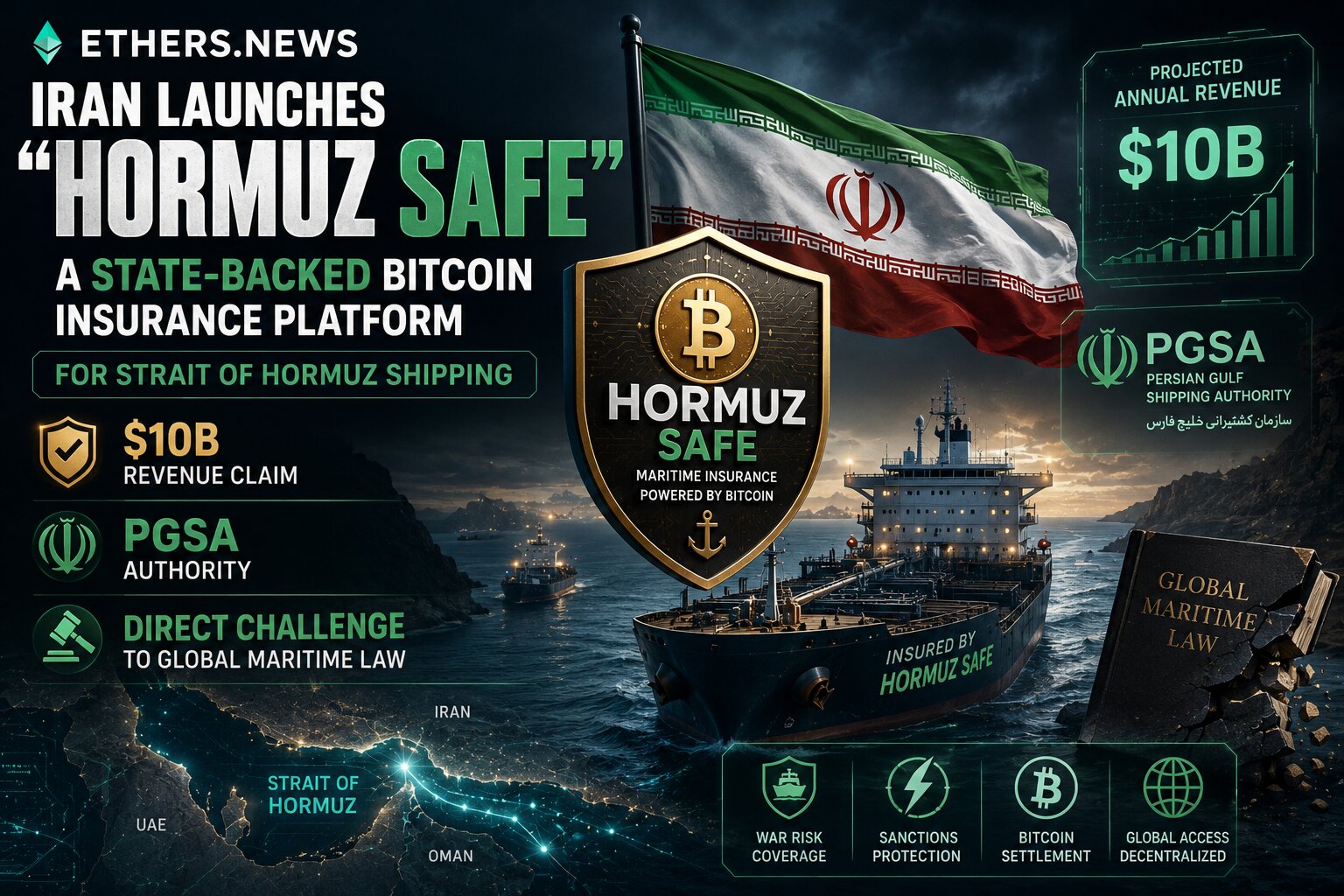
The Strait of Hormuz — the 21-mile-wide chokepoint between Iran and Oman through which approximately 17 to 21 million barrels of oil and gas transit daily, representing roughly one-fifth of the entire world's daily energy supply — has been the subject of geopolitical leverage calculations for four decades. Iran has periodically threatened to close it, mined its approaches, seized tankers within it, and deployed fast-attack craft along its shipping lanes as instruments of asymmetric pressure. On May 16, 2026, Iran introduced a new instrument entirely: a Bitcoin-denominated state insurance platform that reframes control of the strait not as a military threat to be managed but as a financial infrastructure service to be monetised. Hormuz Safe, developed under Iran's Ministry of Economy and Financial Affairs since approximately late April 2026, marks the first time any sovereign government has attempted to use Bitcoin as the settlement layer for a geopolitically mandatory service — and its arrival simultaneously as Iran's Supreme National Security Council establishes the Persian Gulf Strait Authority as the strait's formal administrative governing body signals that this is not an experimental pilot. It is infrastructure for a permanent financial architecture that Iran intends to operate alongside — and in structural competition with — the Lloyd's of London war-risk market that has historically been the only insurer willing to price Hormuz transit risk.
The Platform: Bitcoin Settlement, Blockchain Verification, and What Hormuz Safe Covers
Hormuz Safe's technical architecture, as described in the platform's own documentation and confirmed by Bitbo.io's May 17 reporting drawing directly on Fars News Agency's internal Ministry documents, is built around three operational principles. First: premiums are paid exclusively in Bitcoin — not in rials, not in yuan, not in USDC, and not in any dollar-denominated instrument. The platform's stated rationale, confirmed by The Digital Ship's May 17 analysis, is that Bitcoin operates outside any single sovereign's payment infrastructure, making it uniquely resistant to the secondary sanctions mechanisms the US Treasury Department uses to penalise non-US entities that transact with Iran. Second: coverage activates upon blockchain confirmation — the moment the Bitcoin premium transaction receives sufficient network confirmations to be considered irreversible, the policy is live and a cryptographically signed digital receipt is issued to the cargo owner. InsuranceNewsNet's May 18 analysis describes this as "instantaneous policy activation backed by blockchain immutability rather than the 24-to-72-hour processing window of traditional war-risk policies." Third: the coverage scope is specific. Bitcoin Magazine's May 17 reporting — the most detailed primary English-language source, drawing on Bloomberg's original investigation — confirms that Hormuz Safe covers vessel inspection, detention, and confiscation risk specifically. War-damage claims — meaning losses from direct weapons strikes, mine detonation, or armed conflict — are explicitly excluded from coverage. This exclusion is commercially significant: it means Hormuz Safe is not a replacement for the war-risk policies that Lloyd's and specialist insurers write for Gulf-region shipping but a supplement — or, depending on how Iran's new Persian Gulf Strait Authority operationalises the platform, a potential precondition — for what the platform describes as "safe passage."
"Hormuz Safe represents Iran's most visible attempt yet to convert its control over a waterway that handles around 20% of global oil supply into a revenue-generating financial product — denominated in a currency no foreign government can touch."
— Bitcoin Magazine — May 17, 2026, analysis of Iran's launch of the Hormuz Safe Bitcoin-settled maritime insurance platform, drawing on Bloomberg's original reporting from Fars News Agency's internal Iranian Ministry of Economy documents and the Hormuz Safe platform's self-description as offering "fast, verifiable digital insurance — paid via bitcoin and settled at the speed of blockchain"
The Persian Gulf Strait Authority: Iran's Sovereign Governance Layer Over the Hormuz Corridor
The commercial insurance platform's institutional context was provided two days after Hormuz Safe's unveiling, when Iran's Supreme National Security Council announced on Monday, May 18, that it had established the Persian Gulf Strait Authority — a new sovereign body described by Al Jazeera's May 18 reporting as "designed to deliver real-time updates regarding activities and recent developments in the strait." The timing is not coincidental. Hormuz Safe is the commercial insurance product; the PGSA is the sovereign authority whose existence gives that product its administrative legitimacy — and potentially, depending on how Iran operationalises the PGSA's mandate, its coercive power. Al Jazeera's analysis draws the connection explicitly: "The proposed insurance framework seems to challenge the longstanding principle of freedom of navigation by linking safe passage with financial protection. Instead of labelling it as a toll, Iran appears to be marketing it as a commercial insurance risk management solution." The distinction between a toll — which UNCLOS's freedom of navigation provisions prohibit straits states from imposing on innocent passage — and a voluntary commercial insurance product — which no international maritime law explicitly prohibits — is the legal architecture Iran has constructed for Hormuz Safe. Whether that architecture holds under the scrutiny of the International Maritime Organization, the United Nations, and the legal frameworks of the shipping industry's most significant maritime states is the central question the PGSA's creation raises. Both the United States and China — the world's two largest naval powers and the two states with the most direct strategic interest in Hormuz freedom of navigation — have publicly stated that no country should be permitted to impose a toll for strait transit, as confirmed by Al Jazeera's reporting.
The Bitcoin Context: From Transit Fee Acceptance to Sovereign Insurance Infrastructure
Hormuz Safe did not emerge without precedent within Iran's own policy evolution. Bitcoin Magazine's May 17 analysis traces the direct lineage: "Bitcoin became a formal payment option in April [2026], when Hamid Hosseini, spokesperson for Iran's Oil, Gas and Petrochemical Products Exporters' Union, told the Financial Times that shipping companies could settle Hormuz transit fees in bitcoin or other non-dollar currencies including yuan." The Hosseini announcement to the Financial Times was the first explicit Iranian government statement that Bitcoin was an accepted settlement currency for Strait of Hormuz commercial services — a statement that, at the time, was widely read as a sanctions-evasion mechanism for Iranian export revenues rather than the foundation for a sovereign insurance infrastructure product. Hormuz Safe's May 16 launch reveals that the April payment acceptance announcement was preparation: Iran had been developing the insurance platform framework since "early Ordibehesht" — the Persian calendar month beginning in late April — and was establishing Bitcoin's formal acceptance as a Hormuz payment instrument before the insurance product was publicly launched, so that the payment infrastructure would pre-exist the commercial product it was designed to settle. The Digital Ship's May 17 analysis adds the critical sovereignty framing from the platform's own documentation: Hormuz Safe is described as "the only Iranian sovereign-backed insurance mechanism" for vessels seeking safe passage — language that simultaneously establishes its unique position in the Hormuz insurance market and frames it as a government guarantee rather than a private commercial policy.
The $10 Billion Revenue Claim: Methodology, Credibility, and the Adoption Prerequisite
Iran's projection that Hormuz Safe could generate more than $10 billion in annual revenue is the figure that has attracted the most attention — and the most scrutiny — from the financial analysis community. Yahoo Finance's May 17 reporting on the $10 billion projection confirms that Fars News Agency cited it "without a detailed methodology or time frame." The Digital Ship's May 17 analysis is more precise in its scepticism: "Iranian media claim the platform could generate more than $10 billion in revenue if widely adopted, though no detailed methodology has been published." The credibility of the $10 billion figure depends entirely on the adoption rate assumption embedded within it — and as of the time of all primary source reporting, "no shipping firm or nation has indicated whether they would accept Iran's insurance offer." Al Jazeera's May 18 analysis cites academic Abdul Khalique, who "pointed out that Iran would encounter significant financial, legal, and operational hurdles in executing such a scheme." The legal hurdle is the most immediate: Lloyd's of London standard ship insurance policies for Gulf-region vessels contain sanctions compliance clauses that would likely prohibit the vessel from simultaneously holding a policy from an OFAC-designated Iranian government entity. Any shipping company that accepts Hormuz Safe coverage risks triggering the sanctions compliance provisions of its existing Lloyd's or specialist insurer policy — potentially voiding both. The operational hurdle is equally significant: The Digital Ship confirms that "the platform's website currently appears limited to a holding page, and technical specifications have yet to be publicly disclosed" — meaning Hormuz Safe has been announced as a functional service without providing the actuarial tables, claims processing procedures, or reinsurance arrangements that any legitimate insurance product requires to function.
Geopolitical Implications: Sanctions Architecture, Dollar Displacement, and the Lloyd's of London Alternative
The structural geopolitical significance of Hormuz Safe extends well beyond Iran's specific revenue projections or the platform's current operational limitations. The YouTube analysis from Altcoin Daily on May 18 — the most viewed independent commentary on the platform within 24 hours of its announcement — frames the dollar-displacement dimension most directly: Iran's Hormuz Safe plan represents a "threat to the dollar" because it establishes a precedent in which a sovereign state uses Bitcoin as the settlement layer for a service that is economically mandatory for a significant segment of global shipping, entirely outside the dollar payment infrastructure, the SWIFT messaging network, and the correspondent banking relationships that OFAC's sanctions enforcement depends on. InsuranceNewsNet's May 18 analysis — under the headline "Iran's Hormuz Safe lets shipping companies pay war-risk premiums in Bitcoin to bypass sanctions" — confirms the sanctions-evasion dimension as the primary regulatory and geopolitical concern for Western financial authorities. The concern is not that Iran will immediately collect $10 billion in Bitcoin. The concern is that Hormuz Safe establishes the legal and technical precedent for a Bitcoin-settled sovereign financial service that operates in a geopolitically critical chokepoint, demonstrating to every other sanctions-subject state — North Korea, Russia, Venezuela, Belarus — that sovereign Bitcoin financial infrastructure for mandatory services is operationally feasible. Iran's Ministry of Economy has, whether Hormuz Safe processes a single policy or not, published the blueprint for sanction-resistant sovereign financial infrastructure at a critical global trade chokepoint — and that blueprint's existence is the most consequential output of the platform's May 16 launch.
Editorial Perspective
May 16, 2026: Iran's Ministry of Economy and Financial Affairs unveiled "Hormuz Safe," a state-backed Bitcoin-settled maritime insurance platform for vessels transiting the Strait of Hormuz and Persian Gulf. Source: IRGC-affiliated Fars News Agency citing internal Ministry documents, confirmed by Bloomberg, Yahoo Finance (May 17), Bitcoin Magazine (May 17), Al Jazeera (May 18), InsuranceNewsNet (May 18), Bitbo.io (May 17), The Digital Ship (May 17), Unchain Crypto (May 18), Seeking Alpha (May 18). Platform description: "fast, verifiable digital insurance — paid via bitcoin and settled at the speed of blockchain" (Hormuz Safe website, Bitcoin Magazine). Coverage: vessel inspection, detention, confiscation. War-damage explicitly excluded. Premium settlement: Bitcoin only. Coverage activation: upon Bitcoin blockchain confirmation with cryptographically signed digital receipt issued (Bitbo.io, InsuranceNewsNet). $10 billion annual revenue projected by Iranian government — no methodology or time frame provided (Yahoo Finance, The Digital Ship, Al Jazeera). Platform described as "the only Iranian sovereign-backed insurance mechanism" for vessels seeking safe passage (The Digital Ship). Ministry developing framework since "early Ordibehesht" — late April 2026 (Bitcoin Magazine, Bitbo.io, The Digital Ship). Bitcoin payment option precedent: Hamid Hosseini, spokesperson Iran's Oil Gas and Petrochemical Products Exporters' Union, told FT in April 2026 shipping firms could settle Hormuz transit fees in bitcoin or yuan (Bitcoin Magazine). May 18: Iran's Supreme National Security Council established Persian Gulf Strait Authority (PGSA) for real-time oversight of Hormuz activities (Al Jazeera). Straits of Hormuz: ~20% of global oil and gas supply daily (all sources). US and China publicly stated no country should impose transit toll (Al Jazeera). No shipping firm or nation confirmed acceptance (Al Jazeera, The Digital Ship). Platform website: limited holding page; no actuarial tables or claims procedures published (The Digital Ship). Academic concerns: significant financial, legal, operational hurdles (Abdul Khalique, Al Jazeera). Sanctions conflict: Lloyd's policies contain OFAC sanctions compliance clauses potentially prohibiting dual coverage.
At Ethers News, we assess Hormuz Safe as simultaneously less commercially viable and more geopolitically significant than the $10 billion revenue headline suggests — and the financial press has correctly identified the sanctions-evasion dimension while underweighting the sovereign Bitcoin infrastructure precedent that is the platform's most lasting contribution. The $10 billion revenue projection is not credible in its stated form. Iran has launched a platform described as operational, with a website that The Digital Ship confirms is currently a holding page with no technical specifications, actuarial methodology, reinsurance arrangements, or claims procedures. No insurer, no shipping company, and no maritime lawyer has been named as a counterparty. The coverage exclusion of war-damage — the primary risk that shipping companies actually need to price when transiting a waterway that Iran has mined, in which Iran has seized tankers, and through which the US-Israeli bombing campaign referenced by Al Jazeera was conducted — means Hormuz Safe covers the secondary risks while excluding the primary one. That is not an insurance product. That is, as Al Jazeera's analysis identifies, a toll dressed in commercial insurance language. The deeper significance is the Bitcoin dimension. Iran has established, in public government documentation, that Bitcoin is an acceptable settlement currency for a sovereign financial service at a critical global trade chokepoint. The Ministry of Economy's development of a blockchain-confirmation-triggered insurance activation system demonstrates that Iranian state technical capacity has advanced to the point of designing production-ready Bitcoin settlement infrastructure. Whether Hormuz Safe processes a single policy is almost irrelevant. The blueprint is public. The precedent is set. And the dollar-denominated maritime insurance order that Lloyd's of London has underpinned for 330 years now has a sovereign Bitcoin-settled competitor — operational or not — whose existence will shape every future geopolitical calculation about Bitcoin's role in sanction-circumventing sovereign financial architecture.
Key Sources and References
Bitcoin Magazine — Iran Launches Bitcoin-Backed Insurance Service for Strait of Hormuz, May 17, 2026 (Primary Source, Pull Quote): bitcoinmagazine.com — Pull quote source; Bloomberg confirmed; Fars News Agency internal Ministry documents; "fast, verifiable digital insurance — paid via bitcoin"; vessel inspection/detention/confiscation coverage; war-damage excluded; $10B projection; Ministry developing since April; Hamid Hosseini FT April 2026 quote; Bitcoin as formal payment option precedent

InsuranceNewsNet — Iran's Hormuz Safe Lets Shipping Companies Pay War-Risk Premiums in Bitcoin to Bypass Sanctions, May 18, 2026: insurancenewsnet.com — May 16, 2026 unveil date confirmed; Ministry of Economy confirmed; sanctions-evasion dimension; instantaneous blockchain policy activation confirmed

Al Jazeera — Iran Plans to Offer Insurance for Hormuz Transit: Will It Work?, May 18, 2026: aljazeera.com — Persian Gulf Strait Authority (PGSA) SNSC announcement May 18 confirmed; "real-time updates"; toll vs. insurance framing; US and China opposition; Abdul Khalique financial/legal/operational hurdles; no shipping firm acceptance; 20% global oil/gas confirmed

Yahoo Finance — Iran Pushes $10B Bitcoin Insurance Plan for Strait of Hormuz: Report, May 17, 2026: yahoo.com — $10 billion revenue projection; cargo cover Bitcoin settlement; marine policies and financial responsibility certificates; no time frame on projection

Bitbo.io — Iran Launches $10B Bitcoin Shipping Insurance Plan, May 17, 2026: bitbo.io — Fars News Agency Ministry documents; "fast and cryptographically verifiable insurance policies"; "payments settled in Bitcoin"; coverage activating upon blockchain confirmation; Ministry exploring model since late April

The Digital Ship — Iranian Government Launches Bitcoin Insurance for Strait of Hormuz, May 17, 2026: thedigitalship.com — "Only Iranian sovereign-backed insurance mechanism" language; website currently limited holding page; no technical specifications disclosed; $10B if widely adopted; no methodology published; development since early Ordibehesht (late April)

Unchained Crypto — Iran Launches Bitcoin-Settled Maritime Insurance Platform, May 18, 2026: unchainedcrypto.com — State-backed platform; targeting shipping companies and cargo owners; Ministry of Economy backing; Bitcoin settlement mechanism; $10B projectionAbout the Author
Ethers News
Ether News Team - Highly dedicated to provide up to date crypto related news and upcoming events.
-At Ethers.News, we are committed to delivering accurate, transparent, and well-researched information related to cryptocurrency, blockchain, and digital assets. Our content is created for educational and informational purposes only and should not be considered financial, investment, or legal advice. We encourage readers to conduct their own research and consult with qualified professionals before making any financial decisions. Market conditions can change rapidly, and past performance does not guarantee future results. Our goal is to promote informed decision-making through responsible journalism.