
Kraken Launches Bitcoin Vault: Up to 2.5% Native BTC Yield Without Selling, Wrapping, or Bridging — DeFi Lending via Ink Network, Aave, and Morpho
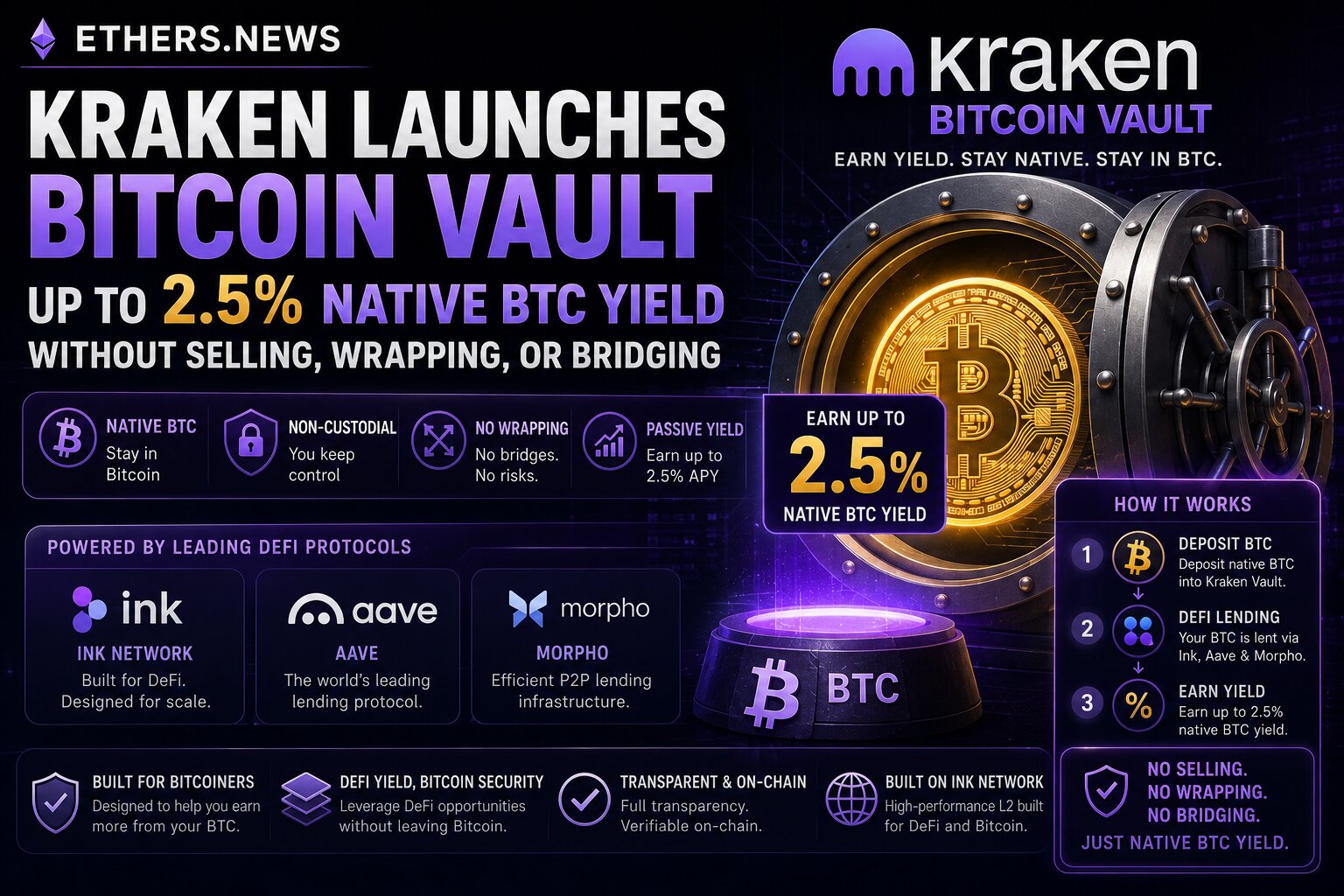
For fifteen years, Bitcoin holders have faced a binary choice: hold BTC and earn zero yield, or sell BTC to deploy capital into yield-generating assets and lose direct price exposure. Lending products existed but required trusting centralised counterparties whose failures — Celsius, BlockFi, FTX — cost customers billions. Wrapped Bitcoin products like WBTC offered DeFi access but required bridging to Ethereum and accepting custodial risk from BitGo or other third parties. Staking solutions like Babylon's integration with Kraken, launched June 2025, paid rewards in BABY tokens rather than Bitcoin itself, creating tax complexity and forcing holders to convert rewards back to BTC. On May 27, 2026, Kraken eliminated every one of those tradeoffs. Bitcoin Vault, launched within Kraken Earn and now live across Kraken web, Kraken Pro, the Kraken app, and the Krak app, offers native BTC yield — meaning rewards accrue and compound in Bitcoin, not in stablecoins or governance tokens — without selling the underlying BTC, without bridging to other chains, and without wrapping to synthetic assets that create additional smart contract risk. The mechanism: BTC remains Bitcoin. It's temporarily wrapped to kBTC on the Ink network for technical interoperability, placed in a non-custodial wallet where Kraken cannot touch it, used as collateral in battle-tested DeFi lending protocols, and the yield flows back as BTC. This is the product Bitcoin maximalists said was impossible without compromising self-custody. Kraken just shipped it.
The Mechanism: From BTC Deposit to kBTC Collateral to Native Yield Auto-Compounding
Bitcoin Vault's technical architecture, documented in Kraken's official support article and confirmed by TradeInformer's May 26 breakdown of the product's onchain mechanics, operates through a seven-step process that preserves Bitcoin exposure while extracting DeFi yield. Step one: user deposits BTC into Bitcoin Vault from their Kraken account with no minimum deposit requirement and no deposit fees. Step two: the deposited BTC is wrapped to kBTC — a tokenised representation of Bitcoin on the Ink network, which is an EVM-compatible Layer 2 blockchain purpose-built for DeFi applications with no gas fees for users. Step three: the kBTC is transferred to a non-custodial embedded wallet where the user retains legal ownership and Kraken cannot move assets without the user's explicit initiation — a critical self-custody protection that distinguishes Bitcoin Vault from traditional exchange lending products where the exchange owns the collateral. Step four: the non-custodial wallet sends the kBTC to a Veda vault, with strategy design and risk management curated by Sentora, a specialised DeFi risk platform. Step five: the kBTC is supplied as collateral to lending protocols including Aave, Morpho, and Tydro — established DeFi markets with billions in total value locked and years of operational history. Step six: stablecoins (primarily USDC) are borrowed against the kBTC collateral at conservative loan-to-value ratios managed by Sentora to prevent liquidation risk, and those stablecoins are deployed into yield-generating DeFi strategies across lending markets, liquidity pools, and other protocols. Step seven: the yield generated from those stablecoin strategies is converted back to kBTC and automatically re-deposited into the vault, compounding the user's Bitcoin position continuously without requiring any manual action. TradeInformer's analysis describes the outcome precisely: "Users deposit BTC into a Vault, rewards auto-compound in Bitcoin, and the position stays fully exposed to BTC price moves. Kraken describes it as yield without changing the holder's exposure." The entire process is verifiable onchain through the Ink network explorer, and the protocols used — Aave, Morpho, Tydro — publish real-time collateral and borrowing data that institutional users can monitor independently.
"Bitcoin Vault is designed to serve both existing Kraken customers and bitcoin holders outside the platform looking to consolidate holdings. Built for long-term Bitcoin holders, Bitcoin Vault enables customers to earn BTC-denominated rewards while holding Bitcoin. Instead of introducing more complexity, Kraken offers a more intuitive path: hold Bitcoin, earn rewards in BTC and manage it directly from a Kraken account."
— Kraken Official Blog — May 27, 2026, announcing the launch of Bitcoin Vault within Kraken Earn, describing the product's design philosophy of providing native BTC yield without requiring users to navigate complex DeFi interfaces directly, while maintaining full Bitcoin price exposure and custody protections through non-custodial embedded wallet architecture on the Ink network
The Yield: 2.5% APY, Performance Fees, Variable Rates, and the Ink Network Gas Advantage
Bitcoin Vault's yield structure, documented in Kraken's support article and confirmed by Bitcoin.com and Bitbo.io's May 26-27 reporting, provides up to 2.5% APY in BTC-denominated rewards — a figure that is variable, not guaranteed, and depends on borrowing demand in the underlying DeFi lending markets. During the initial launch period, Kraken's interface displays a fixed estimate of 2.0% net of fees to set expectations while the product establishes its operational track record and real borrowing demand data accumulates. The displayed APY is calculated as a trailing 7-day average and updates continuously as market conditions change. Kraken's support documentation is explicit about the variability: "Earning rates are variable and depend on borrowing demand in the underlying lending markets. The APY displayed is the trailing 7-day average and may change over time." The fee structure includes a 25% performance fee on vault earnings, applied at the protocol level by Veda and Sentora before rewards are distributed to users — meaning if the gross yield from the stablecoin strategies is 3.0%, the net APY to users after the 25% fee is approximately 2.25%, aligning with the "up to 2.5%" marketing figure. Critically, there are no deposit or withdrawal fees, and there are no gas fees for deposits or withdrawals on the Ink network — a substantial cost advantage over DeFi products on Ethereum mainnet where gas fees can consume a meaningful percentage of small positions. The Ink network's EVM compatibility and Layer 2 architecture enable the complex multi-step process Bitcoin Vault requires (wrapping, collateral deployment, stablecoin borrowing, yield conversion, auto-compounding) to execute with near-zero transaction costs, making the product economically viable for retail users with modest Bitcoin holdings rather than requiring institutional-scale positions to justify the complexity. AFP's May 26 reporting on the launch confirms the protocol allocation strategy: "Their platforms are designed to manage risks and allocate the vaults to well-known onchain protocols like Aave, Morpho, Tydro and more" — a diversification approach that reduces single-protocol risk while accessing the deepest liquidity pools in DeFi.
Withdrawals, Risk Disclosure, and the Non-Custodial Architecture That Distinguishes It From BlockFi
Bitcoin Vault's withdrawal mechanics and risk framework, documented across Kraken's support materials and regulatory disclosures confirmed by TradeInformer and MEXC's May 26-28 reporting, establish clear parameters that differentiate the product from the centralised lending platforms whose collapses defined the 2022 bear market. Users can withdraw their BTC from the vault at any time by initiating a withdrawal request, but the withdrawal is subject to a 5-day wait period before funds are returned to the user's main Kraken account — a delay that reflects the time required to unwind the collateral positions in the underlying DeFi protocols, repay borrowed stablecoins, convert assets back from kBTC to native Bitcoin, and complete the settlement process. Kraken's official website description frames the non-custodial architecture explicitly: "Non-custodial by design – Your BTC is held in a non-custodial embedded wallet. Kraken cannot move your assets without your initiation. Withdraw any time." This self-custodial structure means that even if Kraken the exchange were to face bankruptcy, insolvency, or regulatory seizure, the BTC in users' vaults remains legally segregated in non-custodial wallets that Kraken does not own and cannot access without user authorisation — the opposite of Celsius, BlockFi, and FTX's models where customer assets were commingled with exchange assets and used as corporate collateral. The risk disclosures Kraken publishes are comprehensive and unambiguous. Kraken's support article states: "Kraken is clear that rewards are variable and not guaranteed, and users can lose some or all of their assets" due to smart contract risk, liquidation risk if collateral values drop faster than positions can be unwound, protocol failures in Aave, Morpho, or Tydro, or technical failures in the Veda/Sentora infrastructure. Bitbo.io's analysis confirms: "Kraken said the APY is variable and not guaranteed, and that onchain interactions involve technological, market and operational risks." The vaults are provided by Payward Wallet, LLC — a separate Kraken entity — rather than Kraken the exchange, creating additional legal separation between exchange operations and vault custody.
Availability, the USDC Vaults Precedent, and Why UK, UAE, and Australia Are Excluded
Bitcoin Vault's geographic availability, confirmed by TradeInformer, Bitbo.io, and MEXC's reporting, covers the United States (excluding New York and Maine), the European Economic Area, and Canada — a footprint that includes the majority of Kraken's customer base but notably excludes three jurisdictions where Kraken operates: the United Kingdom, the United Arab Emirates, and Australia. The exclusions reflect the complex regulatory status of DeFi yield products in those markets, where securities laws, financial promotion rules, or licensing requirements create additional compliance burdens that Kraken has not yet resolved for Bitcoin Vault's specific structure. New York and Maine's exclusions within the US reflect those states' particularly restrictive money transmission and virtual currency licensing frameworks under BitLicense and Maine's virtual currency licensing statute. The product's infrastructure is not new. Bitcoin Vault builds on Kraken's existing DeFi Earn platform, which launched USDC Vaults in late 2025 using the same Veda-Sentora-Ink network architecture. TradeInformer's reporting documents the USDC Vaults' traction: "Kraken had already offered USDC Vaults on the same infrastructure, which the company said held more than $180 million across 38,000 users before the BTC launch." That $180 million figure represents validated demand for the vault model among Kraken's customer base — users who have already accepted the 5-day withdrawal period, the 25% performance fee structure, and the DeFi protocol risks in exchange for yield on stablecoins, and who now have the option to apply the same infrastructure to their Bitcoin holdings. The USDC Vaults offered yields "up to 18% annualized" according to CoinMarketCap's May 27 reporting — substantially higher than Bitcoin Vault's 2.5%, reflecting the different risk and return profiles of stablecoin lending versus Bitcoin-collateralised borrowing strategies. Kraken's DeFi Earn page confirms that USDC strategies deliver "up to 5.73% APY" as of the current date, with variable rates across different risk tiers.
Competitive Context: How Bitcoin Vault Compares to Babylon Staking, Wrapped BTC, and Offshore Lending
Bitcoin Vault's market positioning, analysed across the product landscape documented by OKX, Binance Academy, and prior Kraken launches, occupies a distinct niche that neither replicates nor directly competes with existing Bitcoin yield mechanisms. Kraken's own Babylon staking integration, launched June 2025 and still available on the platform, offers approximately 0.03% to 1% APY with rewards paid in Babylon's native BABY token rather than Bitcoin — a structure that provides lower yield, creates tax reporting complexity from receiving a different asset, and requires users to convert BABY to BTC if they want to compound their Bitcoin holdings. Bitcoin Vault's 2.5% BTC-denominated yield and automatic compounding eliminate both problems. Wrapped Bitcoin products like WBTC, cbBTC, or tBTC offer DeFi access but require bridging to Ethereum, accepting custodial risk from BitGo or Coinbase, and navigating gas fees that can exceed the yield on small positions — barriers Bitcoin Vault removes entirely by keeping BTC on Bitcoin (technically wrapped to kBTC on Ink, but without cross-chain bridging risk). Offshore centralised lending platforms including Binance Earn, Nexo, and Ledn offer Bitcoin interest accounts with yields ranging from 1% to 8% depending on lock-up periods, but those products are unavailable to US users, operate under unclear regulatory frameworks, and carry counterparty risk from the centralised platform's solvency — the same risk that destroyed Celsius and BlockFi. Bitcoin Vault's non-custodial structure, regulated US entity provider (Payward Wallet, LLC), and transparent onchain protocol allocation create institutional-grade compliance and risk transparency that offshore platforms cannot match. The closest competitor is Unchained Capital's collaborative custody Bitcoin yield product, which offers approximately 2-4% APY using multisig vaults and institutional lending counterparties — but Unchained requires a $10,000 minimum, charges setup fees, and operates outside the seamless exchange-integrated experience Kraken provides. Yahoo Finance's May 27 framing captures Bitcoin Vault's unique position: "Kraken says its customers can now earn yield on their Bitcoin holdings without selling the cryptocurrency" — the "without selling" dimension being the critical differentiator from every previous mainstream yield option available to regulated-market participants.
Bottomline
May 27, 2026: Kraken launched Bitcoin Vault within Kraken Earn, enabling customers to earn up to 2.5% APY in BTC-denominated rewards without selling, bridging, or wrapping Bitcoin. Sources: AFP (May 26), Yahoo Finance (May 27), Kraken official blog (May 27), Bitbo.io (May 26), Bitcoin.com (May 27), TradeInformer (May 26), MEXC (May 28), CoinDesk, Crypto Briefing, CoinMarketCap. Mechanism: BTC deposited → wrapped to kBTC on Ink network (EVM-compatible L2, no gas fees) → sent to non-custodial embedded wallet (user retains ownership, Kraken cannot move without user initiation) → Veda vault with Sentora risk management → kBTC supplied as collateral to DeFi lending protocols (Aave, Morpho, Tydro) → stablecoins borrowed against collateral → stablecoins deployed to yield strategies → yield converted to kBTC → auto-compounded into vault balance. User maintains full Bitcoin price exposure. Yield: up to 2.5% APY (variable, depends on borrowing demand); 2.0% fixed estimate during initial launch; trailing 7-day average displayed; 25% performance fee on earnings (applied at protocol level). No deposit/withdrawal fees. No gas fees on Ink network. Withdrawals: 5-day wait period. Risks: smart contract risk, liquidation risk, protocol failures, technical/market/operational risks disclosed; variable APY not guaranteed; users can lose some or all assets (Kraken support, Bitbo.io). Vaults provided by Payward Wallet, LLC (separate entity). Availability: US (excluding NY and ME), EEA, Canada. Not available: UK, UAE, Australia. Infrastructure precedent: USDC Vaults launched late 2025 on same Veda-Sentora-Ink stack held $180M+ across 38,000 users before BTC launch (TradeInformer). Kraken: first major regulated exchange native BTC yield via DeFi without selling holdings or bridging to L2s. Live on Kraken web, Kraken Pro, Kraken app, Krak app.
At Ethers News, we assess Bitcoin Vault as the most structurally sound Bitcoin yield product a regulated exchange has ever launched — and the 5-day withdrawal period is the design compromise that makes the entire architecture viable. The non-custodial embedded wallet structure is the critical innovation that distinguishes Bitcoin Vault from every centralised lending platform that collapsed in 2022. When Celsius and BlockFi offered Bitcoin interest accounts, they owned the collateral. When those companies faced liquidity crises, customer Bitcoin was frozen, then lost. Bitcoin Vault's legal architecture places BTC in a non-custodial wallet that Kraken cannot access without user authorisation. If Kraken faces insolvency tomorrow, those vaults are legally segregated assets that creditors cannot seize. That is not marketing language. That is the difference between a custodial lending product and a self-custodial DeFi interface. The 5-day withdrawal period is the tradeoff that enables that protection: because the BTC is actively deployed as collateral in DeFi lending markets, unwinding the position requires time to exit Morpho, repay borrowed stablecoins, convert back from kBTC, and settle. Users who need instant liquidity should not use Bitcoin Vault. But users who plan to hold Bitcoin for months or years and want to extract yield without selling can now do so through infrastructure that is auditable onchain, transparent in its protocol allocation, and legally separate from exchange operations. The 2.5% APY is modest — substantially lower than the 8-12% Celsius promised before its collapse — and that modesty is a feature, not a bug. Unsustainable yields funded by Ponzi-like treasury management are what killed the last generation of Bitcoin interest products. Bitcoin Vault's yield is derived entirely from legitimate DeFi borrowing demand: kBTC is used as collateral, stablecoins are borrowed, those stablecoins earn yield in Aave and Morpho, and that yield flows back as BTC. The mechanism is economically sound. The risk disclosures are comprehensive. The non-custodial structure provides legal protection. And the $180 million in USDC Vaults that preceded it demonstrates that Kraken's customers have already validated the model. Bitcoin Vault is what responsible Bitcoin yield infrastructure looks like in 2026. It is not risk-free — smart contract failures, liquidation cascades, and protocol exploits remain possible — but it is the first Bitcoin yield product from a major exchange that we would consider using ourselves. That is the standard.
Key Sources and References
Kraken Official Blog — Announcing Bitcoin Vault: Earning on Bitcoin Is Now Easy, May 27, 2026 (Primary Source, Pull Quote): blog.kraken.com — Pull quote source; up to 2.5% BTC-denominated rewards; built for long-term Bitcoin holders; simple trusted way; hold Bitcoin earn rewards in BTC manage directly from Kraken account; available through Kraken Earn

Kraken Support — What is the Bitcoin (BTC) Vault on Kraken, May 19, 2026 (Technical Documentation): support.kraken.com — Technical mechanics documented; BTC allocated to onchain lending markets; non-custodial embedded wallet; rewards accrue continuously auto-compounded; 5-day withdrawal; variable APY depends on borrowing demand; trailing 7-day average; 2.0% fixed estimate during initial launch; 25% performance fee; no allocation/deallocation fees; no gas fees on Ink network; APY net of fees displayed

AFP — Kraken Launches Bitcoin Vault to Make Earning on Bitcoin Easy for Millions of Customers, May 26, 2026: afp.com — CHEYENNE, Wyo. dateline; new product within Kraken Earn; built for long-term Bitcoin holders; BTC-denominated rewards; platforms manage risks allocate to Aave, Morpho, Tydro and more; available through Kraken Earn in eligible jurisdictions

Yahoo Finance — Kraken Launches Bitcoin Vault That Provides Yield To Customers, May 27, 2026: yahoo.com — Customers can now earn yield on Bitcoin holdings without selling the cryptocurrency confirmed

TradeInformer — Kraken Launches BTC Vaults With Up to 2.5% Variable APY, May 26, 2026: tradeinformer.com — Inside Krak app; routes BTC through onchain lending markets via non-custodial wallet; available US (excluding NY and ME), EEA, Canada; no minimum deposit; 5-day withdrawal wait; BTC wrapped to kBTC → Ink network → Veda vault → Sentora risk management → lending protocol collateral → stablecoins borrowed → DeFi strategies → rewards converted to kBTC re-deployed; variable not guaranteed; technological market operational risks; Payward Wallet LLC provides vaults; USDC Vaults precedent $180M+ across 38,000 users before BTC launch

Bitbo.io — Kraken Launches Bitcoin Vault With 2.5% BTC Rewards, May 26, 2026: bitbo.io — Up to 2.5% BTC-denominated rewards; powered by Veda with strategy design risk curation by Sentora; allocate vault assets across Aave, Morpho, Tydro; make earning on bitcoin accessible without navigating complex DeFi interfaces; rewards variable not guaranteed users can lose some or all assets; live via Kraken web, Kraken Pro web, Kraken app, Krak app; available everywhere Kraken operates except UK, UAE, Australia

Bitcoin.com — Kraken Rolls Out Bitcoin Vault With 2.5% APY for Long-Term BTC Holders in the US, May 27, 2026: bitcoin.com — 2.5% APY BTC-denominated rewards via DeFi lending on Ink network confirmed

MEXC — Kraken Rolls Out Bitcoin Vault With 2.5% APY, May 28, 2026: mexc.com — Bitcoin wrapped into kBTC and moved to non-custodial embedded wallet on Ink network; lending markets deployment confirmed

CoinDesk / X — Kraken Launches Bitcoin Vault, May 27, 2026: x.com/CoinDesk — Letting BTC holders earn yield through DeFi protocols including Aave and Morpho confirmed

Crypto Briefing / X — NEW: Kraken Launches Bitcoin Vault, May 27, 2026: x.com/Crypto_Briefing — Enabling native BTC holders to earn yield through DeFi protocols including Aave and Morpho confirmed
Tags
About the Author
Ethers News
Ether News Team - Highly dedicated to provide up to date crypto related news and upcoming events.
-At Ethers.News, we are committed to delivering accurate, transparent, and well-researched information related to cryptocurrency, blockchain, and digital assets. Our content is created for educational and informational purposes only and should not be considered financial, investment, or legal advice. We encourage readers to conduct their own research and consult with qualified professionals before making any financial decisions. Market conditions can change rapidly, and past performance does not guarantee future results. Our goal is to promote informed decision-making through responsible journalism.