
SEC's "Innovation Exemption" Drops This Week: Apple, Tesla, Nvidia Stock Tokens to Trade 24/7 On-Chain Under Paul Atkins' Project Crypto — Wall Street's Dual-Market Future
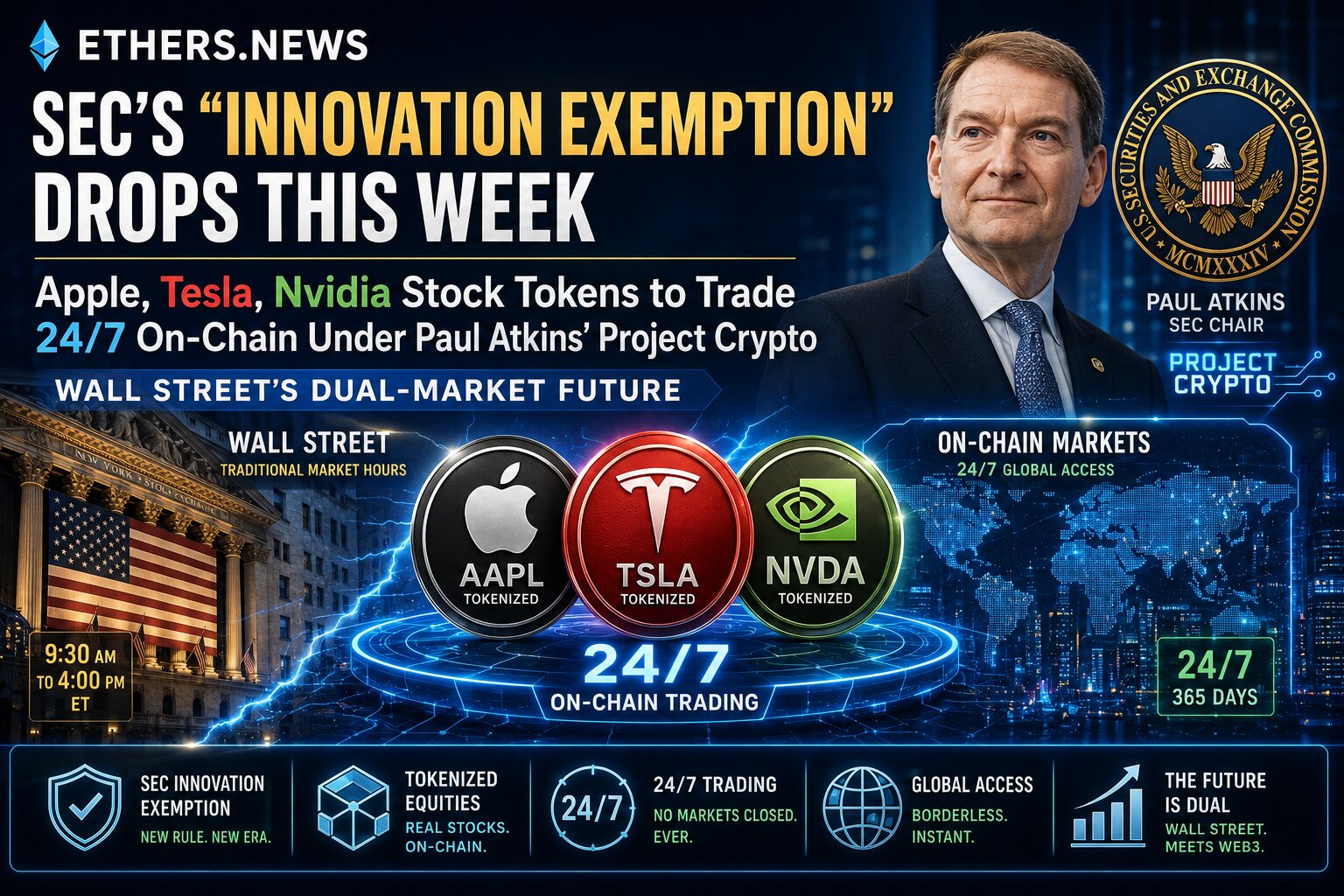
For ninety-two years — since the Securities Exchange Act of 1934 established the statutory foundation for US equity market regulation — every share of every publicly traded American company has been subject to a single, unified regulatory regime: register with the SEC, trade on SEC-regulated exchanges during market hours, settle through the DTCC's infrastructure, and grant shareholders the voting and dividend rights that the Exchange Act codifies. During the week of May 18, 2026, that ninety-two-year monopoly ends. The SEC's Innovation Exemption, expected to be formally announced as early as this week according to Bloomberg's May 18 reporting citing people familiar with the matter, creates a parallel regulatory pathway in which tokenized representations of the same publicly traded stocks can trade on blockchain networks around the clock, in fractional sizes, with near-instant settlement — and without the voting rights, dividend distributions, or direct legal ownership claims that traditional shares provide. As Forbes' May 19 analysis framed it with precision: "America Is About To Have Two Stock Markets For The Same Company." One market operates under the traditional Exchange Act framework. The other operates under the Innovation Exemption's blockchain-native sandbox. Both claim to represent exposure to the same underlying asset. And both will compete for the same capital, the same investors, and the same institutional adoption — starting this week.
What the Innovation Exemption Does: 24/7 Trading, Fractional Ownership, and the Rights It Strips
The Innovation Exemption's operational mechanics, as documented by KuCoin's comprehensive May 18 analysis drawing on Bloomberg's original reporting and SEC pre-announcement coverage under Chair Paul Atkins, create a regulatory sandbox with four defining characteristics. First: continuous trading — tokenized stocks trade 24 hours a day, 7 days a week, including weekends and holidays, without the 9:30 AM to 4:00 PM EST market-hour constraints that traditional equity markets impose. BloomingBit's May 18 reporting on the framework confirms this explicitly: "Tokenized shares would trade on decentralized crypto platforms and be verified through blockchain networks" with no market-hour restrictions. Second: fractional ownership — investors can purchase 0.1 of a Tesla share, 0.01 of an Alphabet share, or any arbitrarily small fraction, enabling retail access at price points far below the full-share cost of high-value equities. Third: near-instant settlement — blockchain confirmation times replace the T+1 standard that traditional equity settlement operates under, reducing counterparty risk and capital lockup. Fourth: programmable custody — smart contracts govern transfer and ownership, enabling automated compliance checks and cross-border accessibility subject to local rules. These four capabilities represent the Innovation Exemption's commercial value proposition. What it strips is equally significant. KuCoin's analysis confirms the exclusions explicitly: "No voting rights at shareholder meetings. No direct dividend distributions through the token contract (economic equivalence is typically passed through via the issuer). No direct legal claim on the underlying company in many proposed structures. No automatic eligibility for tax treatments tied to direct share ownership." Tokenized stocks under the exemption provide economic exposure. They do not provide shareholder governance.
"The SEC is poised to endorse two separate pathways for integrating US equities into blockchain systems, each representing a distinct product that will vie for the same assets. The Nasdaq and DTCC model maintains the entire framework of US securities law (including identical tickers, shareholder rights, and oversight) while inserting a token at the end of the settlement chain. Conversely, the innovation exemption establishes a parallel framework that does not necessarily maintain any of those standards. The crypto asset may represent an ownership interest, or it may not. It might grant voting rights, or it might not."
— Forbes — May 19, 2026, "America Is About To Have Two Stock Markets For The Same Company," analysis of the SEC's Innovation Exemption framework for tokenized stocks under Chair Paul Atkins' Project Crypto, contrasting the DTCC/Nasdaq pathway that maintains traditional securities law with the Innovation Exemption pathway that creates a parallel regulatory structure without guaranteed shareholder rights
The Two Pathways: DTCC's July Pilot vs. the Crypto-Native Innovation Exemption
The most structurally consequential detail in the Innovation Exemption's rollout is that it is not the only tokenization pathway the SEC is operationalising simultaneously. Forbes' May 19 analysis documents the dual-track architecture precisely: the DTCC pathway and the Innovation Exemption pathway are parallel, competitive, and fundamentally incompatible in their regulatory design. The DTCC pathway, announced on May 4, 2026, involves a production pilot launching in July 2026 with over 50 financial institutions including BlackRock, JPMorgan, Goldman Sachs, Nasdaq, Circle, Ondo, and Ripple, according to KuCoin and Phemex's reporting on the DTCC's official announcement. The pilot will trade tokenized versions of Russell 1000 stocks, major ETFs, and US Treasuries — with a full-scale launch planned for October 2026. The critical distinction: DTCC tokenization maintains the entire traditional securities law framework. Tokenized shares issued through the DTCC pathway carry identical tickers to their traditional counterparts, provide the same voting rights, distribute dividends through the same mechanisms, and settle through the same DTCC custodial infrastructure — with blockchain serving solely as the final settlement layer rather than the primary trading venue. The Innovation Exemption pathway, by contrast, explicitly does not maintain those standards. As Forbes documents: "The crypto asset may represent an ownership interest, or it may not. It might grant voting rights, or it might not." Third-party entities can tokenize Apple stock under the Innovation Exemption without Apple's approval, list it on a decentralised exchange, and trade it continuously — and the token's legal relationship to Apple's actual shares is determined by the custodial arrangement and disclosure language the issuer chooses, not by the Exchange Act's statutory shareholder rights. These are not two implementations of the same product. They are two competing visions of how blockchain integrates with equity markets — and both launch in 2026.
Third-Party Tokenization Without Issuer Consent: The Legal Foundation and Three Models
The most commercially and legally consequential provision in the Innovation Exemption is its permission for third-party tokenization without the underlying company's consent. Binance Square's May 18 analysis, drawing on Bloomberg Law's original reporting, frames the significance bluntly: "Tesla, Apple, Nvidia — as long as they're still listed on the US stock market, they could be issued and traded on some chain as 'tokenized TSLA' without any prior notice or consultation. Their legal department can certainly issue a statement to disassociate, but what happens after that? The trading will continue as usual." The legal foundation for this was established in an SEC crypto working group legal memo submitted on January 22, 2026, which Binance's analysis confirms laid out three distinct tokenization models. Model one: direct issuance — the company itself tokenizes its equity on-chain, requiring the issuer's explicit consent and maintaining full legal continuity with traditional shares. Model two: custodial certificate — a third-party custodian purchases and freezes traditional shares, then issues corresponding on-chain certificates backed 1:1 by the underlying holdings, without requiring the issuer's consent because the certificates represent claims on custodied assets rather than direct equity. Model three: synthetic derivative — tokens track the stock's price through derivative contracts without requiring underlying share ownership or issuer consent, creating synthetic exposure that is legally and economically separate from the actual equity. The Innovation Exemption's framework, as described by BloomingBit and Binance's analyses, allows models two and three to operate under the exemption's lighter regulatory requirements — meaning any qualified entity can custody Tesla shares and issue "tokenized TSLA" or create synthetic TSLA-tracking derivatives, list them on decentralised venues, and trade them 24/7, entirely without Tesla's involvement or approval. The only constraint: platforms must disclose which model they use and what rights the token does or does not convey.
The $1.4 Billion Market, Wall Street's Opposition, and the Launch Timeline
The Innovation Exemption does not arrive into a vacuum. Yahoo Finance's May 19 reporting confirms that the tokenized securities market has already reached $1.4 billion in total value and recently grew 30% — a figure that predates the exemption's formal announcement and reflects the early-stage tokenization activity that has been building under existing regulatory frameworks including Regulation D private placements and offshore structures. The $14 billion tokenized US Treasury market, documented by CryptoRank's April 22 analysis citing Token Terminal data, demonstrates that institutional capital has already validated blockchain-based representations of traditional financial assets at significant scale — with Franklin Templeton's BENJI and BlackRock's BUIDL (over $3 billion AUM) as the market's flagship products. The Innovation Exemption extends that institutional validation from fixed-income securities to equities. Wall Street's response has been hostile. CryptoVerse Lawyers' December 7, 2025 analysis documents that on December 2, 2025, major exchanges including Nasdaq, CME Group, and NYSE filed a joint letter to the SEC urging rejection of the exemption, arguing that "allowing crypto firms to bypass rules would erode market integrity and expose investors to undue risks." The opposition reflects a direct competitive threat: if tokenized equities trade 24/7 on decentralised venues with fractional access and lower fees, traditional exchanges lose the monopoly on price discovery, liquidity aggregation, and transaction revenue that their regulatory licenses have historically protected. The timeline for live products, per KuCoin's analysis, follows a staged rollout: "The SEC innovation exemption is expected to be announced as soon as this week, but live retail products typically follow regulatory announcements by several months. Initial offerings are likely to launch first to qualified investors and through registered broker-dealers, with broader retail access expanding as platforms complete operational onboarding and state-level registrations." Tier one assets — mega-cap US equities including Apple, Microsoft, Nvidia, Tesla, Amazon, and Meta — are expected at launch. Tier two (large-cap ETFs like SPY and QQQ) within six months. Tier three (mid-caps and international equities) within twelve-plus months.
Paul Atkins' Project Crypto: From July 2025 Speech to This Week's Exemption Announcement
The Innovation Exemption is not an isolated regulatory action. It is the centrepiece of "Project Crypto" — SEC Chair Paul Atkins' comprehensive initiative to replace the Gensler-era enforcement-heavy approach with clearer rules, token taxonomy, and exemptive relief for novel business models. Atkins first publicly detailed the Innovation Exemption framework on July 31, 2025, in a speech at the America First Policy Institute, where Yahoo Finance confirms he stated that "firms — from household names on Wall Street to tech unicorns in Silicon Valley — are eager to tokenize" and that the SEC would "offer relief where appropriate to ensure that Americans are not left behind." CryptoVerse Lawyers' analysis of that speech documents the exemption's initial parameters: a regulatory sandbox lasting 12 to 36 months, allowing tokenized securities to trade on-chain without complete registration in exchange for accepting trading volume limits, investor whitelists, and periodic reporting requirements. Atkins expanded the framework in his March 17, 2026 speech at the DC Blockchain Summit, published on SEC.gov, in which he announced the SEC's token taxonomy establishing four non-security crypto asset categories (digital commodities, digital collectibles, digital tools, payment stablecoins under the GENIUS Act) and clarified that "only one crypto asset class remains subject to the securities laws: digital securities, namely traditional securities that are tokenized." The March 17 speech also introduced three proposed exemptions: a startup exemption (four-year registration exemption allowing up to $5 million raised), a fundraising exemption (up to $75 million in any 12-month period), and an investment contract safe harbor for crypto assets whose issuers have completed all promised managerial efforts. The Innovation Exemption for tokenized stocks announced this week builds on that March 17 foundation, applying the sandbox model specifically to blockchain-based representations of publicly traded equities. Atkins' April 26, 2026 Bitcoin 2026 fireside chat, documented on YouTube, confirmed the exemption's imminent arrival and its role in the broader Project Crypto agenda.
Ethers News Summary and Editorial Perspective
Ethers News Summary: Week of May 18–21, 2026: SEC expected to announce "Innovation Exemption" for tokenized stocks (Bloomberg May 18, citing people familiar). Framework allows blockchain-based versions of publicly traded companies (Apple, Tesla, Nvidia, Microsoft, Amazon, Meta) to trade 24/7 on crypto-native platforms with fractional ownership, near-instant settlement, under lighter compliance than traditional securities registration. Third-party tokenization without issuer consent permitted. Tokens explicitly exclude voting rights and direct dividends in most structures (KuCoin May 18). Two parallel pathways: (1) DTCC production pilot July 2026 with 50+ institutions (BlackRock, JPMorgan, Goldman Sachs, Nasdaq, Circle, Ondo, Ripple); full launch October 2026 (DTCC announcement May 4); maintains traditional securities law framework. (2) Innovation Exemption: crypto-native venues, lighter rules, parallel regulatory structure (Forbes May 19 "Two Stock Markets For Same Company"). Tokenized securities market: $1.4B, up 30% (Yahoo Finance May 19). Tokenized US Treasuries: $14B market cap (CryptoRank April 22). Three tokenization models: direct issuance, custodial certificate, synthetic derivative (SEC legal memo January 22, 2026; Binance Square May 18). Wall Street opposition: Nasdaq, NYSE, CME Group joint letter December 2, 2025 urging rejection (CryptoVerse Lawyers December 7, 2025). Paul Atkins Project Crypto: first detailed July 31, 2025 America First Policy Institute speech; expanded March 17, 2026 DC Blockchain Summit; April 26, 2026 Bitcoin conference. SEC staff statement January 28, 2026 established tokenization categories. Target assets: Tier 1 mega-cap US equities at launch; Tier 2 large-cap ETFs within 6 months; Tier 3 mid-caps 12+ months. Sandbox: 12–36 months, trading volume limits, whitelists, periodic reporting. Sources: Bloomberg (May 18); Forbes (May 19); Yahoo Finance (May 19); KuCoin (May 17–18); CryptoRank (May 18); BloomingBit (May 18); Binance Square (May 18, 22); CryptoVerse Lawyers (December 7, 2025); SEC.gov (Atkins speeches); DTCC (May 4); Phemex (May 3); CoinMarketCap.
Ethers News Editorial Opinion: At Ethers News, we assess the Innovation Exemption as simultaneously the most consequential equity market structure change since Regulation NMS in 2005 and the most legally fragile regulatory sandbox the SEC has ever constructed — and the competitive tension between the DTCC pathway and the Innovation Exemption pathway will determine which vision of tokenized equities becomes the institutional standard within eighteen months. The Forbes headline "Two Stock Markets For The Same Company" is not hyperbole. It is the precise structural outcome. An investor buying tokenized TSLA under the Innovation Exemption pathway is purchasing a fundamentally different legal instrument than an investor buying TSLA shares through the DTCC tokenization pathway or traditional equity markets — different rights, different custody, different regulatory protections, and potentially different economic exposure depending on which of the three tokenization models (direct, custodial, synthetic) the issuer uses. The market's job is to price that difference. The SEC's Innovation Exemption creates the sandbox. But it does not eliminate the legal risk that a company like Apple issues a cease-and-desist to third-party tokenizers, triggering delisting from decentralised venues, custody disputes, and investor losses that the exemption's lighter regulatory framework provides fewer protections against than traditional securities law. The DTCC pathway avoids that risk entirely by maintaining the full Exchange Act framework. That structural advantage — legal certainty over regulatory flexibility — is why we expect the DTCC pathway to capture the majority of institutional capital despite the Innovation Exemption pathway's 24/7 trading and fractional access features. Retail investors will experiment with Innovation Exemption tokens. Institutional investors will demand DTCC-pathway tokenization. Both will trade. But only one will scale to trillion-dollar volumes. And the choice between them is not about technology. It is about whether voting rights, dividend certainty, and Exchange Act protections matter more than continuous trading hours.
Key Sources and References
Bloomberg via Multiple Secondary Sources — SEC Expected to Release Innovation Exemption This Week, May 18, 2026 (Primary Breaking Source): Reported via KuCoin (May 17–18), CryptoRank (May 18), BloomingBit (May 18), Binance Square (May 18), BingX (May 17), CoinMarketCap (May 19–21) — First report; SEC imminent announcement; third-party tokenization without issuer consent; crypto-native platforms lighter requirements; people familiar with internal SEC planning cited

Forbes — America Is About To Have Two Stock Markets For The Same Company, May 19, 2026 (Pull Quote Source, Analytical Framework): forbes.com — Pull quote source; DTCC vs Innovation Exemption pathway analysis; "two separate pathways vie for same assets"; Nasdaq/DTCC maintains Exchange Act framework; Innovation Exemption parallel structure; voting/dividend rights uncertainty; January 28 SEC staff tokenization categories confirmed

Yahoo Finance — SEC Prepares Tokenized Stock Rules as Onchain Market Tops $1.4B, May 19, 2026: yahoo.com — $1.4 billion tokenized securities market confirmed; 30% growth; exemption imminent this week; Paul Atkins July 31, 2025 America First Policy Institute speech quote "firms eager to tokenize"

KuCoin — SEC Innovation Exemption for Tokenized Stocks: What Paul Atkins' 2026 Move Means for 24/7 Fractional Trading, May 18, 2026: kucoin.com — Comprehensive framework analysis; 24/7 trading, fractional ownership, near-instant settlement confirmed; voting/dividend exclusions documented; three-tier launch timeline (mega-cap / ETFs / mid-caps); custodial mechanics; DTCC pilot July 2026 with 50+ firms; qualified investors first, retail later

BloomingBit — SEC Weighs Plan to Let Apple, Tesla Stock Tokens Trade 24/7 Like Crypto, May 18, 2026: bloomingbit.io — Third-party tokenization without company approval/backing confirmed; fractional trading (0.1 TSLA, 0.01 GOOG); around-the-clock trading; voting/dividend restriction framework; reduced bankruptcy risk structure

Binance Square — SEC Issues License for 'On-Chain US Stocks', May 18, 2026: binance.com — January 22, 2026 SEC legal memo three models confirmed: direct issuance, custodial certificate, synthetic derivative; Atkins April 21 speech at Washington Economic Club confirming 12–36 month sandbox with trading limits/whitelists/periodic reporting; Tesla/Apple/Nvidia tokenization without consent example

SEC.gov — Regulation Crypto Assets: A Token Safe Harbor, Paul S. Atkins, March 17, 2026 (Official Primary Source): sec.gov — Token taxonomy four non-security categories confirmed; digital securities as only securities-law category; startup exemption ($5M / 4 years), fundraising exemption ($75M / 12 months), investment contract safe harbor detailed; DC Blockchain Summit official transcript

KuCoin / Phemex — DTCC Announces Tokenized Securities Pilot July 2026, May 4, 2026: kucoin.com | phemex.com — DTCC production pilot July 2026; 50+ institutions (BlackRock, JPMorgan, Goldman Sachs, Nasdaq, Circle, Ondo, Ripple); Russell 1000 stocks, ETFs, Treasuries; full launch October 2026; SEC no-action relief confirmed; DTC custodian $114T securities

CryptoVerse Lawyers — SEC's Innovation Exemption for Tokenized Stocks & 2026 Crypto Regulation, December 7, 2025: cryptoverselawyers.io — Nasdaq/CME Group/NYSE joint letter December 2, 2025 opposition confirmed; Project Crypto background; Section 3(b) Securities Exchange Act 1934 amendments; January 2026 initial rollout; AML smart contracts, DEX oracle-verified price feeds, volatility caps framework; Securitize and tZERO pilot platforms named

CryptoRank — Tokenized US Treasury Market Cap Soars to $14B, April 22, 2026: cryptorank.io — $14 billion tokenized Treasuries milestone; Franklin Templeton BENJI +381% MoM; BlackRock BUIDL >$3B AUM; Token Terminal data; 24/7 trading, fractional ownership, enhanced liquidity precedent for equity tokenizationAbout the Author
Ethers News
Ether News Team - Highly dedicated to provide up to date crypto related news and upcoming events.
-At Ethers.News, we are committed to delivering accurate, transparent, and well-researched information related to cryptocurrency, blockchain, and digital assets. Our content is created for educational and informational purposes only and should not be considered financial, investment, or legal advice. We encourage readers to conduct their own research and consult with qualified professionals before making any financial decisions. Market conditions can change rapidly, and past performance does not guarantee future results. Our goal is to promote informed decision-making through responsible journalism.