
CLARITY Act Clears Senate Banking 15–9: Bitcoin, Ethereum, Solana Gain Legal Commodity Status — Full Senate Vote Needs 60, July 4 Target Set for Trump Signature
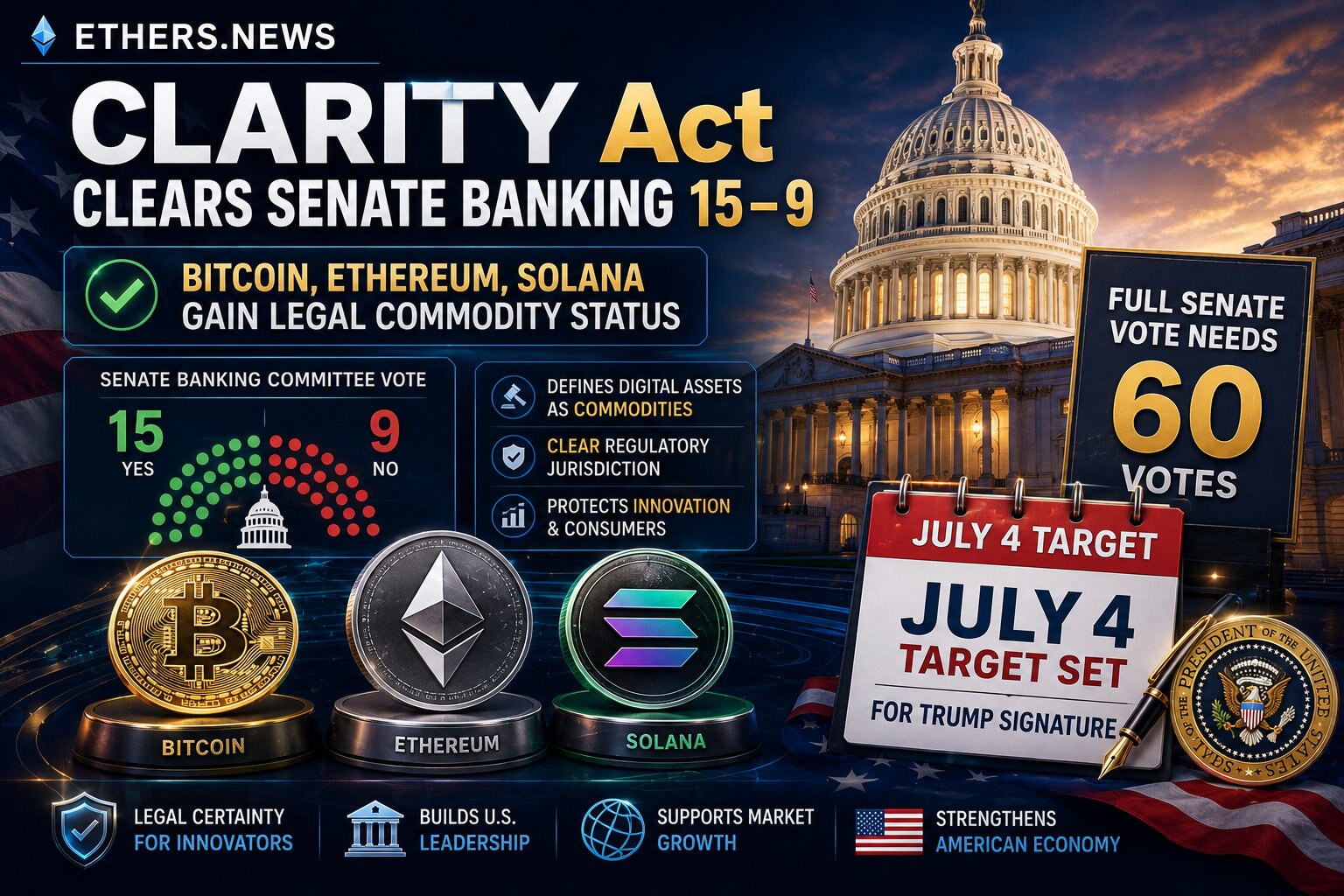
For thirteen years — since Bitcoin's 2009 genesis block launched the cryptocurrency industry — the United States has operated without comprehensive federal legislation defining what digital assets are, which regulators have jurisdiction over them, or what legal protections apply to the Americans who own them. On May 14, 2026, that thirteen-year regulatory vacuum moved within two legislative steps of ending. The Senate Banking Committee's 15-9 vote advancing the CLARITY Act, confirmed by CNBC, Reuters, Forbes, and Elliptic following the May 13 executive markup session, represents the closest the US Congress has ever come to enacting permanent statutory definitions for cryptocurrency market structure — and the crypto industry's response was immediate. Coinbase stock surged approximately 9% on the news, Strategy gained 8%, and both Robinhood and Galaxy Digital rose 6%, according to Forbes' May 14 market coverage. The bill now faces its two most consequential hurdles: a full Senate vote requiring 60 votes to overcome filibuster, and reconciliation with the House's different version passed last fall. If the CLARITY Act clears both before the 2026 midterm elections shift congressional control, it becomes the permanent statutory foundation for US crypto regulation. If it fails, industry analysts warn, comprehensive crypto legislation may not return for years.
The 15–9 Vote: Party Lines, Democrat Crossovers, and the Committee's Final Hurdle Cleared
The Senate Banking Committee's vote breakdown, documented by CNBC and Reuters' May 14 reporting, tells the political story of the CLARITY Act's path forward with precision. All 13 Republican members of the committee voted in favor of advancing the bill. Of the 11 Democratic members, two crossed party lines to support it: Senator Ruben Gallego of Arizona and Senator Angela Alsobrooks of Maryland. The remaining nine Democrats voted against advancement. CNBC's analysis frames the political significance: "The Senate banking committee's vote fell predominantly along party lines, with a tally of 15-9. Democratic Senators Ruben Gallego from Arizona and Angela Alsobrooks from Maryland joined their Republican counterparts in supporting the proposal." Alsobrooks' vote is particularly consequential given her role as the co-architect, alongside Senator Thom Tillis (R-NC), of the stablecoin yield compromise detailed in Section 404 that had stalled the bill for months — her support for the final text she helped negotiate was the critical signal that the Democratic caucus's most engaged crypto skeptic had reached a framework she could endorse. Gallego's support from Arizona, a swing state with significant crypto industry presence, provides geographic and electoral diversity to the bipartisan coalition. The 15-9 margin is sufficient to clear the committee but falls short of the 60-vote threshold the full Senate requires — meaning the bill must attract at least five additional Democrats beyond Gallego and Alsobrooks when it reaches the floor, assuming all Republicans remain unified. Forbes' May 14 analysis is blunt about the floor vote challenge: "To pass, the bill requires at least 60 votes from the 100 senators, meaning that a minimum of seven Democrats must align with the Republicans—a much steeper requirement than the solitary Democratic crossover observed on Thursday."
"The cryptocurrency sector achieved a significant milestone when a Senate committee on Thursday endorsed the Clarity Act, marking the first comprehensive legislation aimed at regulating this emerging industry. The Senate banking committee's vote fell predominantly along party lines, with a tally of 15-9. Democratic Senators Ruben Gallego from Arizona and Angela Alsobrooks from Maryland joined their Republican counterparts in supporting the proposal. However, the legislation faces considerable hurdles before it can become law, as it must navigate not only the entire Senate but also the House before reaching President Donald Trump for approval."
— CNBC — May 14, 2026, reporting on the Senate Banking Committee's 15–9 vote advancing the Digital Asset Market CLARITY Act, the first comprehensive cryptocurrency regulatory bill to clear a Senate committee in US history, following the May 13 markup session and months of negotiations over the Section 404 stablecoin yield compromise that finally resolved the banking industry-crypto industry jurisdictional dispute
What the Bill Does: 16 Tokens as Commodities, CFTC Oversight, and the Decentralization Graduation Pathway
The CLARITY Act's operational framework, as documented by multiple YouTube analyses of the updated bill text released May 12 and confirmed by Elliptic's May 13 regulatory breakdown, establishes four foundational regulatory structures that reshape the entire US crypto market. First: permanent commodity classification for 16 tokens — Bitcoin, Ethereum, Solana, XRP, and 12 others — under CFTC jurisdiction, meaning these assets cannot be reclassified as securities by future SEC chairs and can be listed on regulated US exchanges with legal certainty that survives administration changes. Second: securities classification for tokens where buyers are purchasing based on a team's promise to build something, which remain under SEC oversight but gain a statutory pathway to "graduate" to CFTC commodity status once their networks achieve specific decentralization benchmarks measuring factors including validator distribution, governance structure, and issuer control. Third: stablecoin framework integration with last year's GENIUS Act, which established 1:1 reserve requirements and prohibited issuers from paying yield, now extended by Section 404 to ban passive yield on stablecoins held by exchanges and intermediaries — closing the Coinbase loophole that allowed platforms to offer yield programs even though issuers like Circle could not. Fourth: DeFi developer protections explicitly exempting non-custodial protocol developers from exchange-level registration requirements, preserving the ability to build decentralised infrastructure without compliance costs that industry advocates argue would kill most projects. The YouTube analysis from CryptoCorne r's May 12 breakdown of the updated text confirms the permanence dimension: "So it is creating permanent federal law for what a security and a commodity is in crypto. Permanent meaning the next SEC chair can't just reverse it. So here's what that looks like. 16 tokens, Bitcoin, Ethereum, Solana, XRP and 12 others, become commodities under federal law. That means regulated exchanges can list them, institutions can trade them, and there is legal clarity that doesn't disappear when administrations change."
Section 404: The Stablecoin Yield Ban That Nearly Killed the Bill — and the Activity Rewards Carve-Out That Saved It
Section 404 of the CLARITY Act — the provision banning passive yield on stablecoins held by exchanges and intermediaries — is simultaneously the most commercially controversial component of the bill and the political compromise that made the May 14 committee vote possible. The YouTube analysis from May 20 titled "The CLARITY Act Might End Passive Crypto Income in the US" documents the provision's mechanics and industry impact with precision: "On May 1st, after months of deadlock, Senator Tillis and Alsobrooks cut a deal that kills how most earn yield on stablecoins right now. No more parking USDC or USDT on exchanges and collecting interest. That deal passed the committee on May 14th." The distinction the compromise draws is between passive holdings and activity-based rewards. If a user holds stablecoins on Coinbase without using them — essentially treating the exchange account as a savings vehicle — the platform cannot pay yield. If the user actively uses the stablecoins for payments, trading, liquidity provision, staking, governance participation, or platform loyalty programs, rewards tied to that activity remain legal. The line, as the YouTube analysis frames it, is "whether you're doing something or if you're just parking them like a savings account." The provision extends the GENIUS Act's issuer-level yield prohibition to all intermediaries — exchanges, custodians, and any platform holding stablecoins on behalf of customers — closing what banking industry advocates called a "loophole" that allowed Coinbase and other platforms to offer products that functionally resembled bank deposits without being subject to banking regulations. Elliptic's May 13 analysis confirms the compromise's banking industry rationale: "Their compromise prohibits intermediaries (such as cryptoasset exchanges) from offering yield on customers' passive stablecoin holdings, ensuring that passive stablecoin holdings cannot act like bank deposits." The immediate commercial impact falls on Coinbase, whose Q4 2025 stablecoin revenue was $364.1 million according to prior reporting, a substantial portion of which derived from USDC rewards programs that Section 404 would terminate. The competitive consequence: US-regulated exchanges lose passive yield as a customer acquisition tool while offshore platforms unaffected by US law can continue offering it, potentially driving American retail capital to non-US venues.
The Path to Presidential Signature: Agriculture Merge, 60-Vote Floor Threshold, House Reconciliation, and the July 4 Target
The legislative steps remaining between the May 14 committee vote and the CLARITY Act becoming law are precisely mapped and operationally complex. Elliptic's May 13 analysis documents the immediate next step: "The bill must now be merged with a separate version from the Senate Agriculture Committee prior to undergoing a full Senate vote, which can only take place with the support of 60 members of the Senate." The Senate Agriculture Committee passed its own crypto market structure bill in January 2026, addressing overlapping jurisdictional questions between the CFTC (which Agriculture oversees) and the SEC (which Banking oversees). The two committees must reconcile any textual differences before a unified bill proceeds to the Senate floor — a process that Bloomberg's crypto analyst, cited in the May 18 YouTube coverage, estimates takes "about six to seven weeks for each of the steps." The full Senate vote requires 60 votes to overcome filibuster, meaning at least seven Democrats must cross over if all Republicans remain unified — a significantly higher bar than the two Democrat crossovers the committee vote achieved. If the Senate passes the bill, it then proceeds to reconciliation with the House of Representatives, which passed a different iteration of the CLARITY Act last fall under different stablecoin yield language and before the Tillis-Alsobrooks compromise was negotiated. Reuters' May 14 analysis frames the House challenge: "Should the bill successfully pass through the full Senate, it would then require approval from the House, which had previously endorsed a different iteration of the legislation last fall." The White House has set July 4, 2026 as its target date for presidential signature, according to the YouTube May 20 analysis citing administration statements — a timeline that requires both chambers to complete their respective work, including conference committee reconciliation of textual differences, before the August recess and the political dynamics shift ahead of the November 2026 midterm elections. If the bill misses the July window, the midterm risk becomes existential. As Reuters documents: "Analysts suggest that if the Senate does not pass the bill this year—especially with the potential for Democrats to gain control of the House following the November midterm elections—it may not become law in the near future."
Market Response, the 50 Million American Crypto Owners, and What Passage or Failure Means
The financial market's response to the May 14 committee vote provides the clearest real-time assessment of the CLARITY Act's commercial significance. Forbes' May 14 reporting quantifies the equity market reaction: "This development led to a surge in stocks associated with crypto, with Coinbase rising approximately 9%, Strategy gaining 8%, and both Robinhood and Galaxy Digital seeing a 6% increase." The rally reflects institutional investor assessment that the CLARITY Act's passage materially increases the legal certainty, regulatory clarity, and institutional adoption infrastructure required for crypto to scale as an asset class in US portfolios. The retail investor dimension is quantified by industry estimates cited in Forbes' reporting: "50 million. This number estimates the Americans who own cryptocurrencies and would gain clearer regulatory protections if the bill is enacted, according to industry estimates referenced in the supporting documents for the legislation." Those 50 million Americans currently hold crypto assets without comprehensive federal consumer protection frameworks, recourse mechanisms for fraud or platform failures, or statutory clarity on tax treatment across all transaction types — gaps the CLARITY Act's passage would begin to address. The scenario if the bill passes, per the YouTube May 20 analysis, includes: "Permanent commodity status for Bitcoin, Ethereum, Solana and 13 other major tokens written into federal law. That means they can't be reclassified as securities later. Platforms get statutory certainty. Institutions get a framework that survives administration changes. And DeFi protocols may get a flood of capital if passive yield dies on centralised exchanges but stays legal in non-custodial smart contracts." The scenario if the bill fails: "You keep the March guidance that has no yield restrictions" — meaning the existing regulatory uncertainty persists, the statutory commodity classifications remain uncodified, and the crypto industry operates under SEC and CFTC guidance that can be reversed by future chairs rather than federal law that cannot.
Ethers News Summary and Editorial Perspective
Ethers News Summary: May 14, 2026: US Senate Banking Committee voted 15–9 to advance Digital Asset Market CLARITY Act. Vote: all 13 Republicans + Democrats Ruben Gallego (AZ) and Angela Alsobrooks (MD) supported; 9 Democrats opposed. Sources: CNBC, Reuters, Forbes, Yahoo Finance (all May 14); Elliptic (May 13); Bloomberg Crypto YouTube (May 18); multiple YouTube analyses. Updated bill text released May 12. May 13 markup session livestreamed. Core provisions: (1) 16 tokens (BTC, ETH, SOL, XRP, 12 others) permanent commodity status under CFTC — cannot be reclassified as securities; (2) SEC oversight for tokens based on team promises; graduation pathway to CFTC upon decentralization benchmarks; (3) Section 404: passive yield on stablecoins banned for exchanges/intermediaries (extends GENIUS Act issuer prohibition, closes Coinbase loophole); activity-based rewards legal; (4) DeFi developer protections for non-custodial protocols. Next steps: merge with Senate Agriculture Committee version (passed January 2026); full Senate vote requiring 60 votes (minimum 7 Democrat crossovers); reconciliation with House version (passed fall 2025); presidential signature. White House target: July 4, 2026. Timeline estimate: 6–7 weeks per step (Bloomberg analyst). Midterm election risk: if fails before November 2026, may not return for years (Reuters). Market reaction: Coinbase +9%, Strategy +8%, Robinhood and Galaxy Digital +6% (Forbes). 50 million Americans own crypto (industry estimate, Forbes). Tillis-Alsobrooks May 1 compromise on Section 404 after months of deadlock. Passage impact: permanent federal law, institutional framework, DeFi capital influx. Failure impact: regulatory uncertainty persists, guidance-based regime continues.
Ethers News Editorial Opinion: At Ethers News, we assess the May 14 committee vote as simultaneously the crypto industry's greatest legislative achievement in US history and a bill whose full Senate passage remains significantly less certain than the 9% Coinbase rally suggests — and the Section 404 stablecoin yield ban is the provision whose long-term competitive consequences the market has not yet fully priced. The 15-9 vote is historic. No comprehensive crypto bill has ever cleared a Senate committee before. The bipartisan support from Gallego and Alsobrooks provides the political narrative that this is not a partisan issue but a framework that both pro-innovation Democrats and Republican deregulation advocates can support. The permanent commodity classification for 16 tokens is the single most consequential statutory outcome for institutional adoption — removing the regulatory uncertainty that has prevented pension funds, endowments, and corporate treasuries from treating crypto as a legitimate asset class. But the 60-vote Senate floor threshold is where the CLARITY Act's momentum meets its most significant obstacle. The bill needs five additional Democrats beyond Gallego and Alsobrooks. In a midterm election year where crypto remains polarising within the Democratic caucus, where banking industry opposition to Section 404's activity-rewards carve-out has not fully subsided, and where progressive Democrats view crypto skepticism as aligned with their electoral coalitions, finding those five votes is not assured. The deeper question is Section 404's competitive impact. Coinbase and other US-regulated platforms lose passive stablecoin yield as a retail customer acquisition tool. Offshore exchanges like Binance, operating beyond US jurisdiction, retain it. The bill's proponents argue that activity-based rewards preserve a viable yield mechanism. But "activity-based" is defined by future SEC, CFTC, and Treasury rulemaking — meaning the legal line between prohibited passive yield and permitted activity rewards will be drawn in regulatory guidance after the statute passes, not in the statute itself. That uncertainty creates compliance risk that offshore platforms do not face. If the CLARITY Act passes and Section 404 drives American retail capital offshore to access yield, the regulatory arbitrage that the bill aims to resolve will simply relocate rather than disappear. The July 4 target is ambitious. The 6-to-7-week timeline per legislative step means the Senate, House reconciliation, and presidential signature must all execute without delays. One failed cloture vote, one extended recess, one procedural hold — and the timeline slips past the midterm window. We give the bill 60% odds of Senate passage and 40% odds of becoming law before the midterms shift the political landscape. Those are not odds that justify the market's current pricing.
Key Sources and References
CNBC — Crypto Industry Scores Win as Clarity Act Bill Clears Senate Hurdle, May 14, 2026 (Primary Source, Pull Quote): cnbc.com — Pull quote source; 15–9 vote confirmed; Gallego (D-AZ) and Alsobrooks (D-MD) crossed party lines; 60-vote Senate floor requirement; House reconciliation required; President Trump approval path documented

Reuters — US Senate Committee Advances Crypto Bill in Milestone for Digital Assets, May 14, 2026: reuters.com — Clarity Act regulatory jurisdiction clarification; mark-up session May 13; minimum 7 Democrat votes needed for Senate passage; House passed version last year; midterm election risk if fails 2026; legal certainty for digital asset adoption

Forbes — Crypto Stocks Surge As Senate Committee Advances Long-Stalled Clarity Act, May 14, 2026: forbes.com — Coinbase +9%, Strategy +8%, Robinhood and Galaxy Digital +6%; 15–9 party-line vote; Gallego only Democrat crossover (article pre-Alsobrooks confirmation); CFTC digital commodities classification; SEC securities subset; 50 million Americans own crypto estimate; 60-vote Senate requirement documented

Yahoo Finance — The CLARITY Act Just Cleared the Senate Banking Committee, May 14, 2026: yahoo.com — 15–9 vote confirmed; immediate crypto market response; May 14, 2026 passage date confirmed

Elliptic — Crypto Regulatory Affairs: CLARITY Act Advances from Senate Banking Committee, May 13, 2026: elliptic.co — 15–9 markup session vote confirmed; months of negotiations completed; Tillis-Alsobrooks stablecoin yield compromise prohibits intermediaries from offering yield on passive holdings; must merge with Senate Agriculture Committee version; 60-vote Senate requirement; best chance yet for market structure legislation; comprehensive regulatory framework for cryptoasset market participants

Bloomberg Crypto / YouTube — Clarity Act Wins Senate Committee Vote, Crypto Wrench Attacks Surge, May 18, 2026: youtube.com — Last week Senate Banking Committee advanced landmark crypto legislation; 6–7 weeks per step estimate (Bloomberg analyst); full Senate vote path; Innovation Exemption tokenized stocks context; advisory committee role

YouTube (CryptoCorne Season 2) — Senate Banking Committee Released Updated CLARITY Act Bill, May 12, 2026: youtube.com — Updated bill released May 12; May 14 committee clearance vote; 13 Republicans + 11 Democrats composition; 60-vote Senate floor requirement; reconciliation with House; July 4 target confirmed; Section 404 passive yield on payment stablecoins; activity-based rewards permitted; DeFi developer protections

YouTube — The CLARITY Act Might End Passive Crypto Income in the US, May 20, 2026: youtube.com — May 1 Tillis-Alsobrooks deal; passive yield banned; May 14 committee passage; White House July 4 target; 16 tokens permanent commodity status (BTC, ETH, SOL, XRP, 12 others); CFTC regulation; decentralization graduation pathway for SEC tokens; GENIUS Act framework integration; DeFi non-custodial developer protections; passive vs activity-based rewards distinction; intermediary prohibition extension; offshore platform competitive dynamic; Senate Agriculture merge required; passage vs failure scenarios detailed

YouTube (Senate Banking Committee) — LIVE: Clarity Act Markup Session, May 13, 2026: youtube.com — Official livestream of May 13 executive session; Senate Banking, Housing, and Urban Affairs Committee markup session primary sourceAbout the Author
Ethers News
Ether News Team - Highly dedicated to provide up to date crypto related news and upcoming events.
-At Ethers.News, we are committed to delivering accurate, transparent, and well-researched information related to cryptocurrency, blockchain, and digital assets. Our content is created for educational and informational purposes only and should not be considered financial, investment, or legal advice. We encourage readers to conduct their own research and consult with qualified professionals before making any financial decisions. Market conditions can change rapidly, and past performance does not guarantee future results. Our goal is to promote informed decision-making through responsible journalism.