
Kevin Warsh Fed Nomination: The Hawkish Shockwave Hitting Crypto
The Nomination: From Speculation to Reality
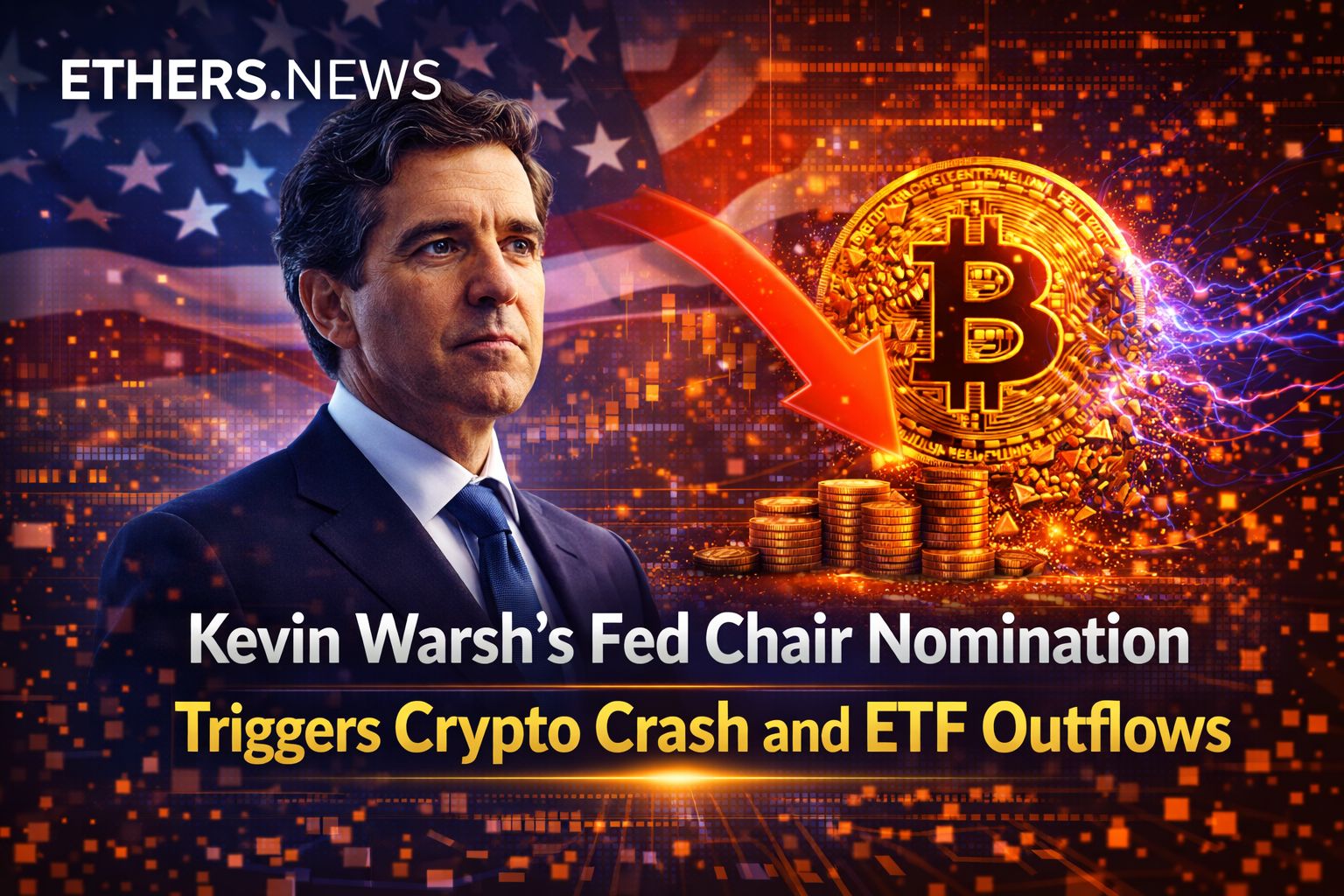
President Donald Trump formally nominated Kevin Warsh—former Fed Governor from 2006 to 2011 and a vocal critic of Jerome Powell’s tenure—to serve as the next Federal Reserve Chair, with the transition targeted for May 2026 pending Senate confirmation. Warsh, who has advised crypto firms like Bitwise while maintaining a hawkish stance on inflation and liquidity, surged in nomination odds to 59% in early January before the official announcement. His selection signals a sharp pivot toward monetary “discipline,” slower rate cuts, accelerated quantitative tightening, and less predictable FOMC communication—directly challenging the cheap‑money environment that has fueled crypto’s 2025 rally.
Markets reacted swiftly. Bitcoin plunged as much as 6% post‑nomination, briefly hitting $81,045—its weakest level since November 2025—before stabilizing near $84,000. The drop erased weak‑dollar trades and dovish Fed bets, with leveraged positions amplifying the pain through forced liquidations estimated at $2.5 billion across crypto markets over the following weekend.
Immediate Market Carnage: Bitcoin, ETFs and Liquidations
Bitcoin’s Sharp Reversal
Bitcoin’s reaction was textbook risk‑off. After hovering near $85,000–$87,000 in late January, BTC crashed through key supports, bottoming near $81,000 on January 30 before a partial rebound. The move reflected cascading deleveraging: perpetual futures open interest dropped sharply, funding rates flipped negative, and spot volumes spiked as weak hands capitulated. Ethereum followed suit, falling toward $2,200 amid correlated selling in altcoins, with the total crypto market cap shedding roughly $200 billion in intraday value.
Analysts like those at Tokenize Capital noted that Warsh’s nomination “killed” expectations for aggressive 2026 rate cuts, leaving Bitcoin exposed to higher real yields and a stronger U.S. dollar—conditions that historically crush speculative assets. The correlation between BTC and Nasdaq futures, already high at ~0.73, amplified the downside as tech stocks also sold off on Fed tightening fears.
Record ETF Outflows
U.S. spot Bitcoin ETFs bore the brunt of the panic. On January 29–30 alone, investors yanked $817.87 million—the largest single‑day outflow since late 2025—with BlackRock’s IBIT and Fidelity’s FBTC leading the exodus. Over the week ending January 29, the figure ballooned to $1.82 billion across Bitcoin and Ethereum ETFs, pushing January into negative territory for the first time in months. Cumulative outflows since October 2025 now exceed $5.7 billion, signaling fraying institutional conviction amid policy uncertainty.
The selloff extended into February, with mid‑month updates logging continued bleeding from leveraged products and a rotation toward stablecoins and gold as “safe havens” within risk assets. Warsh’s hawkish profile—advocating faster balance‑sheet runoff and “communication shocks” to reset expectations—directly fueled this de‑risking, as institutions trimmed exposure to liquidity‑sensitive holdings.
Warsh’s Hawkish Playbook: What Markets Fear
Monetary Discipline Over Easy Money
Warsh’s track record as a 2008 crisis veteran and Powell critic centers on three pillars that terrify crypto bulls: slower, more gradual rate cuts in 2026–2027; accelerated quantitative tightening to shrink the Fed’s balance sheet; and unpredictable FOMC messaging designed to “discipline” markets hooked on accommodation. Unlike Powell’s data‑dependent dovishness, Warsh favors pre‑emptive tightening to anchor inflation expectations, even at the cost of short‑term growth.
For crypto, this translates to a regime shift. Bitcoin and altcoins have thrived on low real rates, dollar weakness, and abundant liquidity—conditions Warsh views as fueling speculation rather than sustainable growth. His nomination odds surge alone shaved 3% off BTC in early January, a preview of the volatility ahead during confirmation hearings and his first FOMC meetings.
Crypto‑Nuanced but Not Bullish
Warsh is no crypto antagonist—he has advised firms like Bitwise, supports a U.S. wholesale CBDC, and sees Bitcoin as a “policy barometer” for dollar strength. However, he explicitly views crypto as thriving in “low‑rate environments” and not a dollar substitute, positioning it as vulnerable to normalization. This duality creates short‑term pain (tighter liquidity) but potential long‑term upside (regulatory clarity via Clarity Act and stablecoin frameworks).
Broad Market Ripple: Tech, Gold and Stablecoin Rotation
The nomination’s shockwaves extended beyond crypto. Gold and precious metals plunged in tandem with BTC as dollar‑strength bets strengthened, though analysts like Kitco argue structural uncertainty will sustain bullion demand long‑term. Nasdaq futures correlated tightly, with tech megacaps facing margin calls amid leveraged unwindings.
Inside crypto, capital rotated to stablecoins and RWAs as “2026 safe havens,” with Binance’s SAFU fund even converting $1 billion in stables to BTC over 30 days as a contrarian bet. Ethereum ETFs saw parallel outflows (~$85 million weekly), but altcoin narratives like Solana staking and XRP ETFs picked up selective inflows.
Three Scenarios for Crypto Under Warsh
KuCoin research outlines three paths forward. In the “dovish compromise” scenario (40% probability), Warsh balances discipline with gradual cuts, supporting crypto recovery toward $100K BTC by mid‑year. The “full hawk” case (30%) sees aggressive QT and higher‑for‑longer rates, risking a deeper correction to $60K–$70K BTC lows. A “political balance” middle ground (30%) delivers short‑term volatility but long‑term stability via CBDC and regulatory progress.
Confirmation hearings will be pivotal: expect grilling on crypto policy, CBDC risks, and how Warsh reconciles hawkishness with Trump’s pro‑Bitcoin stance. Markets will trade the headlines, with FOMC previews adding fuel.
What Comes Next: Policy, Liquidations and Recovery Signals
Near‑term, watch ETF flows for de‑risking exhaustion—outflows slowing below $500 million weekly could signal stabilization. Leverage metrics (funding rates, OI) must normalize to avoid retests of $81K BTC lows. Broader U.S. crypto talks—White House, banks, Clarity Act—offer counterbalance, potentially legitimizing stables and ETFs under Warsh’s pragmatic oversight.
Long‑term, Warsh could foster a “healthier” crypto ecosystem by weeding out leverage bubbles, even if valuations suffer. For our readers, the nomination underscores crypto’s macro entanglement: no longer a niche rebellion, but a high‑beta play on Fed policy. The Fed put may be dead, but the adaptation cycle has just begun.
About the Author
Jeffrey Mathew
Jeffrey is a blockchain journalist for ethers.news, specializing in decentralized finance (DeFi) and Ethereum governance and Cryptocurrencies
-At Ethers.News, we are committed to delivering accurate, transparent, and well-researched information related to cryptocurrency, blockchain, and digital assets. Our content is created for educational and informational purposes only and should not be considered financial, investment, or legal advice. We encourage readers to conduct their own research and consult with qualified professionals before making any financial decisions. Market conditions can change rapidly, and past performance does not guarantee future results. Our goal is to promote informed decision-making through responsible journalism.